In this section we’ll dive into more depth on the performance characteristics of DC motors. We’ll derive the torque-speed curve, efficiency, and power output of a DC motor, and see how these depend on the motor parameters.
We begin with the standard DC motor equations from Eq. (1) in the main text:
which is larger than ωnl in (3). In other words, friction reduces the no-load speed of the motor. The speed ωmax is often quoted as the “maximum speed” of the motor, even though it is not achievable in practice when there is friction.
The stall torque and current in (4) are unaffected by friction, since at stall the motor is not moving and thus frictional losses are zero.
We care about output power and efficiency, and we want to know when they are maximized and at what operating points (what speed, what load torque). This is essentially an exercise in algebra with a bit of calculus.
Since we are trying to derive the entire range of possible performance for the motor, it’s important to think about what is being held fixed and what is being allowed to vary.
Let’s parameterize performance in terms of motor speed ω. Combining (2) and (6), we view this as a system of 5 equations in unknowns (i,TL,Pin,Pout,η), treating vin and ω as fixed parameters. Solving this system, we obtain
where ωmax, istall, Tstall are given by (5) and (4). The reason for normalizing the power by 41Tstallωmax is that this quantity is the maximum output power, as we will see shortly.
The parameter σ>0 captures the effect of viscous friction and resistance on motor performance: the larger σ is, the more losses the motor has relative to its torque constant K. An ideal motor has σ=0.
Substituting (8) into (7), we obtain normalized power-speed relationships:
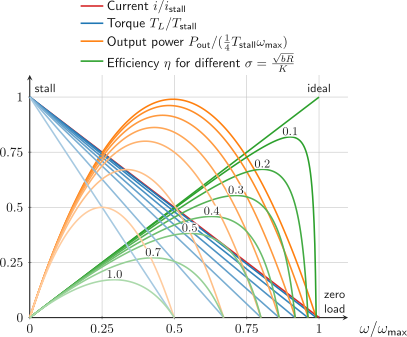
In other words, maximum power is achieved when the motor is loaded to half its stall torque, which causes it to run at half its no-load speed. The maximum output power decreases as friction and resistance increase (as σ increases), and approaches the ideal value of 41Tstallωmax=vin2/(4R) as σ→0.
Maximizing power output does not necessarily maximize efficiency. To find the speed that maximizes efficiency, we take the derivative of η in (9) and set it to zero. This gives us optimal efficiency at the operating point:
In other words, the closer to ideal the motor is (the smaller σ is), the higher the maximum efficiency. Moreover, the motor is most efficient when it runs faster and with less load torque.
For example, if the motor has a maximum efficiency of 80%, then it achieves this efficiency at 90% of its no-load speed and loaded at 10% of its stall torque.
To see what different performance curves might look like, we can plot the solutions in Eq. (9) as a function of normalized speed ωˉ for different values of the parameter σ.
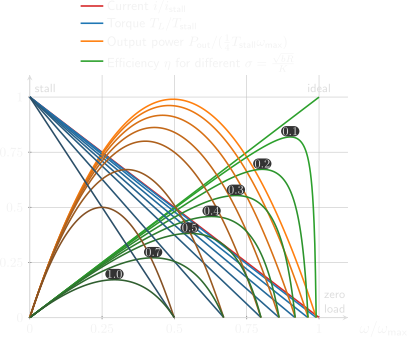
Figure 1:Normalized output power and efficiency of a DC motor as a function of normalized speed for different values of the parameter σ=KbR.
To get a sense of scale, consider a brushless drone motor. Typical values are given by
This corresponds to values of σ ranging from 0.03 to 0.3.
From the plot in Figure 1, we can see that as σ increases (i.e., as friction and resistance increase), both the maximum output power and maximum efficiency decrease. The shape of the power-speed curve also changes, becoming more skewed towards lower speeds. The efficiency curve also shifts downwards, indicating that the motor becomes less efficient at all operating points.
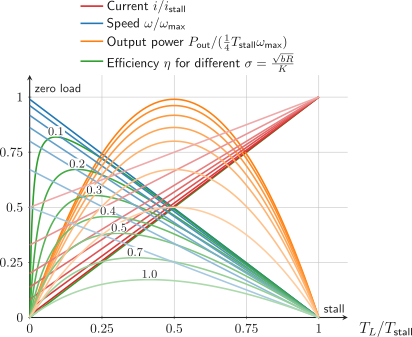
Instead of parameterizing performance in terms of motor speed, we can instead parameterize in terms of load torque TL. Combining (2) and (6), we can view this as a system of 5 equations in unknowns (i,ω,Pin,Pout,η), this time treating vin and TL as fixed parameters. We can carry out the same analysis as before and this time plot the results as a function of normalized load torque TˉL.
This leads us to the following power-torque plot, where this time we vary normalized load torque TˉL instead of speed, for different values of the parameter σ.
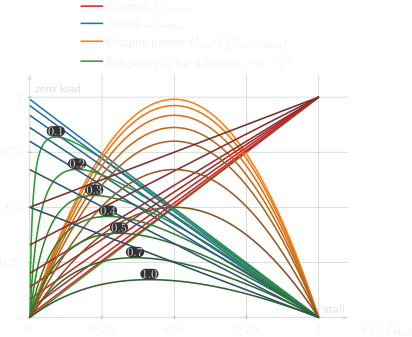
Figure 2:Normalized output power and efficiency of a DC motor as a function of normalized load torque for different values of the parameter σ=KbR.