More root locus
In this section, we cover some extensions and variations on the basic root locus plot we introduced in the previous section, and we finish with a discussion on how root locus can be used for control design.
Closed-loop calculations
Gain calculation
When sketching a root locus, we typically focus on the shape of the locus and not the specific locations of the poles for a given value of . However, it can be useful to calculate the gain for a specific point on the root locus. For example, if we want to know how much gain we need to add to move a pole from its open-loop location to a desired closed-loop location, we can use the magnitude condition to calculate .
Example: Consider the system . We want to calculate the proportional gain required to give the closed-loop poles a damping ratio of .
Solution: Based on our intuition, the root locus has an initial real part, where the poles come together and meet at -1. Then, they break away and move vertically along the line . We reach the desired damping ratio when the poles are located at . The magnitude condition states that for a point on the root locus, the gain is given by: . So the gain required to place a pole at is
We can verify this by plugging into the characteristic equation and solving for :
Sum of closed-loop poles
Using the gain condition tells us the gain for a specific location on the locus, but all closed-loop poles move simultaneously as varies! Here is a useful fact about how closed-loop poles move.
One useful consequence of this fact is that when closed-loop poles go off to infinity, they do so “at the same rate”. In other words, they all approach equally spaced points on an ever-growing circle centered at the centroid.
More zeros than poles
Although physical systems always have (more poles than zeros), one can still think about what would happen if we had more zeros than poles. In this case, there is a simple trick we can use; just rewrite the characteristic equation as
So instead of analyzing the root locus of with gain , we can analyze the root locus of with gain . Now has more poles than zeros, so we can apply all the same properties as before. Practically speaking, we sketch as follows:
Sketch the root locus exactly as you would if the poles and zeros were reversed.
Flip the directions of the arrows on the branches, so they still start at the open-loop poles and end at the open-loop zeros.
For the asymptotes, imagine there are “poles at infinity”. So instead of the infinite branches starting at poles and heading to infinity along asymptotes, they arrive from infinity along asymptotes and end at zeros.
Exotic breakaway/break-in points
We originally discussed what happens if two branches meet at a point on the real axis and then break away or break-in. There are a couple additional cases that can occur and are worth knowing about, but they are quite rare.
Multiple branches colliding
It can happen that three or more branches collide at the same point on the real axis. In such cases, they always collide and equal angles and break away at equal angles. This occurs in a manner analogous to how the positive locus and negative locus have asymptotes that are offset from each other. Here are two examples of such cases.
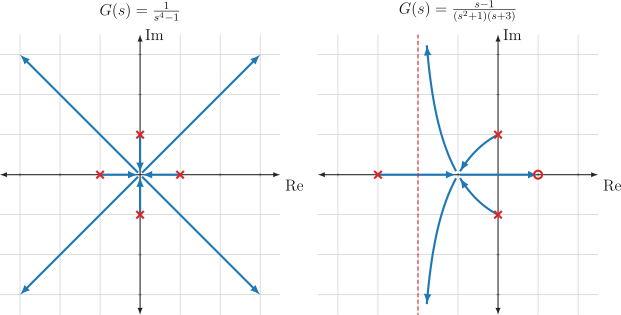
Figure 1:Root loci with multiple branches colliding at the same point on the real axis. Left: four colliding branches. Right: three colliding branches.
Collisions outside the real axis
It can also happen that two branches collide at a point that is not on the real axis. In such cases, they break away at equal angles as well. Here are two examples of such cases.
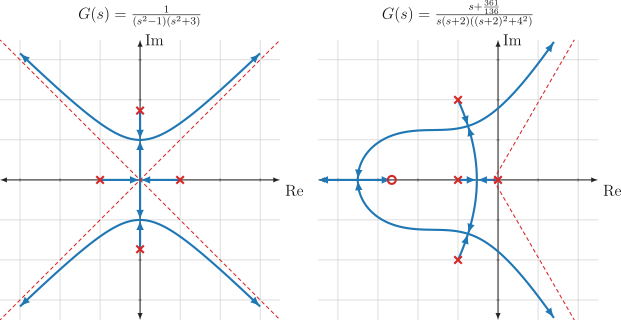
Figure 2:Root loci with branches colliding outside the real axis.
Some additional comments about the loci above:
For the locus on the left, there is nothing special about the imaginary axis. If we had translated all poles to the left by the same amount, the collision point would also have translated to the left by the same amount and would no longer be on the imaginary axis.
For the locus on the right, the complex collision point involves branches breaking in/out at equal angles, even though the angles themselves are not the usual multiples of we come to expect for real-axis collisions.
We can solve for any such collision point similarly to how we find real-axis break-in/breakaway points. We look for such that and belongs to the root locus. Points on the locus satisfy , i.e., . So belongs to the locus if () and ().
The negative locus
When we analyzed the root locus previously, we assumed that the plant had the form
If there is an additional positive constant in front of the transfer function, it does not affect the shape of the root locus (only our calculation of ). However, if there is a negative constant in front of the transfer function, then then this is equivalent to using a negative gain in the characteristic equation. So instead of , we have . This is called the negative locus.
Example. The root locus of is the solution to , so (negative real axis). If we instead consider , then the root locus is the solution to , so (positive real axis). The asymptote goes to the right instead of the left! This is a simple example, but the negative locus can be more complicated for higher-order systems.
In fact, each property for the positive locus has a corresponding property for the negative locus. Here is a summary:
Branches and limits. Unchanged. There are still branches that start at the open-loop poles. of them end up at open-loop zeros, and the remaining go to infinity along asymptotes.
Real locus. A point on the real axis is on the negative locus precisely when it is to the left of an even number of poles and zeros. This is the complement of the condition for the positive locus. So together, the positive and negative loci cover the entire real axis.
Asymptotes and centroid. The centroid is the same as the positive locus. The asymptotes remain evenly spaced, but point in different directions. The formula for the angles of the negative locus asymptotes is
Here is what they look like.
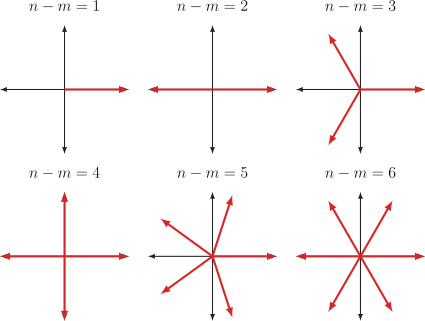
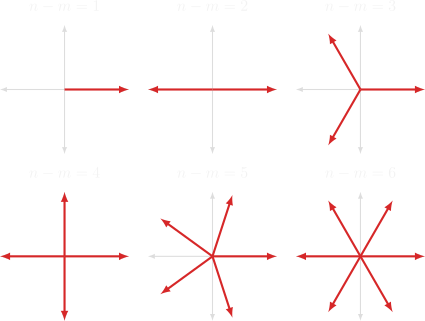
Figure 3:Asymptotes of the negative locus for different values of . Compare to the asymptotes of the positive locus in Figure 4.
Break-in and breakaway points Break-in and breakaway points occur in similar situations and behave similarly. In fact, the necessary condition (11) is the same for both the positive and negative loci. So when we apply the condition, we find all break-in and breakaway points. We can determine which belong to the positive or negative locus by checking the real locus condition.
Imaginary axis crossings. The imaginary axis crossings are determined the same way for both the positive and negative loci.
Angles of departure and arrival. The angles of departure and arrival are rotated by for the negative locus compared to the positive locus. So the formulas for departure from a pole and arrival at a zero are, respectively,
where and are the angles from the other poles and zeros, as before.
Sketching a negative locus is similar to sketching a positive locus, and we can follow the same steps as before, keeping in mind the differences in the properties above.
Smoothness property
The positive and negative loci connect together at the open-loop poles (when ), and do so without any sharp corners. This is because the angles of departure and arrival are rotated by for the negative locus compared to the positive locus. So as we cross at a pole, the locus transitions smoothly from the negative locus to the positive locus. This is a nice property to keep in mind when sketching root loci, since it can help us determine the shape of the locus near the open-loop poles. Here are some examples of full (positive and negative) root locus plots that illustrate this property.
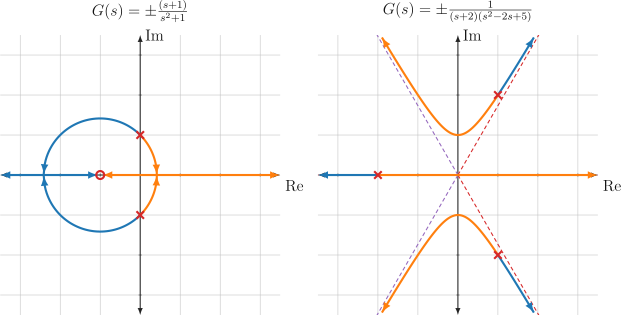
Figure 4:Examples of superimposed positive (blue) and negative (orange) loci. The loci are smooth as they cross the open-loop poles () and connect together. Asymptotes are shown in different colors for the positive and negative loci.
Wrapping around infinity
A strange behavior occurs when sketching the negative locus of a system with the same number of poles and zeros. For such a system, is finite and positive. This means the characteristic equation:
has a solution at for a finite value of . This is not the same as an asymptote; asymptotes are caused by zeros at infinity and the locus approaches them as but never reaches them. In our case, we have no excess poles, no zeros at infinity, and no asymptotes. Instead, the locus wraps around infinity.
To illustrate, consider . The characteristic equation for the positive locus is:
This starts at and ends at as . However, the characteristic equation for the negative locus is:
As we increase from 0 to 1, the root locus moves from to . Then, as we increase past 1 to , the root locus moves from to . So the locus still goes from to , but it does so by wrapping around infinity. Here are the two root locus plots:
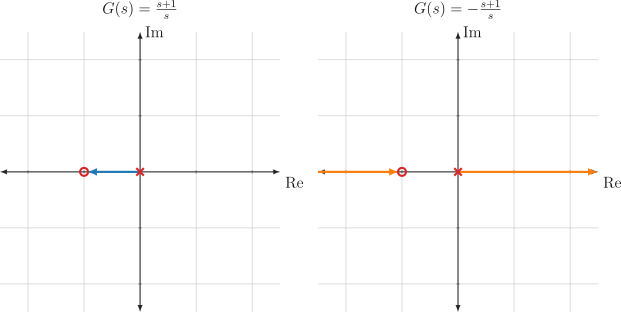
Figure 5:Comparison of the positive and negative loci for . The positive locus goes from to to the left, while the negative locus goes from to to the right by wrapping around infinity.
Similarly to break-in and breakaway points, the most common way for a locus to wrap around infinity is along the real axis. However, more exotic cases can occur where multiple branches wrap around infinity simultaneously in different directions. Such cases are fragile, just like multiple collision points and complex collision points. Here are a couple examples of such cases:
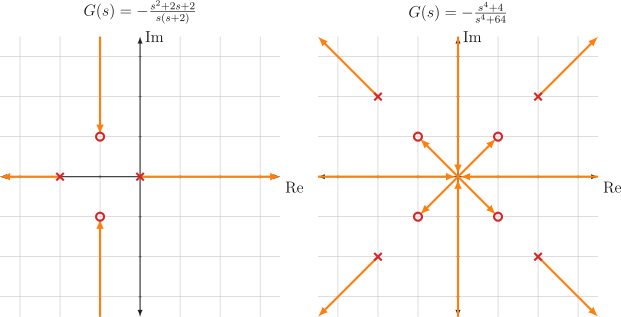
Figure 6:Two exotic negative loci with multiple branches wrapping around infinity simultaneously in different directions.
In the examples above, swapping the zeros and poles changes the directions of the arrows. Also, slightly perturbing any poles or zeros will cause the complex branches to collapse into arcs that break in or out of the real axis instead of wrapping around infinity. So these are very fragile examples, but they do illustrate the interesting behavior that can occur for negative loci.
Single-parameter locus
Root locus plots show us how closed-loop poles vary as we change the proportional gain . However, we can use the same idea to plot how poles vary as we change any single parameter. All we have to do is rewrite the characteristic equation in the form , where is the parameter we want to vary.
Example: variable damper
Consider a spring-mass-damper system
Suppose and are fixed, and we want to understand how the poles of the system vary as we change the damping coefficient . The characteristic equation is
Since is our parameter of interest, we can rewrite this as
So we can plot the root locus of to understand how the poles vary as we change . The root locus is shown below.
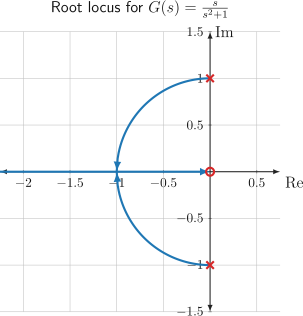
Figure 7:Parameter-locus of poles for a spring-mass-damper system as we vary the damping coefficient .
Some observations:
When , the poles are at (undamped oscillation). This makes sense since the system is just a spring-mass system with no damper.
As increases, the poles move along the root locus. Since , changing is just changing while keeping fixed. So the poles move along a circle of radius , as shown in the figure.
The break-in point satisfies , which yields . Using the magnitude condition, this corresponds to . So the break-in point occurs at . We can confirm by plugging into the characteristic equation: . As anticipated, we have a double root at .
Integral gain design
Consider the system again. We design a PI controller for this system, so . How do the closed-loop poles vary as we change while keeping fixed? The closed-loop poles satisfy the characteristic equation
We can rearrange this as:
We can explore what happens as we vary by plotting the root locus of . The root locus is shown below for .
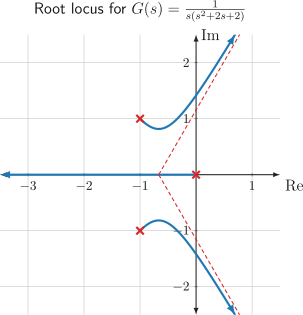
Figure 8:Root locus of the closed-loop poles for a system with a PI controller as we vary the integral gain while keeping a fixed proportional gain .
No matter what is, the root locus for will have three poles and no zeros. Therefore, there will be three asymptotes, two of which will point to the right and therefore eventually cross into the RHP (instability). This confirms what we know about integral gains; making them too large can lead to instability!
Test your knowledge
Let’s return to the interactive root locus demo:
Use the demo to test your understanding of the properties of root locus plots we saw in this section. Specifically:
More zeros than poles. Test your skills at sketching root loci with some examples that contain more poles than zeros by hiding the locus, placing the poles and zeros, and then revealing the locus again to check your work.
Exotic break-in/breakaway points. Reproduce the examples from Figure 1 and Figure 2 and try moving the poles and zeros slightly to verify the fragility of such loci.
Negative locus. Reveal the negative locus and verify the real axis, asymptote, and continuity/smoothness properties for the negative locus.
Wrapping around infinity. Can you create a case where the negative locus wraps around infinity? What about multiple branches wrapping around infinity?