Root locus
We first encountered root locus plots in the section on feedback, where we started with a plant and used proportional control with unity feedback, as below:


Figure 1:Unity feedback loop with proportional controller.
The closed-loop transfer function from the reference input to the output is
We saw that had the same order (same number of poles) as , but the poles changed as we varied . We then made a root locus plots showing how these poles moved in the complex plane as increased from 0 to . We found that:
For a first-order system, the pole moved left along the real axis, leading to a faster response (reduced settling time) as increased.
For a second-order system, the poles moved away from each other vertically, leading to a more oscillatory response (increased overshoot and damped frequency) but unchanged settling time as increased.
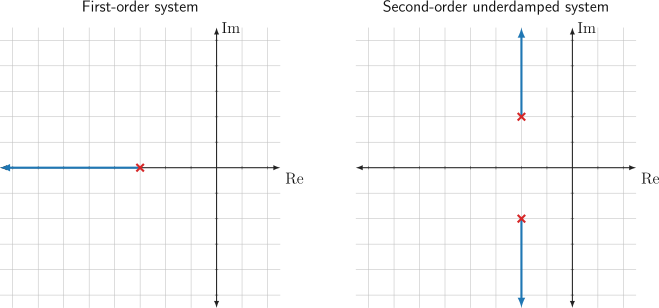
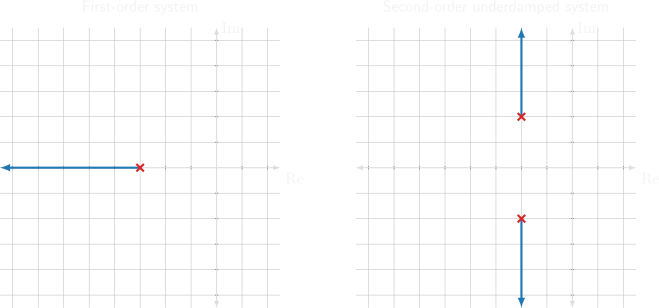
Figure 2:Left: Root locus plot for a first-order system. Right: Root locus plot for a second-order underdamped system.
In this section, we will generalize these results to arbitrary systems and derive rules for sketching root locus plots without having to calculate the closed-loop poles for every value of .
Definition and conditions for root locus
Suppose we have a plant :
where are the poles of and are the zeros of . We will assume that is proper, meaning that . We connect this plant in a unity feedback loop with a proportional controller as shown in Figure 1. The closed-loop transfer function is
The root locus is the set of points in the complex plane that are poles of for some value of . In other words, the root locus is the set of points that satisfy the following characteristic equation for some choice of :
Magnitude and phase conditions
If a complex number satisfies the characteristic equation (4), then we can rearrange the equation to get
Recall the properties of complex numbers we reviewed earlier. The magnitude satisfies and the angle satisfies . Taking the magnitude of both sides of Eq. (5) gives us the magnitude condition:
and taking the angle of both sides gives us the phase condition:
this tells us precisely when a point is on the root locus. These properties can be used to derive a series of rules for sketching root locus plots, which we now discuss.
Properties of root locus plots
1. Branches and limits
The characteristic equation (4) can be rewritten as
Remember that and are polynomials of degree and , respectively, with . For each fixed , this equation has solutions. As we vary , these solutions trace out curves in the complex plane, which are called the branches of the root locus.
When the characteristic equation reduces to . The solutions are the poles of , so the branches start at the poles of .
When , then we must have either or . In other words, each branch either goes to infinity or ends at a zero of . Specifically:
Exactly of the branches end at zeros of . Each zeros is the endpoint of exactly one branch.
The remaining branches go to infinity. Each branch that goes to infinity does so in a different direction. We discuss this in Property 3.
Referring to Figure 2: the first-order system has one branch that starts at the pole and goes to infinity, while the second-order system has two branches that start at the poles and go to infinity. These examples have no zeros, which is why all branches go to infinity.
Some additional useful properties of branches:
No self-intersection. A branch cannot cross itself. However, separate branches can collide (e.g. at break-in and breakaway points, which we discuss in Property 4).
Symmetry. The root locus is symmetric about the real axis. Therefore, any branches that are not on the real axis come in complex conjugate pairs. A branch above the real axis has a mirror image branch below the real axis.
2. Real locus
The part of the root locus that lies on the real axis is called the real locus. A point on the real axis is on the root locus precisely when it is to the left of an odd number of poles and zeros. A few caveats:
This property does not tell us anything about points that are not on the real axis.
This property doesn’t tell us whether the poles move left or right as increases, just whether they are on the root locus or not.
When counting poles and zeros, we can restrict our attention to the real axis and ignore everything else.
Referring to Figure 2: the first-order system has a real locus that extends from the pole to (that part of the real axis is to the left of one pole), while the second-order system has no real locus.
Here are some examples of real loci:
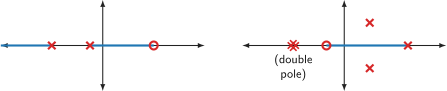
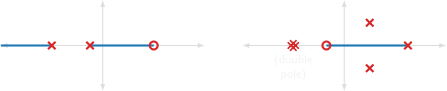
Figure 3:Two examples of real loci. Left: Two real locus segments. The left segment extends to infinity. Right: Single real locus segment. Note that the double pole does not trigger the real locus because it does not change the parity of the number of poles/zeros. Likewise, the complex poles can be ignored.
3. Asymptotes and centroid
We saw in Property 1 that branches of the root locus go to infinity. The quantity is called the relative degree of the open-loop transfer function . The branches that go to infinity do so by converging to straight lines called asymptotes. The asymptotes are equally spaced in angle and intersect at a point called the centroid. The angles of the asymptotes are given by
and the centroid is given by
Referring to Figure 2: the first-order system has relative degree one, with , so its one asymptote is along the negative real axis. The second-order system has relative degree two, with and , so its two asymptotes are vertical. Its centroid is (same real part as the poles).
It is easier to remember asymptotes visually rather than memorizing a formula. Here are what asymptotes look like for relative degree up to six (the pattern is clear after that!)
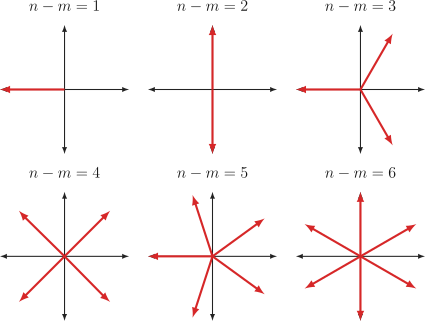
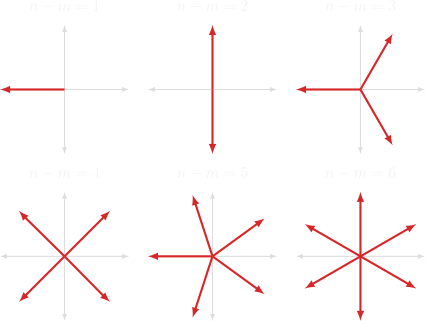
Figure 4:Asymptotes for root locus branches that go to infinity depending on how many of them there are (this corresponds to the relative degree of the open-loop transfer function). The asymptotes are always equally spaced in angle.
4. Break-in and breakaway points
Whenever branches collide on the real axis, it means there is a value of for which the closed-loop transfer function has a repeated real pole. The most common case is when two branches collide (double pole). When this happens, there are two cases:
Breakaway (from the real axis). The branches are moving along the real axis towards each other. When they collide, they break away from the real axis and move into the complex plane at an initial angle of 90 degrees.
Break-in (to the real axis). The branches are moving towards the real axis on opposite sides (one above, one below). They collide at a point on the real axis, hitting the real axis at a 90 degree angle. When they collide, they split and move along the real axis in opposite directions.
Here is what these two scenarios look like:
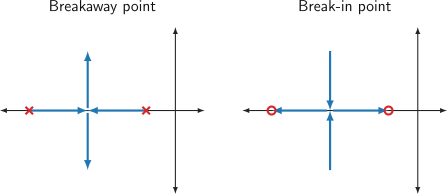
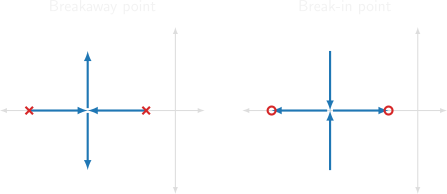
Figure 5:Left: Breakaway from the real axis. Right: Break-in to the real axis.
Certain scenarios guarantee the existence of break-in or breakaway points:
If the real locus connects two consecutive real poles, then there must be a breakaway point between them.
If the real locus connects two consecutive real zeros, then there must be a break-in point between them.
If the real locus connects a real pole and a real zero, then there could be nothing between them, or possibly a breakaway and a break-in point between them.
It’s also possible to find the exact locations of break-in and breakaway points. If they occur at , then the condition is satisfied. If we write then this condition amounts to solving the equation:
The condition (11) is only a necessary condition. So all break-in and breakaway points satisfy it, but not all solutions to it must be break-in or breakaway points. In fact, solutions to this equation may not even lie on the root locus!
It is also possible for multiple branches to collide at the same point, but this is less common. This means that for a particular value of , the closed-loop transfer function has a pole of multiplicity greater than two. In this case, the branches will collide at equally spaced angles and also break away at equally spaced angles. We will examine this is more detail in the next section.
5. Imaginary axis crossings
As we increase from 0 to , the branches of the root locus move continuously in the complex plane. If a branch crosses the imaginary axis, then there is a value of for which the closed-loop system has a purely imaginary pole. This is important because it corresponds to a marginally stable system, and it also indicates that the system transitions from stable to unstable (or vice versa) at this point.
There are two ways to find the imaginary axis crossings:
Substitution. If we know that the crossing occurs at for some , then we can substitute into the characteristic equation and solve for and . Specifically, we must have . This gives us two equations (real part and imaginary part) that we can solve for and .
Stability criteria. Recalling the section on stability, we can write out the characteristic polynomial of the closed-loop system and apply our stability criteria to find values of that lead to marginal stability. Once that is done, we can plug those values of back into the characteristic equation to find the corresponding imaginary axis crossings.
6. Angles of departure and arrival (bonus)
When a branch of the root locus leaves a pole or arrives at a zero, it does so at a particular angle. We already covered the case of real poles and zeros (either the branch stays of the real axis or it leaves/arrives at a 90 degree angle and we have a breakaway/break-in point). However, for complex poles and zeros, we can have any angle of departure or arrival. To figure out the angle, we can use the phase condition (7). This leads us to the formulas:
The angle of departure from a complex pole is given by
where are the angles from the zeros to the pole and are the angles from the remaining poles to the pole .
The angle of arrival at a complex zero is given by
where as before, are the angles from the poles to the zero and are the angles from the remaining zeros to the zero .
For example, consider the transfer function . This system has poles at and zeros at .
The angle of departure from the pole at is given by
The angle of arrival at the zero at is given by
This indicates that the branch doesn’t follow a straight line from the pole to the zero, but rather it leaves the pole at a 135 degree angle and arrives at the zero at a 45 degree angle, making an arc. The bottom half of the locus can be inferred by symmetry. Here is what the root locus looks like for this system:
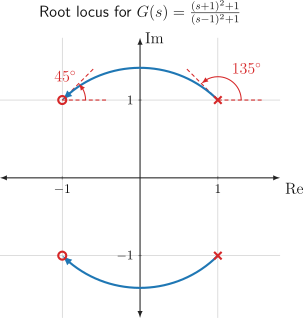
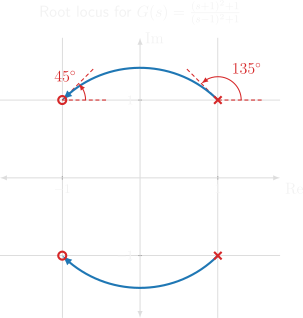
Figure 6:Root locus plot. The departure angle from the pole at is 135 degrees, and the arrival angle at the zero at is 45 degrees. The branch follows an arc between them.
Sketching root locus plots
Example 1: three real poles
Let’s sketch the root locus for following the steps outlined above.
Poles and zeros. The poles are at , , and . There are no zeros.
Real locus. The real locus is on the segments and .
Asymptotes. The relative degree is , so there are three asymptotes at angles of , , and . The centroid is .
Sketch root locus. We can now sketch the root locus. The three branches start at the poles and move towards infinity, with two branches moving into the complex plane and one branch moving along the real axis towards .
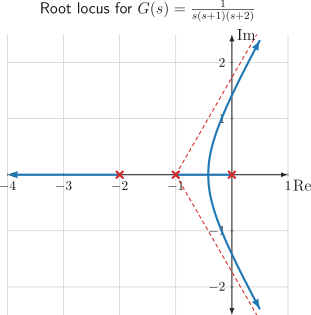
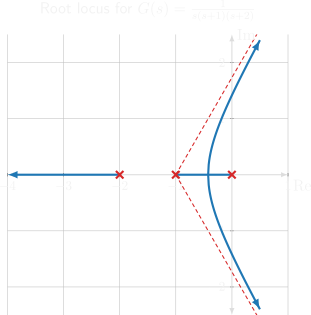
Figure 7:Root locus plot for a plant with three real poles and no zeros. This root locus has three asymptotes and one breakaway point.
Note that it is a coincidence that the centroid happens to be at the same location as one of the poles. In general this will not be the case! To get a bit more accuracy, we can also calculate the exact locations of the breakaway point and the imaginary axis crossings.
Breakaway point. We can also calculate the exact location of the breakaway point using the formula (11). In this case, we have and , so the condition reduces to . The solution to this equation is . Only the solution lies on the root locus, so this is the location of the breakaway point.
Imaginary axis crossing. Substitution method: We can find the imaginary axis crossing by substituting into the characteristic equation. This gives us , which can be rearranged to . Expanding and comparing real and imaginary parts gives us:
From the second equation, we see that crossings occur at and , which from the first equation correspond to and , respectively.
Stability criteria: Alternatively, we can expand the characteristic equation as a function of , which produces . Applying our stability criteria tells us that the system is stable for , meaning that we transition to instability when . At this point, the characteristic polynomial is:
The only imaginary solutions are , which matches our previous calculation.
Example 2: two poles one zero
Let’s sketch the root locus for following the steps outlined above.
Poles and zeros. The poles are at . The zero is at .
Real locus. The real locus is on the segment .
Asymptotes. The relative degree is , so there is a single asymptote to the left. No need to calculate the centroid!
Sketch root locus. Given the location of the real locus, we anticipate a break-in point on the real axis to the left of .
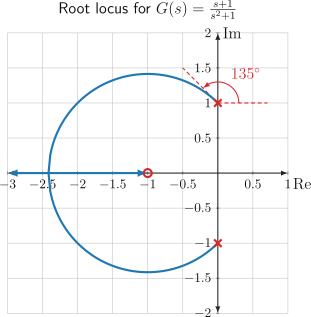
Figure 8:Root locus plot for a plant with two complex poles and one real zero. This root locus has one asymptote and one break-in point.
Break-in point. We can calculate the exact location of the break-in point using the formula (11). In this case, we have and , so the condition reduces to . The solutions to this equation are . Only the solution lies on the root locus, so this is the location of the break-in point.
Angles of departure. The angle of departure from the pole at is given by
So the locus leaves the pole at at an angle of 135 degrees.
Interactive demo
The interactive demo below allows you to explore how the root locus changes as you vary the pole and zero locations. You can drag the poles and zeros around to see how the locus changes. You can also toggle the asymptotes. The slider at the bottom allows you to see how the closed-loop poles move along the root locus as you vary the proportional gain .
Test your knowledge
Rather than giving you a bunch of practice problems, we encourage you to use the interactive demo above to test your understanding of root locus. You can do the following:
Turn off the root locus and asymptotes.
Place the poles and zeros in a configuration of your choice.
Try to sketch the root locus by hand using the properties we discussed above.
Turn on the root locus and asymptotes to see how well your sketch matches the actual root locus.