In this section, we dive deeper into the analysis of second-order systems. We will define quantitative notions of performance, and relate them to the canonical parameters we already learned about, such as natural frequency and damping ratio.
We can make several observations about this function:
Initial value: At t=0, we have y(0)=K(1−1−ζ21sin(ϕ)). Recall that cosϕ=ζ, so sin(ϕ)=1−ζ2. Therefore, y(0)=0. This makes sense, since the system starts at rest and the step input is applied at t=0.
Steady-state value: As t→∞, the exponential term e−ζωnt goes to zero, so y(t)→K. This means that the system will eventually settle at the value K. This is similar to what we observed for first-order systems, where the steady-state value is also determined by the DC gain.
Exponential envelope: Since the sine term can only be between -1 and 1, the exponential e−ζωnt defines an envelope that bounds the oscillations of the response:
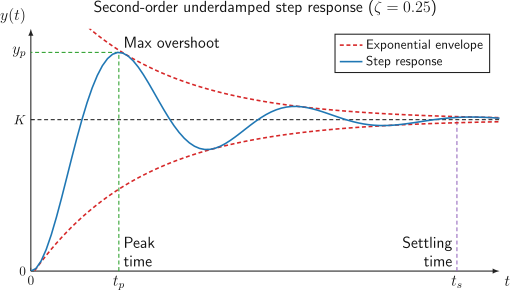
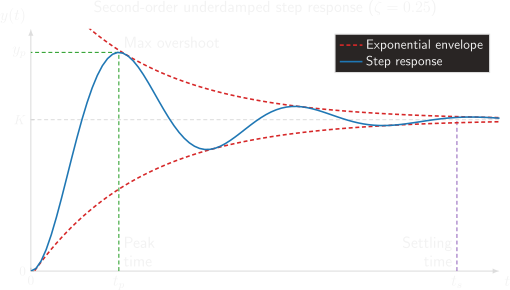
This is enough information to make a first pass and sketch the step response. Here is what a step response with ζ=0.25 looks like:
Figure 1:Step response of a second-order system with ζ=0.25 showing peak time, settling time, and maximum overshoot.
When it comes to performance, we are often interested in the following quantities:
Peak timetp: the time at which the response reaches its maximum value. Generally, we want this to be as small as possible, since it indicates how quickly the system responds to the step input.
Percent overshootMp: the amount by which the response overshoots its steady-state value, expressed as a percentage. We typically want this to be small, since large overshoots are often undesirable in practice.
Settling timets: the time it takes for the response to get sufficiently close to its steady-state value and stay there. This is similar to notion of settling time for first-order systems.
We will now go into more detail about each of these performance metrics, and how they relate to the parameters of the second-order system.
The peak time tp is the time at which the response reaches its maximum value. To find this, we can take the time derivative of the step response (1) and set it equal to zero:
This tells us that the response reaches its maximum value at integer multiples of π/ωd. In particular, the slope is zero at t=0, and the peak time is given by setting n=1.
The percent overshoot Mp is the amount by which the response overshoots its steady-state value, expressed as a percentage. Mathematically, the formula is:
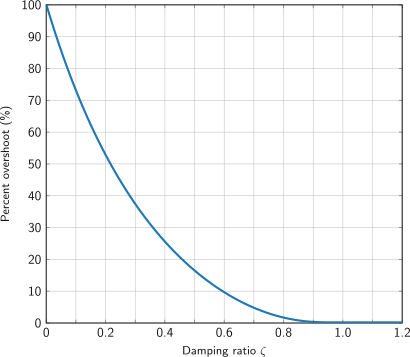
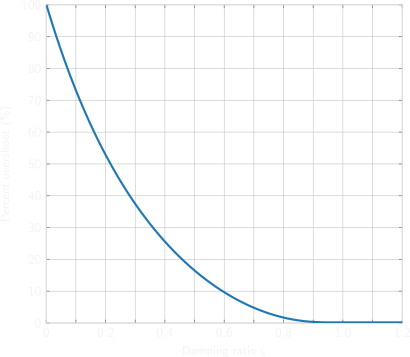
The percent overshoot only depends on the damping ratio ζ (or equivalently, the pole angle ϕ). However, it can be cumbersome to calculate due to the complexity of the formula. Instead, we can simply plot Mp as a function of ζ to see how the overshoot changes with damping to get a better intuition.
Figure 2:Relationship between percent overshoot Mp and damping ratio ζ for a second-order system. The percent overshoot decreases as the damping ratio increases, and approaches zero as ζ→1.
For example, we see from Figure 2 that when ζ=0.25, the percent overshoot is around 45%, which matches what we see in the step response Figure 1.
To find the settling time, we need to determine when the response gets sufficiently close to its steady-state value K and stays there. This is difficult to determine exactly, so instead we will use the exponential envelope to find an upper bound on the settling time. As with first-order systems, we will use the 2% criterion.
The exponential envelope decays like e−ζωnt. If we compare that to a standard exponential decay e−t/τ, we can see that the time constant τ of the envelope is given by:
This means that the envelope will decay to 2% of its initial value after approximately 4τ seconds. Therefore, we can use the following formula to get an upper bound on the settling time:
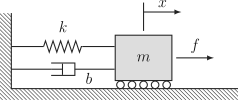
with m=1 kg, k=10 N/m, and b=1 Ns/m. Let’s sketch the step response of this system. In other words, let’s plot x(t) with unit step force f(t)=H(t)⋅1 N.
Canonical form. The transfer function of this system is given by:
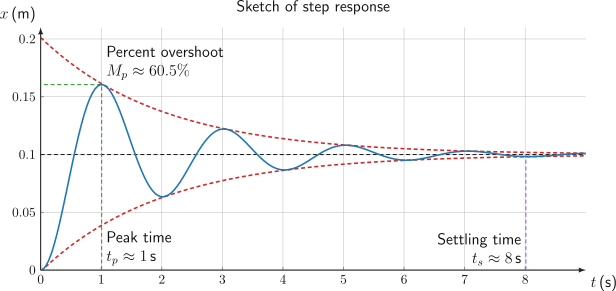
Detailed sketch. We can now make our detailed sketch using the steps outlined above. We can verify that the first peak of our sketch is approximately 60.5% above the steady-state value, which matches our calculation of Mp.
Figure 4:Step response sketch for the spring-mass-damper system with m=1 kg, k=10 N/m, and b=1 Ns/m. The response has a peak time of approximately 1 second, a settling time of approximately 8 seconds, and a percent overshoot of approximately 60.5%.
This allows us to infer performance directly from the pole location!
The peak time tp is inversely proportional to the imaginary part of the poles. Poles with larger imaginary part have smaller peak times (faster response).
The percent overshoot Mp is determined by the angle ϕ of the poles. Poles with smaller angle (closer to the real axis) will have smaller percent overshoot.
The settling time ts is inversely proportional to the real part of the poles. Therefore, poles with larger negative real part will have smaller settling times (faster settling).
Sometimes, we will be given performance specifications and asked to determine where the poles of the system can be located to meet those specifications. For example, suppose we have a second-order system and we would like:
a peak time of at most 2 second,
a percent overshoot of at most 20%, and
a settling time of at most 3 seconds.
Let’s see where the poles of such a system can be located. We can use the formulas for tp, Mp, and ts to derive inequalities that the parameters ζ and ωn must satisfy, and then translate those into constraints on the pole locations in the complex plane.
tp≤2 implies ωdπ≤2, which means ωd≥2π. So the imaginary part of the poles must be at least 2π≈1.57.
Mp≤20% implies (see Figure 2) that ζ>0.45. Therefore the pole angle satisfies ϕ<acos(0.45)≈63∘, which means the poles must be located within 63 degrees of the negative real axis.
ts≤3 implies ζωn4≤3, which means ζωn≥34. So the real part of the poles must be at least 34≈1.33.
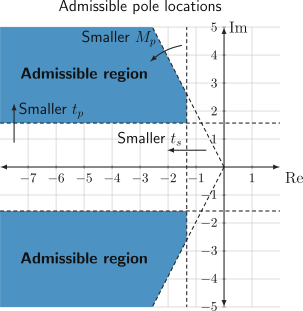
We can combine these constraints and plot them on the complex plane to see where the poles can be located to meet the performance specifications.
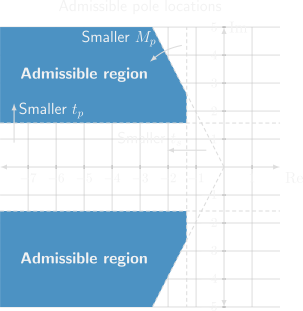
Figure 5:The shaded region indicates where the poles of a second-order system can be located to meet the performance specifications of peak time at most 2 seconds, percent overshoot at most 20%, and settling time at most 3 seconds.
Note that there are two regions of admissible pole locations, one in the upper half-plane and one in the lower half-plane. This is because the poles of a second-order system come in complex conjugate pairs, so if one pole is located at s=−ζωn+jωd, then the other pole must be located at s=−ζωn−jωd.
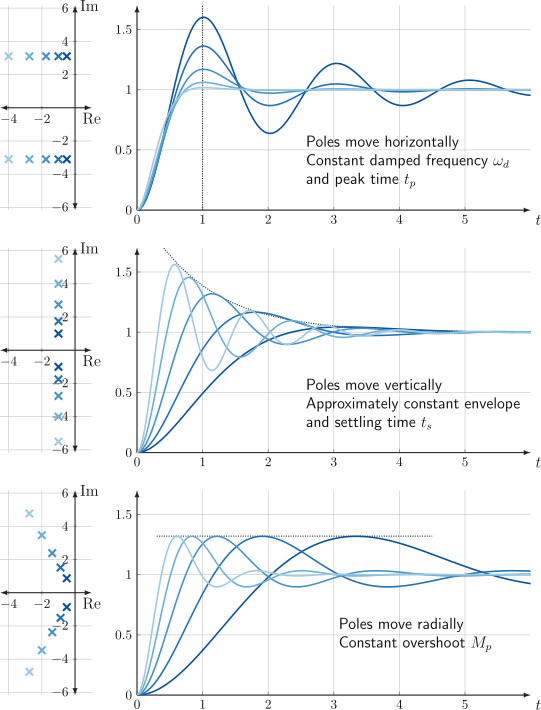
We can also examine what happens to the step response as we move the poles around in the complex plane.
If we move the poles horizontally (i.e., change the real part), then damped frequency and peak time remain the same.
If we move the poles vertically (i.e., change the imaginary part), then the settling time remains approximately constant.
If we move the poles radially away from the origin, then the percent overshoot remains approximately constant.
Here is a figure that illustrates all three cases.
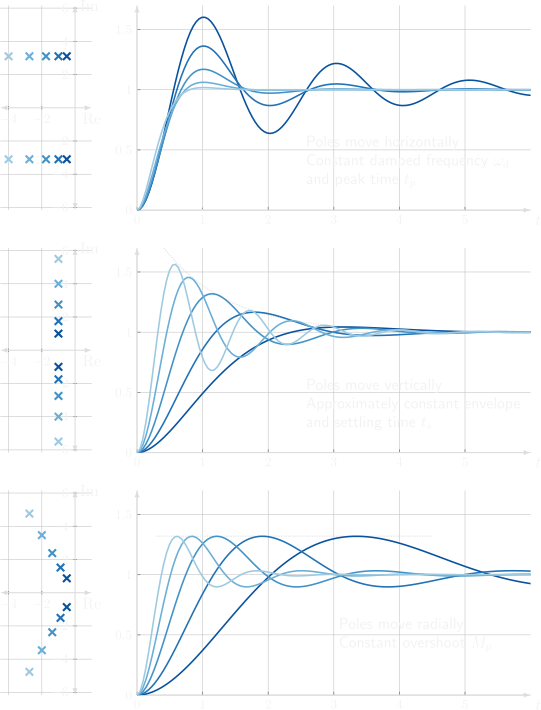
Figure 6:Figure showing how the step response changes as the poles of a second-order system move around in the complex plane, either horizontally, vertically, or radially away from the origin.
Using the applet below (click the icon in the lower-right corner to fullscreen it), you can interactively explore how the step response of a second-order system changes as you change the parameters K, ζ, and ωn. You can also see how tp, Mp, and ts change as you adjust the parameters, and how the pole locations move around.
The poles of G are the roots of the denominator. So if we want the poles to be located at s1,2=−4±2j, then the denominator must be equal to (s−(−4+2j))(s−(−4−2j)). We can expand this to get:
Therefore, we have Q=8 and R=20. To find P, we can use the fact that in canonical form, P=Kωn2 and R=ωn2. Therefore, K=P/R. We want K=0.5 and we have R=20, so we get P=0.5⋅20=10. Therefore, the transfer function is:
If we double the value of R, then the denominator becomes s2+8s+40. The poles of the system are now the roots of this new denominator, which can be calculated using the quadratic formula:
We could have estimated other performance metrics from the plot, such as peak time or settling time, and then used those to find ζ and ultimately b. However, both of these approaches would have been more complicated. Also, the percent overshoot is much easier to estimate from this sort of plot than the settling time!