Second-order systems are the next level of complexity after first-order systems. They can exhibit a wider range of behaviors, including oscillations and overshoot, which are not possible in first-order systems. In this section, we will explore the properties of second-order systems, how to analyze their behavior, and how to find their responses to various inputs.
Examples and intuition ¶ Second-order systems are common in many areas of science and engineering. We have seen many examples so far:
Spring-mass-damper system : We saw both translational and rotational examples. For example, the ODE for the translational case with a single mass is given by
m x ¨ ( t ) + b x ˙ ( t ) + k x ( t ) = f ( t ) m\ddot{x}(t) + b\dot{x}(t) + kx(t) = f(t) m x ¨ ( t ) + b x ˙ ( t ) + k x ( t ) = f ( t ) RLC circuit : We saw both series and parallel examples. For example, the ODE for the series RLC circuit is given by
L d 2 i ( t ) d t 2 + R d i ( t ) d t + 1 C i ( t ) = v ˙ in ( t ) L\frac{\dd^2 i(t)}{\dd t^2} + R\frac{\dd i(t)}{\dd t} + \frac{1}{C}i(t) = \dot v_\textsf{in}(t) L d t 2 d 2 i ( t ) + R d t d i ( t ) + C 1 i ( t ) = v ˙ in ( t ) Linearized pendulum : We saw a simple pendulum with mass m m m , length ℓ \ell ℓ , and angle θ ( t ) \theta(t) θ ( t ) from the vertical. A torque T ( t ) T(t) T ( t ) is applied at the pivot. The ODE is given by
m ℓ 2 θ ¨ ( t ) + m g ℓ θ ( t ) = T ( t ) m\ell^2\ddot{\theta}(t) + mg\ell\theta(t) = T(t) m ℓ 2 θ ¨ ( t ) + m g ℓ θ ( t ) = T ( t ) DC motor : The ODE governing angular velocity ω ( t ) \omega(t) ω ( t ) of a DC motor with input voltage v in ( t ) v_\textsf{in}(t) v in ( t ) and no load torque is given by
J L ω ¨ ( t ) + ( J R + b L ) ω ˙ ( t ) + ( b R + K 2 ) ω ( t ) = K v in ( t ) J L \ddot{\omega}(t) + (JR+bL)\dot{\omega}(t) + (bR+K^2)\omega(t) = K v_\textsf{in}(t) J L ω ¨ ( t ) + ( J R + b L ) ω ˙ ( t ) + ( b R + K 2 ) ω ( t ) = K v in ( t ) In fact, first-order systems (refer to the examples ) become second-order systems when chained together appropriately. For example:
Two RC circuits connected so that the capacitor of the first circuit drives the resistor of the second circuit.
A two-tank system where the outflow of the first tank feeds into the second tank.
A thermal system where a small object cools by exchanging heat with a larger object, which in turn cools by exchanging heat with the environment.
A two-stage chemical reaction where the product of the first reaction is the reactant for the second reaction.
First-order systems have one “energy storage” element: a capacitor storing charge, a mass storing kinetic energy, a tank storing fluid, a thermal mass storing heat, and so on. Energy can only flow in and out of that one storage element, so the dynamics are relatively simple.
Second-order systems have two “energy storage” elements, which can interact to produce more complex dynamics such as oscillations. For example, in a spring-mass-damper system, the mass stores kinetic energy while the spring stores potential energy. The energy can flow back and forth between these two storage elements, leading to oscillatory behavior.
The differential equation for a general second-order system is given by
a y ¨ ( t ) + b y ˙ ( t ) + c y ( t ) = d u ( t ) a \ddot y(t) + b \dot y(t) + c y(t) = d u(t) a y ¨ ( t ) + b y ˙ ( t ) + cy ( t ) = d u ( t ) where a a a , b b b , c c c , and d d d are constants that depend on the specific system. The system therefore has the following transfer function, which we normalize in a particular way:
G ( s ) = Y ( s ) U ( s ) = d a s 2 + b s + c = d a s 2 + b a s + c a G(s) = \frac{Y(s)}{U(s)} = \frac{d}{a s^2 + b s + c} = \frac{\frac{d}{a}}{s^2 + \frac{b}{a} s + \frac{c}{a}} G ( s ) = U ( s ) Y ( s ) = a s 2 + b s + c d = s 2 + a b s + a c a d So there are three degrees of freedom, which we can think of as the three parameters d a \frac{d}{a} a d , b a \frac{b}{a} a b , and c a \frac{c}{a} a c . This is more complicated than the first-order case, where there were only two degrees of freedom. The canonical form of a second-order system is as follows:
G ( s ) = Y ( s ) U ( s ) = K ω n 2 s 2 + 2 ζ ω n s + ω n 2 \boxed{G(s) = \frac{Y(s)}{U(s)} = \frac{K\omega_n^2}{s^2 + 2\zeta\omega_n s + \omega_n^2}} G ( s ) = U ( s ) Y ( s ) = s 2 + 2 ζ ω n s + ω n 2 K ω n 2 This may seem like an unusual choice, but we will see that the parameters ω n \omega_n ω n , ζ \zeta ζ , and K K K have clear physical interpretations that make it easier to understand the behavior of second-order systems.
Returning to the time domain, the corresponding canonical-form ODE is:
y ¨ ( t ) + 2 ζ ω n y ˙ ( t ) + ω n 2 y ( t ) = K ω n 2 u ( t ) \boxed{\ddot y(t) + 2\zeta\omega_n \dot y(t) + \omega_n^2 y(t) = K \omega_n^2 u(t)} y ¨ ( t ) + 2 ζ ω n y ˙ ( t ) + ω n 2 y ( t ) = K ω n 2 u ( t ) The three parameters ω n \omega_n ω n , ζ \zeta ζ , and K K K have names:
ω n \omega_n ω n (“omega-n”) is the natural frequency , which sets the time scale of the system’s dynamics. It is nonnegative and has units of radians per second.
ζ \zeta ζ (“zeta”) is the damping ratio , which is a measure of how much damping is present in the system. It is nonnegative and dimensionless.
K K K is the DC gain of the system, which has a similar interpretation to the DC gain of a first-order system. It can be positive or negative.
As with first-order systems, the canonical form above only applies to systems that are stable . If you try to put an unstable second-order system in the canonical form, you will find that ζ \zeta ζ is negative, which is not allowed.
Example: spring-mass-damper ¶ Consider a simple spring-mass-damper system . The equations of motion are:
m x ¨ ( t ) + b x ˙ ( t ) + k x ( t ) = f ( t ) m\ddot{x}(t) + b\dot{x}(t) + kx(t) = f(t) m x ¨ ( t ) + b x ˙ ( t ) + k x ( t ) = f ( t ) The transfer function is given by
G ( s ) = X ( s ) F ( s ) = 1 m s 2 + b s + k = 1 m s 2 + b m s + k m G(s) = \frac{X(s)}{F(s)} = \frac{1}{ms^2 + bs + k} = \frac{\frac{1}{m}}{s^2 + \frac{b}{m} s + \frac{k}{m}} G ( s ) = F ( s ) X ( s ) = m s 2 + b s + k 1 = s 2 + m b s + m k m 1 Matching coefficients with the canonical form, we see that
1 m = K ω n 2 b m = 2 ζ ω n k m = ω n 2 \begin{aligned}
\frac{1}{m} &= K \omega_n^2 \\
\frac{b}{m} &= 2 \zeta \omega_n \\
\frac{k}{m} &= \omega_n^2
\end{aligned} m 1 m b m k = K ω n 2 = 2 ζ ω n = ω n 2 From the last equation, we can solve for ω n \omega_n ω n :
ω n = k m \omega_n = \sqrt{\frac{k}{m}} ω n = m k Then we can solve for ζ \zeta ζ :
ζ = b 2 m ω n = b 2 k m \zeta = \frac{b}{2 m \omega_n} = \frac{b}{2 \sqrt{km}} ζ = 2 m ω n b = 2 km b Finally, we can solve for K K K :
K = 1 m ω n 2 = 1 k K = \frac{1}{m \omega_n^2} = \frac{1}{k} K = m ω n 2 1 = k 1 Therefore, we have:
ω n = k m , ζ = b 2 k m , K = 1 k \boxed{
\omega_n = \sqrt{\frac{k}{m}}, \quad
\zeta = \frac{b}{2 \sqrt{km}}, \quad
K = \frac{1}{k}
} ω n = m k , ζ = 2 km b , K = k 1 Example: DC motor ¶ Recall the ODE for a DC motor with input voltage v in ( t ) v_\textsf{in}(t) v in ( t ) and no load torque:
J L ω ¨ + ( J R + b L ) ω ˙ + ( b R + K m 2 ) ω = K m v in J L\, \ddot\omega + (J R + b L)\, \dot\omega + (b R + K_m^2)\, \omega = K_m v_\textsf{in} J L ω ¨ + ( J R + b L ) ω ˙ + ( b R + K m 2 ) ω = K m v in Dividing through by J L J L J L to make the leading coefficient equal to 1, we get
ω ¨ + J R + b L J L ω ˙ + b R + K m 2 J L ω = K m J L v in \ddot\omega + \frac{J R + b L}{J L}\dot\omega + \frac{b R + K_m^2}{J L} \omega = \frac{K_m}{J L} v_\textsf{in} ω ¨ + J L J R + b L ω ˙ + J L b R + K m 2 ω = J L K m v in Matching coefficients with the canonical form, we see that
K m J L = K ω n 2 J R + b L J L = 2 ζ ω n b R + K m 2 J L = ω n 2 \begin{aligned}
\frac{K_m}{J L} &= K \omega_n^2 \\
\frac{J R + b L}{J L} &= 2 \zeta \omega_n \\
\frac{b R + K_m^2}{J L} &= \omega_n^2
\end{aligned} J L K m J L J R + b L J L b R + K m 2 = K ω n 2 = 2 ζ ω n = ω n 2 Solving as before, we obtain:
ω n = b R + K m 2 J L , ζ = J R + b L 2 J L b R + K m 2 , K = K m b R + K m 2 \boxed{
\omega_n = \sqrt{\frac{b R + K_m^2}{J L}}, \quad
\zeta = \frac{J R + b L}{2 \sqrt{J L}\sqrt{b R + K_m^2}}, \quad
K = \frac{K_m}{b R + K_m^2}
} ω n = J L b R + K m 2 , ζ = 2 J L b R + K m 2 J R + b L , K = b R + K m 2 K m Classification ¶ Second-order systems have two poles, which are given by the roots of the denominator of the transfer function:
s 2 + 2 ζ ω n s + ω n 2 = 0 s^2 + 2\zeta\omega_n s + \omega_n^2 = 0 s 2 + 2 ζ ω n s + ω n 2 = 0 Therefore, the roots are given by the quadratic formula:
s = − ζ ω n ± ω n ζ 2 − 1 s = -\zeta\omega_n \pm \omega_n \sqrt{\zeta^2 - 1} s = − ζ ω n ± ω n ζ 2 − 1 Depending on the value of ζ \zeta ζ , we can have three different cases, which lead to very different behaviors. Each case has a special name:
Undamped : ζ = 0 \zeta = 0 ζ = 0 . We have two purely imaginary poles, which leads to sustained oscillations (marginal stability). The poles are at s = ± j ω n s = \pm j \omega_n s = ± j ω n .
Underdamped : 0 < ζ < 1 0 < \zeta < 1 0 < ζ < 1 . We have two complex conjugate poles, which leads to damped oscillatory behavior. The poles are at s = − ζ ω n ± j ω n 1 − ζ 2 s = -\zeta \omega_n \pm j \omega_n \sqrt{1 - \zeta^2} s = − ζ ω n ± j ω n 1 − ζ 2 .
Critically damped : ζ = 1 \zeta = 1 ζ = 1 . We have two repeated real poles, which leads to the fastest possible response without oscillations. Both poles are at s = − ω n s = -\omega_n s = − ω n .
Overdamped : ζ > 1 \zeta > 1 ζ > 1 . We have two real poles, so we can decompose the system into two first-order systems, as in the DC motor case study . The poles are given by Eq. (21) .
Intuitively, the damping ratio ζ \zeta ζ is a measure of how much damping is present in the system. The terminology above is ordered from “least damped” to “most damped”.
As we vary ζ \zeta ζ from 0 to ∞ \infty ∞ , the poles start on the imaginary axis, move along a semicircle in the left half-plane, meet at the real axis, and then split apart along the real axis. To see why this is the case, look at the magnitude (length) of the poles when they are complex:
∣ s ∣ = ( − ζ ω n ) 2 + ( ω n 1 − ζ 2 ) 2 = ζ 2 ω n 2 + ( 1 − ζ 2 ) ω n 2 = ω n 2 = ω n \begin{aligned}
|s| &= \sqrt{(-\zeta\omega_n)^2 + \bigl(\omega_n \sqrt{1 - \zeta^2}\bigr)^2} \\
&= \sqrt{\zeta^2 \omega_n^2 + (1 - \zeta^2) \omega_n^2} \\
&= \sqrt{\omega_n^2} \\
&= \omega_n
\end{aligned} ∣ s ∣ = ( − ζ ω n ) 2 + ( ω n 1 − ζ 2 ) 2 = ζ 2 ω n 2 + ( 1 − ζ 2 ) ω n 2 = ω n 2 = ω n Since the magnitude is constant and equal to ω n \omega_n ω n , the poles must lie on a semicircle of radius ω n \omega_n ω n centered at the origin.
Once the poles are real, they break apart and move along the real axis in opposite directions. The pole on the left goes off to infinity, while the pole on the right moves towards zero but remains in the left-half plane.
Use the interactive plot below to see how the poles move around in the complex plane as you vary ζ \zeta ζ with ω n \omega_n ω n held fixed.
Step response ¶ Let’s see how an underdamped second-order system responds to a unit step input. The transfer function is given by:
G ( s ) = K ω n 2 s 2 + 2 ζ ω n s + ω n 2 G(s) = \frac{K\omega_n^2}{s^2 + 2\zeta\omega_n s + \omega_n^2} G ( s ) = s 2 + 2 ζ ω n s + ω n 2 K ω n 2 To simplify our calculations, let’s define ω d = ω n 1 − ζ 2 \omega_d = \omega_n \sqrt{1 - \zeta^2} ω d = ω n 1 − ζ 2 , which is called the damped natural frequency . The poles can now be written as s = − ζ ω n ± j ω d s = -\zeta \omega_n \pm j \omega_d s = − ζ ω n ± j ω d , and we can complete the square in the denominator of the transfer function:
G ( s ) = K ω n 2 ( s + ζ ω n ) 2 + ω d 2 G(s) = \frac{K\omega_n^2}{(s + \zeta \omega_n)^2 + \omega_d^2} G ( s ) = ( s + ζ ω n ) 2 + ω d 2 K ω n 2 To find the step response, we multiply G ( s ) G(s) G ( s ) by the Laplace transform of a unit step input, which is 1 s \frac{1}{s} s 1 , and perform PFE to find the inverse Laplace transform. We will use the PFE shortcut to save ourselves some algebra.
K ω n 2 s ( s 2 + 2 ζ ω n s + ω n 2 ) = A s + B ( s + ζ ω n ) + C ω d s 2 + 2 ζ ω n s + ω n 2 \frac{K\omega_n^2}{s(s^2 + 2\zeta\omega_n s + \omega_n^2)}
= \frac{A}{s} + \frac{B (s+\zeta \omega_n) + C \omega_d}{s^2 + 2\zeta\omega_n s + \omega_n^2} s ( s 2 + 2 ζ ω n s + ω n 2 ) K ω n 2 = s A + s 2 + 2 ζ ω n s + ω n 2 B ( s + ζ ω n ) + C ω d Therefore, the inverse Laplace transform will be
y ( t ) = A + e − ζ ω n t ( B cos ( ω d t ) + C sin ( ω d t ) ) y(t) = A + e^{-\zeta \omega_n t} \bigl(B \cos(\omega_d t) + C \sin(\omega_d t)\bigr) y ( t ) = A + e − ζ ω n t ( B cos ( ω d t ) + C sin ( ω d t ) ) Using cover-up on Eq. (25) tells us that A = K A=K A = K . Using the systematic method, we have:
K ω n 2 = K ( s 2 + 2 ζ ω n s + ω n 2 ) + B s ( s + ζ ω n ) + C s ω d K\omega_n^2 = K(s^2 + 2\zeta\omega_n s + \omega_n^2) + B s(s+\zeta \omega_n) + C s \omega_d K ω n 2 = K ( s 2 + 2 ζ ω n s + ω n 2 ) + B s ( s + ζ ω n ) + C s ω d Solving for the remaining coefficients, we find that B = − K B = -K B = − K and C = − K ζ ω n / ω d C = -K \zeta \omega_n / \omega_d C = − K ζ ω n / ω d , which simplifies to C = − K ζ / 1 − ζ 2 C= -K \zeta / \sqrt{1 - \zeta^2} C = − K ζ / 1 − ζ 2 . Therefore, substituting these values into Eq. (26) gives us the final step response:
y ( t ) = K ( 1 − e − ζ ω n t ( cos ( ω d t ) + ζ 1 − ζ 2 sin ( ω d t ) ) ) y(t) = K \left(1 - e^{-\zeta \omega_n t} \left(\cos(\omega_d t) + \tfrac{\zeta}{\sqrt{1 - \zeta^2}} \sin(\omega_d t)\right)\right) y ( t ) = K ( 1 − e − ζ ω n t ( cos ( ω d t ) + 1 − ζ 2 ζ sin ( ω d t ) ) ) We can simplify a bit more. Let’s define the pole angle ϕ \phi ϕ as the angle between the negative real axis and the line connecting the origin to one of the poles, so cos ϕ = ζ \cos\phi = \zeta cos ϕ = ζ and sin ϕ = 1 − ζ 2 \sin\phi = \sqrt{1 - \zeta^2} sin ϕ = 1 − ζ 2 . Now rewrite the step response as follows:
y ( t ) = K ( 1 − 1 1 − ζ 2 e − ζ ω n t ( 1 − ζ 2 cos ( ω d t ) + ζ sin ( ω d t ) ) ) = K ( ( 1 − 1 1 − ζ 2 e − ζ ω n t ( sin ϕ cos ( ω d t ) + cos ϕ sin ( ω d t ) ) ) \begin{aligned}
y(t) &= K \left(1 - \tfrac{1}{\sqrt{1-\zeta^2}} e^{-\zeta \omega_n t} \left( \sqrt{1-\zeta^2} \cos(\omega_d t) + \zeta \sin(\omega_d t)\right)\right) \\
&= K\left((1 - \tfrac{1}{\sqrt{1-\zeta^2}} e^{-\zeta \omega_n t} \left( \sin\phi \cos(\omega_d t) + \cos\phi \sin(\omega_d t)\right)\right)
\end{aligned} y ( t ) = K ( 1 − 1 − ζ 2 1 e − ζ ω n t ( 1 − ζ 2 cos ( ω d t ) + ζ sin ( ω d t ) ) ) = K ( ( 1 − 1 − ζ 2 1 e − ζ ω n t ( sin ϕ cos ( ω d t ) + cos ϕ sin ( ω d t ) ) ) The last step can be simplified using the trigonometric identity for the sine of a sum: sin ( a + b ) = sin ( a ) cos ( b ) + cos ( a ) sin ( b ) \sin(a+b) = \sin(a)\cos(b) + \cos(a)\sin(b) sin ( a + b ) = sin ( a ) cos ( b ) + cos ( a ) sin ( b ) . Therefore, the final step response is:
y ( t ) = K ( 1 − e − ζ ω n t 1 − ζ 2 sin ( ω d t + ϕ ) ) \boxed{
y(t) = K \left(1 - \frac{e^{-\zeta \omega_n t}}{\sqrt{1 - \zeta^2}} \sin(\omega_d t + \phi)\right)
} y ( t ) = K ( 1 − 1 − ζ 2 e − ζ ω n t sin ( ω d t + ϕ ) ) and also remember the new quantities we defined:
ω d = ω n 1 − ζ 2 (damped frequency) ϕ = cos − 1 ζ (pole angle) \boxed{
\begin{aligned}
\omega_d &= \omega_n \sqrt{1 - \zeta^2} && \textsf{(damped frequency)} \\
\phi &= \cos^{-1}\zeta && \textsf{(pole angle)}
\end{aligned}
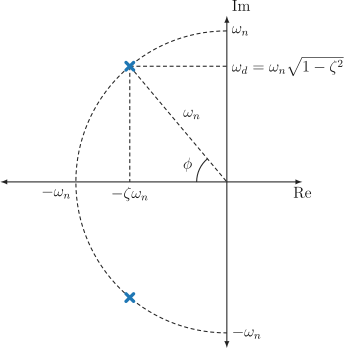
} ω d ϕ = ω n 1 − ζ 2 = cos − 1 ζ (damped frequency) (pole angle) Let’s redraw our pole-zero plot with the new quantities we defined. This helps us see the geometric connection between the poles more clearly.
Figure 1: Pole-zero plot showing the natural frequency ω n \omega_n ω n , the damped frequency ω d \omega_d ω d , the pole angle ϕ \phi ϕ , and the damping ratio ζ \zeta ζ .
Impulse response ¶ We can derive the impulse response of a second-order system in a similar way to the step response, but the derivation is much more straightforward. The transfer function for the impulse response is given by
G ( s ) = Y ( s ) U ( s ) = K ω n 2 s 2 + 2 ζ ω n s + ω n 2 = K ω n 2 ( s + ζ ω n ) 2 + ω d 2 G(s) = \frac{Y(s)}{U(s)} = \frac{K\omega_n^2}{s^2 + 2\zeta\omega_n s + \omega_n^2} = \frac{K\omega_n^2}{(s + \zeta \omega_n)^2 + \omega_d^2} G ( s ) = U ( s ) Y ( s ) = s 2 + 2 ζ ω n s + ω n 2 K ω n 2 = ( s + ζ ω n ) 2 + ω d 2 K ω n 2 The impulse response is just the inverse Laplace transform of G ( s ) G(s) G ( s ) , which we can obtain directly from the Laplace transform table :
y ( t ) = K ω n 2 ω d e − ζ ω n t sin ( ω d t ) = K ω n 2 ω n 1 − ζ 2 e − ζ ω n t sin ( ω d t ) \begin{aligned}
y(t) &= \frac{K \omega_n^2}{\omega_d} e^{-\zeta \omega_n t} \sin(\omega_d t) \\
&= \frac{K \omega_n^2}{\omega_n\sqrt{1-\zeta^2}} e^{-\zeta \omega_n t} \sin(\omega_d t)
\end{aligned} y ( t ) = ω d K ω n 2 e − ζ ω n t sin ( ω d t ) = ω n 1 − ζ 2 K ω n 2 e − ζ ω n t sin ( ω d t ) Therefore, the impulse response is given by:
y ( t ) = K ω n 1 − ζ 2 e − ζ ω n t sin ( ω d t ) \boxed{
y(t) = \frac{K \omega_n}{\sqrt{1-\zeta^2}} e^{-\zeta \omega_n t} \sin(\omega_d t) } y ( t ) = 1 − ζ 2 K ω n e − ζ ω n t sin ( ω d t ) Comparing the impulse response (34) to the step response (30) , we can see that both are decaying sinusoids with the same frequency and the same rate of decay. This is similar to what we observed with first-order systems, where the step response and impulse response had the same time constant.
In the next section, we will sketch the step response to see how the different parameters affect the shape of the response, both qualitatively and quantitatively.
Test your knowledge ¶ For each of the three following second order systems, find the natural frequency ω n \omega_n ω n and the damping ratio ζ \zeta ζ . Indicate whether the system is undamped, underdamped, critically damped, or overdamped.
Linearized pendulum with m = 50 g m=50\,\text{g} m = 50 g , ℓ = 0.2 m \ell=0.2\,\text{m} ℓ = 0.2 m , and g = 9.81 m/s 2 g=9.81\,\text{m/s}^2 g = 9.81 m/s 2 . The ODE is given by
m ℓ 2 θ ¨ ( t ) + m g ℓ θ ( t ) = T ( t ) m\ell^2\ddot{\theta}(t) + mg\ell\theta(t) = T(t) m ℓ 2 θ ¨ ( t ) + m g ℓ θ ( t ) = T ( t ) Series RLC circuit with R = 200 Ω R=200\,\Omega R = 200 Ω , L = 40 mH L=40\,\text{mH} L = 40 mH , and C = 1 μ F C=1\,\mu\text{F} C = 1 μ F . The ODE is given by
L d 2 i ( t ) d t 2 + R d i ( t ) d t + 1 C i ( t ) = v ˙ in ( t ) L\frac{\dd^2 i(t)}{\dd t^2} + R\frac{\dd i(t)}{\dd t} + \frac{1}{C}i(t) = \dot v_\textsf{in}(t) L d t 2 d 2 i ( t ) + R d t d i ( t ) + C 1 i ( t ) = v ˙ in ( t ) DC motor with the parameters from Table 1 . The ODE is given by
J L ω ¨ ( t ) + ( J R + b L ) ω ˙ ( t ) + ( b R + K 2 ) ω ( t ) = K v in ( t ) J L \ddot{\omega}(t) + (JR+bL)\dot{\omega}(t) + (bR+K^2)\omega(t) = K v_\textsf{in}(t) J L ω ¨ ( t ) + ( J R + b L ) ω ˙ ( t ) + ( b R + K 2 ) ω ( t ) = K v in ( t ) For the ODE a y ¨ ( t ) + b y ˙ ( t ) + c y ( t ) = d u ( t ) a \ddot y(t) + b \dot y(t) + c y(t) = d u(t) a y ¨ ( t ) + b y ˙ ( t ) + cy ( t ) = d u ( t ) ,
the natural frequency and damping ratio are given by the formulas
ω n = c a , ζ = b 2 a c \omega_n = \sqrt{\frac{c}{a}}, \quad
\zeta = \frac{b}{2 \sqrt{a c}} ω n = a c , ζ = 2 a c b We can apply this formula to each of the three systems:
For the pendulum, we have a = m ℓ 2 a = m \ell^2 a = m ℓ 2 , b = 0 b = 0 b = 0 , and c = m g ℓ c = mg\ell c = m g ℓ . Therefore,
ω n = m g ℓ m ℓ 2 = g ℓ = 9.81 m/s 2 0.2 m = 7 rad/s ζ = 0 2 m 2 ℓ 3 g = 0 \begin{aligned}
\omega_n &= \sqrt{\frac{mg\ell}{m\ell^2}} = \sqrt{\frac{g}{\ell}} = \sqrt{\frac{9.81 \text{ m/s}^2}{0.2 \text{ m}}} = 7\,\text{rad/s} \\
\zeta &= \frac{0}{2 \sqrt{m^2 \ell^3 g}} = 0
\end{aligned} ω n ζ = m ℓ 2 m g ℓ = ℓ g = 0.2 m 9.81 m/s 2 = 7 rad/s = 2 m 2 ℓ 3 g 0 = 0 So the natural frequency is ω n = 7 rad/s \omega_n = 7\,\text{rad/s} ω n = 7 rad/s , the damping ratio is ζ = 0 \zeta = 0 ζ = 0 , and the system is undamped .
For the series RLC circuit, we have a = L a = L a = L , b = R b = R b = R , and c = 1 C c = \frac{1}{C} c = C 1 . Therefore,
ω n = 1 / C L = 1 / ( 1 μ F ) 40 mH = 1 0 6 0.04 ≈ 5000 rad/s ζ = R 2 L / C = 200 2 40 × 1 0 − 3 / ( 1 0 − 6 ) = 200 2 4 × 1 0 4 = 0.5 \begin{aligned}
\omega_n &= \sqrt{\frac{1/C}{L}} = \sqrt{\frac{1/(1\,\mu\text{F})}{40\,\text{mH}}} = \sqrt{\frac{10^6}{0.04}} \approx 5000\,\text{rad/s} \\
\zeta &= \frac{R}{2\sqrt{L/C}} = \frac{200}{2\sqrt{40 \times 10^{-3}/(10^{-6})}} = \frac{200}{2\sqrt{4 \times 10^4}} = 0.5
\end{aligned} ω n ζ = L 1/ C = 40 mH 1/ ( 1 μ F ) = 0.04 1 0 6 ≈ 5000 rad/s = 2 L / C R = 2 40 × 1 0 − 3 / ( 1 0 − 6 ) 200 = 2 4 × 1 0 4 200 = 0.5 So the natural frequency is ω n = 5000 rad/s \omega_n = 5000\,\text{rad/s} ω n = 5000 rad/s , the damping ratio is ζ = 0.5 \zeta = 0.5 ζ = 0.5 , and the system is underdamped .
For the DC motor, we have a = J L a = J L a = J L , b = J R + b L b = JR + bL b = J R + b L , and c = b R + K 2 c = bR + K^2 c = b R + K 2 . Therefore,
The math contains several errors. Here’s the corrected version:
ω n = b R + K 2 J L = 1 0 − 4 × 0.5 + 0.0 5 2 2.5 × 1 0 − 4 × 1.5 × 1 0 − 3 ≈ 82 rad/s ζ = J R + b L 2 J L ( b R + K 2 ) = J R + b L 2 J L ω n = 2.5 × 1 0 − 4 × 0.5 + 1 0 − 4 × 1.5 × 1 0 − 3 2 × 2.5 × 1 0 − 4 × 1.5 × 1 0 − 3 × 82 ≈ 2 \begin{aligned}
\omega_n &= \sqrt{\frac{bR + K^2}{J L}} = \sqrt{\frac{10^{-4} \times 0.5 + 0.05^2}{2.5 \times 10^{-4} \times 1.5\times 10^{-3}}} \approx 82\,\text{rad/s} \\
\zeta &= \frac{JR + bL}{2 \sqrt{J L (bR + K^2)}}
= \frac{JR+bL}{2JL\omega_n} \\
&= \frac{2.5 \times 10^{-4} \times 0.5 + 10^{-4} \times 1.5\times 10^{-3}}{2 \times 2.5 \times 10^{-4} \times 1.5\times 10^{-3} \times 82} \approx 2
\end{aligned} ω n ζ = J L b R + K 2 = 2.5 × 1 0 − 4 × 1.5 × 1 0 − 3 1 0 − 4 × 0.5 + 0.0 5 2 ≈ 82 rad/s = 2 J L ( b R + K 2 ) J R + b L = 2 J L ω n J R + b L = 2 × 2.5 × 1 0 − 4 × 1.5 × 1 0 − 3 × 82 2.5 × 1 0 − 4 × 0.5 + 1 0 − 4 × 1.5 × 1 0 − 3 ≈ 2 So the natural frequency is ω n ≈ 82 rad/s \omega_n \approx 82\,\text{rad/s} ω n ≈ 82 rad/s , the damping ratio is ζ ≈ 2 \zeta \approx 2 ζ ≈ 2 , and the system is overdamped .