Inverse Laplace transforms
In the previous section, we learned how to decompose a rational function into a sum of simpler terms via partial fraction expansion. Now we develop the inverse Laplace transform pairs needed to convert each term back to the time domain.
The terms arising from PFE have specific forms depending on the pole type:
A simple real pole s = r s=r s = r a s − r \displaystyle\frac{a}{s - r} s − r a
Complex conjugate poles s = p ± q j s=p\pm qj s = p ± q j a s + b ( s − p ) 2 + q 2 \displaystyle\frac{as + b}{(s-p)^2 + q^2} ( s − p ) 2 + q 2 a s + b
Repeated poles produce terms like
a ( s − r ) k \displaystyle\frac{a}{(s - r)^k} ( s − r ) k a a s + b ( ( s − p ) 2 + q 2 ) k \displaystyle\frac{as + b}{((s-p)^2 + q^2)^k} (( s − p ) 2 + q 2 ) k a s + b
We will derive the inverse Laplace transform for each of these cases.
Review of complex numbers ¶ Before proceeding, we review some essential facts about complex numbers.
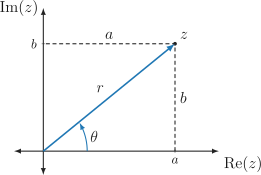
Complex number representations ¶ It is useful to think of a complex number as a point (vector) in the complex plane, where the x-axis corresponds to the real part and the y-axis corresponds to the imaginary part.
Figure 1: Complex number z z z
The different components of a complex number z z z Figure 1
real part : a = Re ( z ) imaginary part : b = Im ( z ) magnitude (or modulus) : r = ∣ z ∣ angle (or argument) : θ = ∠ z \begin{aligned}
\textsf{real part}: && a &= \text{Re}(z) \\
\textsf{imaginary part}: && b &= \text{Im}(z) \\
\textsf{magnitude (or modulus)}: && r &= |z| \\
\textsf{angle (or argument)}: && \theta &= \angle z
\end{aligned} real part : imaginary part : magnitude (or modulus) : angle (or argument) : a b r θ = Re ( z ) = Im ( z ) = ∣ z ∣ = ∠ z We can convert between these components using the geometric relationships evident from the triangle in Figure 1
a = r cos θ , b = r sin θ , r = a 2 + b 2 , θ = atan2 ( b , a ) \begin{aligned}
a &= r \cos \theta, &
b &= r \sin \theta, \\
r &= \sqrt{a^2 + b^2}, &
\theta &= \aatan(b,a)
\end{aligned} a r = r cos θ , = a 2 + b 2 , b θ = r sin θ , = atan2 ( b , a ) The function atan2 ( y , x ) \aatan(y,x) atan2 ( y , x ) two-argument arctangent , which returns the angle of the vector ( x , y ) (x,y) ( x , y ) atan2 \aatan atan2 atan \atan atan atan ( b / a ) \atan(b/a) atan ( b / a ) a > 0 a > 0 a > 0 atan2 \aatan atan2 a = 0 a=0 a = 0
atan2 ( y , x ) : = { atan ( y x ) x > 0 atan ( y x ) + π x < 0 and y ≥ 0 atan ( y x ) − π x < 0 and y < 0 + π 2 x = 0 and y > 0 − π 2 x = 0 and y < 0 undefined x = 0 and y = 0 \aatan(y,x) := \begin{cases}
\atan\bigl(\frac{y}{x}\bigr) & x > 0 \\
\atan\bigl(\frac{y}{x}\bigr) + \pi & x < 0 \textsf{ and } y \geq 0 \\
\atan\bigl(\frac{y}{x}\bigr) - \pi & x < 0 \textsf{ and } y < 0 \\
+\tfrac{\pi}{2} & x = 0 \textsf{ and } y > 0 \\
-\tfrac{\pi}{2} & x = 0 \textsf{ and } y < 0 \\
\text{undefined} & x = 0 \textsf{ and } y = 0
\end{cases} atan2 ( y , x ) := ⎩ ⎨ ⎧ atan ( x y ) atan ( x y ) + π atan ( x y ) − π + 2 π − 2 π undefined x > 0 x < 0 and y ≥ 0 x < 0 and y < 0 x = 0 and y > 0 x = 0 and y < 0 x = 0 and y = 0 Note that atan \atan atan ( − π 2 , π 2 ) \bigl(-\tfrac{\pi}{2}, \tfrac{\pi}{2}\bigr) ( − 2 π , 2 π ) atan2 \aatan atan2 ( − π , π ] (-\pi, \pi] ( − π , π ]
We can represent a complex number in two equivalent ways, which are analogous to Cartesian and polar coordinates for points in the plane.
z = a + j b ⏟ rectangular form = j r e j θ ⏟ polar form \boxed{z \;=\; \underbrace{a + jb}_{\substack{\textsf{rectangular}\\\textsf{form}}} \;=\; \underbrace{\,\vphantom{j}re^{j\theta}\,}_{\substack{\textsf{polar}\\\textsf{form}}}} z = rectangular form a + jb = polar form j r e j θ z 1 ± z 2 = ( a 1 ± a 2 ) + j ( b 1 ± b 2 ) z_1 \pm z_2 = (a_1 \pm a_2) + j(b_1 \pm b_2) z 1 ± z 2 = ( a 1 ± a 2 ) + j ( b 1 ± b 2 ) In other words,
R e ( z 1 ± z 2 ) = R e ( z 1 ) ± R e ( z 2 ) I m ( z 1 ± z 2 ) = I m ( z 1 ) ± I m ( z 2 ) \begin{aligned}
\Re(z_1 \pm z_2) &= \Re(z_1) \pm \Re(z_2) \\
\Im(z_1 \pm z_2) &= \Im(z_1) \pm \Im(z_2)
\end{aligned} Re ( z 1 ± z 2 ) Im ( z 1 ± z 2 ) = Re ( z 1 ) ± Re ( z 2 ) = Im ( z 1 ) ± Im ( z 2 ) z 1 z 2 = r 1 r 2 e j ( θ 1 + θ 2 ) and z 1 z 2 = r 1 r 2 e j ( θ 1 − θ 2 ) z_1 z_2 = r_1 r_2 e^{j(\theta_1 + \theta_2)}
\qquad\textsf{and}\qquad
\frac{z_1}{z_2} = \frac{r_1}{r_2} e^{j(\theta_1 - \theta_2)} z 1 z 2 = r 1 r 2 e j ( θ 1 + θ 2 ) and z 2 z 1 = r 2 r 1 e j ( θ 1 − θ 2 ) In other words,
∣ z 1 z 2 ∣ = ∣ z 1 ∣ ∣ z 2 ∣ ∠ ( z 1 z 2 ) = ∠ z 1 + ∠ z 2 ∣ z 1 z 2 ∣ = ∣ z 1 ∣ ∣ z 2 ∣ ∠ ( z 1 z 2 ) = ∠ z 1 − ∠ z 2 \begin{aligned}
|z_1 z_2| &= |z_1| |z_2|\quad &
\angle(z_1 z_2) &= \angle z_1 + \angle z_2 \\
\left|\frac{z_1}{z_2}\right| &= \frac{|z_1|}{|z_2|} \quad &
\angle\left(\frac{z_1}{z_2}\right) &= \angle z_1 - \angle z_2
\end{aligned} ∣ z 1 z 2 ∣ ∣ ∣ z 2 z 1 ∣ ∣ = ∣ z 1 ∣∣ z 2 ∣ = ∣ z 2 ∣ ∣ z 1 ∣ ∠ ( z 1 z 2 ) ∠ ( z 2 z 1 ) = ∠ z 1 + ∠ z 2 = ∠ z 1 − ∠ z 2 The formulas (2) Figure 1 z = r e j θ z = r\,e^{j\theta} z = r e j θ Euler’s formula [1]
e j θ = cos θ + j sin θ e^{j\theta} = \cos\theta + j\sin\theta e j θ = cos θ + j sin θ
First we must address the question “what does it even mean to raise e e e z z z
e z = ∑ n = 0 ∞ z n n ! = 1 + z 1 ! + z 2 2 ! + z 3 3 ! + ⋯ e^{z} = \sum_{n=0}^{\infty} \frac{z^n}{n!} = 1 + \frac{z}{1!} + \frac{z^2}{2!} + \frac{z^3}{3!} + \cdots e z = n = 0 ∑ ∞ n ! z n = 1 + 1 ! z + 2 ! z 2 + 3 ! z 3 + ⋯ Setting z = j θ z = j\theta z = j θ
e j θ = 1 + j θ 1 ! + ( j θ ) 2 2 ! + ( j θ ) 3 3 ! + ( j θ ) 4 4 ! + ⋯ = 1 + j θ 1 ! − θ 2 2 ! − j θ 3 3 ! + θ 4 4 ! + ⋯ = ( 1 − θ 2 2 ! + θ 4 4 ! − ⋯ ) + j ( θ 1 ! − θ 3 3 ! + θ 5 5 ! − ⋯ ) = cos θ + j sin θ \begin{aligned}
e^{j\theta} &= 1 + \frac{j\theta}{1!} + \frac{(j\theta)^2}{2!} + \frac{(j\theta)^3}{3!} + \frac{(j\theta)^4}{4!} + \cdots \\
&= 1 + j\frac{\theta}{1!} - \frac{\theta^2}{2!} - j\frac{\theta^3}{3!} + \frac{\theta^4}{4!} + \cdots \\
&= \left(1 - \frac{\theta^2}{2!} + \frac{\theta^4}{4!} - \cdots\right) + j\left(\frac{\theta}{1!} - \frac{\theta^3}{3!} + \frac{\theta^5}{5!} - \cdots\right) \\
&= \cos\theta + j\sin\theta
\end{aligned} e j θ = 1 + 1 ! j θ + 2 ! ( j θ ) 2 + 3 ! ( j θ ) 3 + 4 ! ( j θ ) 4 + ⋯ = 1 + j 1 ! θ − 2 ! θ 2 − j 3 ! θ 3 + 4 ! θ 4 + ⋯ = ( 1 − 2 ! θ 2 + 4 ! θ 4 − ⋯ ) + j ( 1 ! θ − 3 ! θ 3 + 5 ! θ 5 − ⋯ ) = cos θ + j sin θ The last step follows from the Taylor series expansions of cos θ \cos\theta cos θ sin θ \sin\theta sin θ
We can use Euler’s formula to write complex exponentials as a combination of a real exponential and trig functions. For a complex number z = a + b j z = a + bj z = a + bj t ∈ R t\in \R t ∈ R
e z t = e ( a + j b ) t = e a t e j b t = e a t ( cos b t + j sin b t ) \boxed{e^{zt} = e^{(a+jb)t} = e^{at}e^{jbt} = e^{at}(\cos bt + j\sin bt)} e z t = e ( a + jb ) t = e a t e jb t = e a t ( cos b t + j sin b t ) This formula will be central to deriving the inverse Laplace transforms for complex poles.
Complex conjugate ¶ Another useful concept is the complex conjugate of a complex number. The complex conjugate of z = a + j b z = a + jb z = a + jb z ˉ \bar{z} z ˉ
z ˉ = a − j b \bar{z} = a - jb z ˉ = a − jb In polar form, the complex conjugate is given by:
z ˉ = r e − j θ \bar{z} = re^{-j\theta} z ˉ = r e − j θ Graphically, the complex conjugate is the reflection of z z z Figure 1
When squaring a real number, we have x 2 ≥ 0 x^2 \geq 0 x 2 ≥ 0 x ∈ R x\in\R x ∈ R
z z ˉ ≥ 0 z \bar z \geq 0 z z ˉ ≥ 0 This is because z z ˉ = ( a + j b ) ( a − j b ) = a 2 + b 2 = ∣ z ∣ 2 ≥ 0 z \bar z = (a + jb)(a - jb) = a^2 + b^2 = |z|^2 \geq 0 z z ˉ = ( a + jb ) ( a − jb ) = a 2 + b 2 = ∣ z ∣ 2 ≥ 0 z z z z ˉ = z \bar z = z z ˉ = z z z ˉ = z 2 z \bar z = z^2 z z ˉ = z 2
Simplifying fractions ¶ When working with complex numbers, it is often necessary to simplify fractions involving complex numbers. The key technique is to multiply the numerator and denominator by the complex conjugate of the denominator. For example, let’s simplify the expression:
2 + 3 j 1 + 4 j = ( 2 + 3 j ) ( 1 − 4 j ) ( 1 + 4 j ) ( 1 − 4 j ) = 2 + 3 j − 8 j − 12 j 2 1 − 16 j 2 = 2 − 5 j + 12 1 + 16 = 14 − 5 j 17 = 14 17 − 5 17 j \begin{aligned}
\frac{2+3j}{1 + 4j}
&= \frac{(2+3j)(1 - 4j)}{(1 + 4j)(1 - 4j)} \\
&= \frac{2 + 3j - 8j - 12j^2}{1 - 16j^2} \\
&= \frac{2 - 5j + 12}{1 + 16} \\
&= \frac{14 - 5j}{17} \\
&= \frac{14}{17} - \frac{5}{17}j
\end{aligned} 1 + 4 j 2 + 3 j = ( 1 + 4 j ) ( 1 − 4 j ) ( 2 + 3 j ) ( 1 − 4 j ) = 1 − 16 j 2 2 + 3 j − 8 j − 12 j 2 = 1 + 16 2 − 5 j + 12 = 17 14 − 5 j = 17 14 − 17 5 j Simplifying powers ¶ When raising complex numbers to powers, it is often easier to use the polar representation. For example, to compute ( 1 + j ) 10 (1 + j)^{10} ( 1 + j ) 10
1 + j = 1 2 + 1 2 e j atan ( 1 / 1 ) = 2 e j π / 4 1 + j = \sqrt{1^2 + 1^2}\, e^{j\atan(1/1)} = \sqrt{2}\, e^{j\pi/4} 1 + j = 1 2 + 1 2 e j atan ( 1/1 ) = 2 e jπ /4 Next, we use the property of exponents:
( 1 + j ) 10 = ( 2 e j π / 4 ) 10 = ( 2 ) 10 e j 10 π / 4 = 2 5 e j 5 π / 2 = 32 e j π / 2 = 32 j (1 + j)^{10} = (\sqrt{2} e^{j\pi/4})^{10} = (\sqrt{2})^{10} e^{j10\pi/4} = 2^{5} e^{j5\pi/2} = 32 e^{j\pi/2} = 32j ( 1 + j ) 10 = ( 2 e jπ /4 ) 10 = ( 2 ) 10 e j 10 π /4 = 2 5 e j 5 π /2 = 32 e jπ /2 = 32 j The simplification e j 5 π / 2 = e j π / 2 = j e^{j5\pi/2} = e^{j\pi/2} = j e j 5 π /2 = e jπ /2 = j e j 2 π = 1 e^{j2\pi} = 1 e j 2 π = 1 2 π 2\pi 2 π
e j π / 2 = cos ( π 2 ) + j sin ( π 2 ) = j e^{j\pi/2} = \cos\bigl(\tfrac{\pi}{2}\bigr) + j\sin\bigl(\tfrac{\pi}{2}\bigr) = j e jπ /2 = cos ( 2 π ) + j sin ( 2 π ) = j Now that we have reviewed complex numbers, we can use their properties to derive the inverse Laplace transforms needed for PFE terms. Let’s start with exponential functions.
Exponentials ¶ Let’s consider the Laplace transform of the exponential function e z t e^{zt} e z t z ∈ C z\in\C z ∈ C
L { e z t } = ∫ 0 ∞ e − s t e z t d t = ∫ 0 ∞ e ( z − s ) t d t = [ 1 z − s e ( z − s ) t ] t = 0 ∞ = 1 s − z \Lap\{e^{zt}\} = \int_0^{\infty} e^{-st} e^{zt} \, \dd t = \int_0^{\infty} e^{(z-s)t} \, \dd t = \left[\frac{1}{z-s} e^{(z-s)t}\right]_{t=0}^{\infty} = \frac{1}{s-z} L { e z t } = ∫ 0 ∞ e − s t e z t d t = ∫ 0 ∞ e ( z − s ) t d t = [ z − s 1 e ( z − s ) t ] t = 0 ∞ = s − z 1 If z z z z = − a z = -a z = − a a ∈ R a\in\R a ∈ R (20)
L { e − a t } = 1 s + a \boxed{\Lap\{e^{-at}\} = \frac{1}{s+a}} L { e − a t } = s + a 1 No surprises here; this is what we previously derived in Table 1
Sinusoids and damped sinusoids ¶ Let’s now assume z = − a + b j z = -a+bj z = − a + bj a , b ∈ R a,b\in\R a , b ∈ R (20)
L { e z t } = 1 s + a − b j \Lap\{e^{zt}\} = \frac{1}{s + a - bj} L { e z t } = s + a − bj 1 The left-hand side of (22) (12)
e z t = e ( − a + j b ) t = e − a t ( cos b t + j sin b t ) e^{zt} = e^{(-a+jb)t} = e^{-at}(\cos bt + j\sin bt) e z t = e ( − a + jb ) t = e − a t ( cos b t + j sin b t ) Therefore: L { e z t } = L { e − a t cos b t } + j L { e − a t sin b t } \Lap\{e^{zt}\} = \Lap\{e^{-at}\cos bt\} + j\Lap\{e^{-at}\sin bt\} L { e z t } = L { e − a t cos b t } + j L { e − a t sin b t }
The right-hand side of (22)
1 s + a − b j = ( s + a + b j ) ( s + a − b j ) ( s + a + b j ) = s + a ( s + a ) 2 + b 2 + j b ( s + a ) 2 + b 2 \begin{aligned}
\frac{1}{s + a - bj} &= \frac{(s+a+bj)}{(s+a-bj)(s+a+bj)}\\
&= \frac{s + a}{(s + a)^2 + b^2} + j\frac{b}{(s + a)^2 + b^2}
\end{aligned} s + a − bj 1 = ( s + a − bj ) ( s + a + bj ) ( s + a + bj ) = ( s + a ) 2 + b 2 s + a + j ( s + a ) 2 + b 2 b Equating real and imaginary parts on both sides gives:
L { e − a t cos b t } = s + a ( s + a ) 2 + b 2 L { e − a t sin b t } = b ( s + a ) 2 + b 2 \boxed{
\begin{aligned}
\Lap\{e^{-at}\cos bt\} &= \frac{s+a}{(s+a)^2 + b^2}\\
\Lap\{e^{-at}\sin bt\} &= \frac{b}{(s+a)^2 + b^2}
\end{aligned}
} L { e − a t cos b t } L { e − a t sin b t } = ( s + a ) 2 + b 2 s + a = ( s + a ) 2 + b 2 b Since sin \sin sin cos \cos cos − e − a t -e^{-at} − e − a t + e − a t +e^{-at} + e − a t exponential envelope .
The parameter a a a decay rate : if a > 0 a > 0 a > 0 a < 0 a < 0 a < 0 a = 0 a=0 a = 0
The parameter b b b frequency of oscillation : the larger b b b
The interactive app below allows you to visualize the effects of changing a a a b b b e − a t cos b t e^{-at}\cos bt e − a t cos b t
Repeated poles ¶ Let’s return to our exponential Laplace formula (20)
L { e z t } = 1 s − z \Lap\{e^{zt}\} = \frac{1}{s - z} L { e z t } = s − z 1 We can actually differentiate both sides with respect to z z z t t t [2]
Differentiating with respect to z z z
L { t e z t } = 1 ( s − z ) 2 \Lap\{t e^{zt}\} = \frac{1}{(s - z)^2} L { t e z t } = ( s − z ) 2 1 We can repeat this process n − 1 n-1 n − 1
L { t n e z t } = n ! ( s − z ) n + 1 \Lap\{t^n e^{zt}\} = \frac{n!}{(s - z)^{n+1}} L { t n e z t } = ( s − z ) n + 1 n ! So, for example, when z = − a z=-a z = − a
L { t n e − a t } = n ! ( s + a ) n + 1 \boxed{\Lap\{t^n e^{-at}\} = \frac{n!}{(s + a)^{n+1}}} L { t n e − a t } = ( s + a ) n + 1 n ! We can also obtain a formula for the case of repeated complex poles by substituting z = − a + b j z= -a + bj z = − a + bj (28) (12) (25)
The following table summarizes the Laplace transform pairs we’ve seen so far.
Time domain f ( t ) f(t) f ( t ) Frequency domain F ( s ) F(s) F ( s ) Pole type e − a t e^{-at} e − a t 1 s + a \displaystyle\frac{1}{s+a} s + a 1 Simple real t n − 1 ( n − 1 ) ! e − a t \displaystyle\frac{t^{n-1}}{(n-1)!}e^{-at} ( n − 1 )! t n − 1 e − a t 1 ( s + a ) n \displaystyle\frac{1}{(s+a)^n} ( s + a ) n 1 Repeated real (order n n n e − a t cos b t e^{-at}\cos bt e − a t cos b t s + a ( s + a ) 2 + b 2 \displaystyle\frac{s+a}{(s+a)^2+b^2} ( s + a ) 2 + b 2 s + a Complex conjugate pair e − a t sin b t e^{-at}\sin bt e − a t sin b t b ( s + a ) 2 + b 2 \displaystyle\frac{b}{(s+a)^2+b^2} ( s + a ) 2 + b 2 b Complex conjugate pair
For the repeated real pole, we rearranged (29) n = 1 n=1 n = 1
We also included a more comprehensive table in our appendix on Laplace transforms
System stability ¶ Now that we have seen what sorts of functions of time we can expect out of LTI systems, we can start to think about the notion of stability , which is important for control systems. We say a LTI system is:
stable if the states go to zero. This is also called asymptotically stable . For example, a decaying exponential e − t e^{-t} e − t
unstable if the states go to infinity. For example, a growing exponential e t e^{t} e t
marginally stable if the states do not go to zero or infinity, but remain constant or oscillate indefinitely. For example, sin t \sin t sin t
We can characterize stability for the functions of time we’ve seen so far:
Time domain f ( t ) f(t) f ( t ) Stable Marginally stable Unstable e − a t e^{-at} e − a t a > 0 a > 0 a > 0 a = 0 a = 0 a = 0 a < 0 a < 0 a < 0 t n − 1 ( n − 1 ) ! e − a t \frac{t^{n-1}}{(n-1)!}e^{-at} ( n − 1 )! t n − 1 e − a t a > 0 a > 0 a > 0 a = 0 a = 0 a = 0 n = 1 n = 1 n = 1 a < 0 a < 0 a < 0 e − a t cos b t e^{-at}\cos bt e − a t cos b t a > 0 a > 0 a > 0 a = 0 a = 0 a = 0 a < 0 a < 0 a < 0 e − a t sin b t e^{-at}\sin bt e − a t sin b t a > 0 a > 0 a > 0 a = 0 a = 0 a = 0 a < 0 a < 0 a < 0
Stability is governed by a a a a = 0 a=0 a = 0 n = 1 n=1 n = 1
This leads us to the following important conclusion about system stability:
Inverting real quadratic terms ¶ When we have an irreducible quadratic denominator and the numerator does not fit neatly into one of the forms in Eq. (25)
L − 1 { 2 s + 3 s 2 − 2 s + 10 } \Lap^{-1}\left\{\frac{2s + 3}{s^2 - 2s + 10}\right\} L − 1 { s 2 − 2 s + 10 2 s + 3 } First, complete the square in the denominator:
s 2 − 2 s + 10 = ( s − 1 ) 2 + 9 = ( s − 1 ) 2 + 3 2 s^2 - 2s + 10 = (s - 1)^2 + 9 = (s-1)^2 + 3^2 s 2 − 2 s + 10 = ( s − 1 ) 2 + 9 = ( s − 1 ) 2 + 3 2 This reveals that a = − 1 a = -1 a = − 1 b = 3 b = 3 b = 3 (25)
L − 1 { s − 1 ( s − 1 ) 2 + 3 2 } = e t cos 3 t L − 1 { 3 ( s − 1 ) 2 + 3 2 } = e t sin 3 t \begin{aligned}
\Lap^{-1}\left\{\frac{s - 1}{(s - 1)^2 + 3^2}\right\} &= e^{t}\cos 3t \\
\Lap^{-1}\left\{\frac{3}{(s - 1)^2 + 3^2}\right\} &= e^{t}\sin 3t
\end{aligned} L − 1 { ( s − 1 ) 2 + 3 2 s − 1 } L − 1 { ( s − 1 ) 2 + 3 2 3 } = e t cos 3 t = e t sin 3 t Our goal is to write the original fraction as a linear combination of these two fractions. So we need to find constants A A A B B B
2 s + 3 ( s − 1 ) 2 + 3 2 = A ( s − 1 ( s − 1 ) 2 + 3 2 ) + B ( 3 ( s − 1 ) 2 + 3 2 ) \frac{2s + 3}{(s-1)^2 + 3^2} = A\left(\frac{s-1}{(s-1)^2 + 3^2}\right) + B\left(\frac{3}{(s-1)^2 + 3^2}\right) ( s − 1 ) 2 + 3 2 2 s + 3 = A ( ( s − 1 ) 2 + 3 2 s − 1 ) + B ( ( s − 1 ) 2 + 3 2 3 ) If we can do this, then we can take the inverse Laplace transform term-by-term using the formulas above and obtain:
L − 1 { 2 s + 3 s 2 − 2 s + 10 } = A e t cos 3 t + B e t sin 3 t \Lap^{-1}\left\{\frac{2s + 3}{s^2 - 2s + 10}\right\} = A e^{t}\cos 3t + B e^{t}\sin 3t L − 1 { s 2 − 2 s + 10 2 s + 3 } = A e t cos 3 t + B e t sin 3 t To find A A A B B B s s s PFE :
2 s + 3 = A ( s − 1 ) + B ⋅ 3 = A s + ( 3 B − A ) \begin{aligned}
2s+3 &= A(s-1) + B\cdot 3 \\
&= As + (3B-A)
\end{aligned} 2 s + 3 = A ( s − 1 ) + B ⋅ 3 = A s + ( 3 B − A ) Therefore, we need to solve the system of equations:
A = 2 3 B − A = 3 \begin{aligned}
A &= 2 \\
3B - A &= 3
\end{aligned} A 3 B − A = 2 = 3 Solving gives A = 2 A = 2 A = 2 B = 5 3 B = \frac{5}{3} B = 3 5 (34)
L − 1 { 2 s + 3 s 2 − 2 s + 10 } = 2 e t cos 3 t + 5 3 e t sin 3 t \boxed{\Lap^{-1}\left\{\frac{2s + 3}{s^2 - 2s + 10}\right\} = 2e^{t}\cos 3t + \frac{5}{3}e^{t}\sin 3t} L − 1 { s 2 − 2 s + 10 2 s + 3 } = 2 e t cos 3 t + 3 5 e t sin 3 t When we did PFE , we looked to write terms involving irreducible quadratics in the denominator as
A s + B ( s + a ) 2 + b 2 \frac{As + B}{(s+a)^2 + b^2} ( s + a ) 2 + b 2 A s + B However, if our ultimate goal is to find the inverse Laplace transform, we can save ourselves some algebra by writing the numerator in terms of ( s + a ) (s+a) ( s + a ) b b b PFE , we instead look for terms of the form:
A ( s + a ) + B b ( s + a ) 2 + b 2 \frac{A(s+a) + Bb}{(s+a)^2 + b^2} ( s + a ) 2 + b 2 A ( s + a ) + B b This way, we can directly read off the inverse Laplace transform using the formulas in (25) PFE , we are already done!
Complete worked example ¶ Let’s put everything together with a complete worked example. Let’s find:
L − 1 { s + 10 s 4 + 2 s 3 + 10 s 2 } \Lap^{-1}\left\{ \frac{s+10}{s^4 + 2s^3 + 10s^2} \right\} L − 1 { s 4 + 2 s 3 + 10 s 2 s + 10 } Solution: The denominator factors as s 2 ( s 2 + 2 s + 10 ) s^2(s^2 + 2s + 10) s 2 ( s 2 + 2 s + 10 ) s 2 + 2 s + 10 s^2 + 2s + 10 s 2 + 2 s + 10 b 2 − 4 a c = 2 2 − 4 ⋅ 1 ⋅ 10 = − 36 < 0 b^2 - 4ac = 2^2 - 4\cdot 1 \cdot 10 = -36 < 0 b 2 − 4 a c = 2 2 − 4 ⋅ 1 ⋅ 10 = − 36 < 0
s 2 + 2 s + 10 = ( s + 1 ) 2 + 3 2 s^2 + 2s + 10 = (s+1)^2 + 3^2 s 2 + 2 s + 10 = ( s + 1 ) 2 + 3 2 Using our PFE shortcut A A A B B B C C C
s + 10 s 2 ( s 2 + 2 s + 10 ) = A s + B s 2 + C ( s + 1 ) + 3 D ( s + 1 ) 2 + 3 2 \frac{s+10}{s^2(s^2 + 2s + 10)} = \frac{A}{s} + \frac{B}{s^2} + \frac{C(s+1) + 3D}{(s+1)^2 + 3^2} s 2 ( s 2 + 2 s + 10 ) s + 10 = s A + s 2 B + ( s + 1 ) 2 + 3 2 C ( s + 1 ) + 3 D Once we find A A A B B B C C C D D D
L − 1 { s + 10 s 4 + 2 s 3 + 10 s 2 } = A ⋅ 1 + B ⋅ t + C e − t cos 3 t + D e − t sin 3 t \Lap^{-1}\left\{\frac{s+10}{s^4 + 2s^3 + 10s^2}\right\} = A \cdot 1 + B \cdot t + C e^{-t}\cos 3t + D e^{-t}\sin 3t L − 1 { s 4 + 2 s 3 + 10 s 2 s + 10 } = A ⋅ 1 + B ⋅ t + C e − t cos 3 t + D e − t sin 3 t We can find B B B (42) s 2 s^2 s 2 s = 0 s=0 s = 0
B = 0 + 10 0 2 + 0 + 10 = 1 B = \frac{0 + 10}{0^2 + 0 + 10} = 1 B = 0 2 + 0 + 10 0 + 10 = 1 To find A A A C C C D D D (42) s 2 ( s 2 + 2 s + 10 ) s^2(s^2 + 2s + 10) s 2 ( s 2 + 2 s + 10 )
s + 10 = A s ( s 2 + 2 s + 10 ) + ( s 2 + 2 s + 10 ) + [ C ( s + 1 ) + 3 D ] s 2 = A s 3 + 2 A s 2 + 10 A s + s 2 + 2 s + 10 + C s 3 + C s 2 + 3 D s 2 = ( A + C ) s 3 + ( 2 A + 1 + C + 3 D ) s 2 + ( 10 A + 2 ) s + 10 \begin{aligned}
s + 10 &= A s (s^2 + 2s + 10) + (s^2 + 2s + 10) + [C(s+1) + 3D] s^2 \\
&= A s^3 + 2A s^2 + 10A s + s^2 + 2s + 10 + C s^3 + C s^2 + 3D s^2 \\
&= (A + C) s^3 + (2A + 1 + C + 3D) s^2 + (10A + 2) s + 10
\end{aligned} s + 10 = A s ( s 2 + 2 s + 10 ) + ( s 2 + 2 s + 10 ) + [ C ( s + 1 ) + 3 D ] s 2 = A s 3 + 2 A s 2 + 10 A s + s 2 + 2 s + 10 + C s 3 + C s 2 + 3 D s 2 = ( A + C ) s 3 + ( 2 A + 1 + C + 3 D ) s 2 + ( 10 A + 2 ) s + 10 Comparing coefficients gives the system of equations:
A + C = 0 2 A + 1 + C + 3 D = 0 10 A + 2 = 1 10 = 10 \begin{aligned}
A + C &= 0 \\
2A + 1 + C + 3D &= 0 \\
10A + 2 &= 1 \\
10 &= 10
\end{aligned} A + C 2 A + 1 + C + 3 D 10 A + 2 10 = 0 = 0 = 1 = 10 Solving gives A = − 1 10 A = -\frac{1}{10} A = − 10 1 C = 1 10 C = \frac{1}{10} C = 10 1 D = − 3 10 D = -\frac{3}{10} D = − 10 3 (43)
L − 1 { s + 10 s 4 + 2 s 3 + 10 s 2 } = − 1 10 + t + 1 10 e − t cos 3 t − 3 10 e − t sin 3 t \boxed{\Lap^{-1}\left\{\frac{s+10}{s^4 + 2s^3 + 10s^2}\right\} = -\frac{1}{10} + t + \frac{1}{10} e^{-t}\cos 3t - \frac{3}{10} e^{-t}\sin 3t} L − 1 { s 4 + 2 s 3 + 10 s 2 s + 10 } = − 10 1 + t + 10 1 e − t cos 3 t − 10 3 e − t sin 3 t Test your knowledge ¶ First, complete the square in the denominator:
s 2 + 4 s + 13 = ( s + 2 ) 2 + 3 2 s^2 + 4s + 13 = (s + 2)^2 + 3^2 s 2 + 4 s + 13 = ( s + 2 ) 2 + 3 2 This reveals that a = − 2 a = -2 a = − 2 b = 3 b = 3 b = 3 (25)
L − 1 { s + 2 ( s + 2 ) 2 + 3 2 } = e − 2 t cos 3 t L − 1 { 3 ( s + 2 ) 2 + 3 2 } = e − 2 t sin 3 t \begin{aligned}
\Lap^{-1}\left\{\frac{s + 2}{(s + 2)^2 + 3^2}\right\} &= e^{-2t}\cos 3t \\
\Lap^{-1}\left\{\frac{3}{(s + 2)^2 + 3^2}\right\} &= e^{-2t}\sin 3t
\end{aligned} L − 1 { ( s + 2 ) 2 + 3 2 s + 2 } L − 1 { ( s + 2 ) 2 + 3 2 3 } = e − 2 t cos 3 t = e − 2 t sin 3 t Our goal is to write the original fraction as a linear combination of these two fractions. So we need to find constants A A A B B B
3 s + 5 ( s + 2 ) 2 + 3 2 = A ( s + 2 ( s + 2 ) 2 + 3 2 ) + B ( 3 ( s + 2 ) 2 + 3 2 ) \frac{3s + 5}{(s + 2)^2 + 3^2} = A\left(\frac{s + 2}{(s + 2)^2 + 3^2}\right) + B\left(\frac{3}{(s + 2)^2 + 3^2}\right) ( s + 2 ) 2 + 3 2 3 s + 5 = A ( ( s + 2 ) 2 + 3 2 s + 2 ) + B ( ( s + 2 ) 2 + 3 2 3 ) If we can do this, then we can take the inverse Laplace transform term-by-term using the formulas above and obtain:
L − 1 { 3 s + 5 s 2 + 4 s + 13 } = A e − 2 t cos 3 t + B e − 2 t sin 3 t \Lap^{-1}\left\{\frac{3s + 5}{s^2 + 4s + 13}\right\} = A e^{-2t}\cos 3t + B e^{-2t}\sin 3t L − 1 { s 2 + 4 s + 13 3 s + 5 } = A e − 2 t cos 3 t + B e − 2 t sin 3 t To find A A A B B B s s s PFE :
3 s + 5 = A ( s + 2 ) + B ⋅ 3 = A s + ( 2 A + 3 B ) \begin{aligned}
3s + 5 &= A(s + 2) + B\cdot 3 \\
&= As + (2A + 3B)
\end{aligned} 3 s + 5 = A ( s + 2 ) + B ⋅ 3 = A s + ( 2 A + 3 B ) Therefore, we need to solve the system of equations:
A = 3 2 A + 3 B = 5 \begin{aligned}
A &= 3 \\
2A + 3B &= 5
\end{aligned} A 2 A + 3 B = 3 = 5 Solving gives A = 3 A = 3 A = 3 B = − 1 3 B = -\frac{1}{3} B = − 3 1
L − 1 { 3 s + 5 s 2 + 4 s + 13 } = 3 e − 2 t cos 3 t − 1 3 e − 2 t sin 3 t \boxed{\Lap^{-1}\left\{\frac{3s + 5}{s^2 + 4s + 13}\right\} = 3e^{-2t}\cos 3t - \frac{1}{3}e^{-2t}\sin 3t} L − 1 { s 2 + 4 s + 13 3 s + 5 } = 3 e − 2 t cos 3 t − 3 1 e − 2 t sin 3 t We start with the partial fraction expansion:
4 ( s + 1 ) ( s + 2 ) ( s + 3 ) 2 = A s + 1 + B s + 2 + C s + 3 + D ( s + 3 ) 2 \frac{4}{(s+1)(s+2)(s+3)^2
} = \frac{A}{s+1} + \frac{B}{s+2} + \frac{C}{s+3} + \frac{D}{(s+3)^2} ( s + 1 ) ( s + 2 ) ( s + 3 ) 2 4 = s + 1 A + s + 2 B + s + 3 C + ( s + 3 ) 2 D We can find A A A B B B D D D
A = 4 ( − 1 + 2 ) ( − 1 + 3 ) 2 = 1 B = 4 ( − 2 + 1 ) ( − 2 + 3 ) 2 = − 4 D = 4 ( − 3 + 1 ) ( − 3 + 2 ) = 2 \begin{aligned}
A &= \frac{4}{( -1 + 2)( -1 + 3)^2} = 1 \\
B &= \frac{4}{( -2 + 1)( -2 + 3)^2} = -4 \\
D &= \frac{4}{( -3 + 1)( -3 + 2)} = 2
\end{aligned} A B D = ( − 1 + 2 ) ( − 1 + 3 ) 2 4 = 1 = ( − 2 + 1 ) ( − 2 + 3 ) 2 4 = − 4 = ( − 3 + 1 ) ( − 3 + 2 ) 4 = 2 So far, we have:
4 ( s + 1 ) ( s + 2 ) ( s + 3 ) 2 = 1 s + 1 − 4 s + 2 + C s + 3 + 2 ( s + 3 ) 2 \frac{4}{(s+1)(s+2)(s+3)^2} = \frac{1}{s+1} - \frac{4}{s+2} + \frac{C}{s+3} + \frac{2}{(s+3)^2} ( s + 1 ) ( s + 2 ) ( s + 3 ) 2 4 = s + 1 1 − s + 2 4 + s + 3 C + ( s + 3 ) 2 2 To find C C C s = 0 s=0 s = 0
4 18 = 1 1 − 4 2 + C 3 + 2 9 \frac{4}{18} = \frac{1}{1} - \frac{4}{2} + \frac{C}{3} + \frac{2}{9} 18 4 = 1 1 − 2 4 + 3 C + 9 2 Solving gives C = 3 C = 3 C = 3 PFE is:
4 ( s + 1 ) ( s + 2 ) ( s + 3 ) 2 = 1 s + 1 − 4 s + 2 + 3 s + 3 + 2 ( s + 3 ) 2 \frac{4}{(s+1)(s+2)(s+3)^2} = \frac{1}{s+1} - \frac{4}{s+2} + \frac{3}{s+3} + \frac{2}{(s+3)^2} ( s + 1 ) ( s + 2 ) ( s + 3 ) 2 4 = s + 1 1 − s + 2 4 + s + 3 3 + ( s + 3 ) 2 2 Taking the inverse Laplace transform term-by-term gives:
L − 1 { 4 ( s + 1 ) ( s + 2 ) ( s + 3 ) 2 } = e − t − 4 e − 2 t + 3 e − 3 t + 2 t e − 3 t \boxed{\Lap^{-1}\left\{\frac{4}{(s+1)(s+2)(s+3)^2}\right\} = e^{-t} - 4e^{-2t} + 3e^{-3t} + 2te^{-3t}} L − 1 { ( s + 1 ) ( s + 2 ) ( s + 3 ) 2 4 } = e − t − 4 e − 2 t + 3 e − 3 t + 2 t e − 3 t