Rotational systems
Newton’s laws (rotational version)
In this lecture, we consider mechanical systems with rotational motion along a single fixed axis. We will begin by specializing Newton’s laws from the previous section.
The rotational version of Newton’s second law is not a new principle; it follows from Newton’s laws for translational motion. For a complete derivation, see the appendix on Newton’s laws.
Pendulums
Among the simplest rotational systems are pendulums. We will see several examples.
Example: simple pendulum
Let’s start with the pendulum shown in Figure 1 below. We assume the rod is massless (all the mass is concentrated at the end), and we have two external forces: a torque applied at the pivot, and gravity.
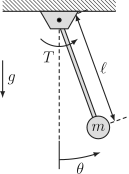
Figure 1:Pendulum under the influence of gravity and an applied torque at the pivot.
As with the linear case, we draw a free body diagram to keep track of all the external torques.
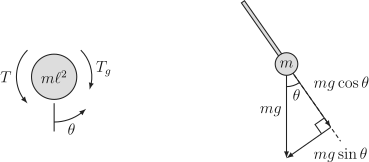
Figure 2:Left: Free body diagram of the pendulum from Figure 1. Right: Gravity force acting on the mass, decomposed into radial and tangential components (only the tangential component contributes to the torque about the pivot).
The moment of inertia of the pendulum about the pivot is , since all the mass is concentrated at the tip of the pendulum.
The torque due to gravity is the moment arm times the component of the gravity force in the tangential direction. Based on Figure 2, we see that . Together with the rotational version of Newton’s second law, we obtain:
As with the linear case, we must be mindful of the directions of the torques. The direction of is counterclockwise, therefore the applied torque is counted as while the torque due to gravity is counted as , since they are counterclockwise and clockwise in the free body diagram, respectively. Eliminating and in Eq. (2), we obtain
If is small, we can write and divide by to obtain the simpler model
Example: solid pendulum
Now consider a pendulum made from a solid uniform rod of mass and length .
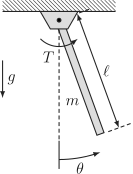
Figure 3:Solid pendulum under the influence of gravity and an applied torque at the pivot.
The free body diagram is the same as Figure 2, except the mass is now distributed, so we must re-think how to calculate .
When external forces act on a rigid body, the effect is the same is if the sum of all external forces acted at the center of mass (for a derivation, see the appendix on Newton’s laws). If the center of mass is at a distance from the pivot, the torque contribution is . Therefore, our equation of motion is
Given that the rod is uniform with mass and length , the moment of inertia about one end is . Moreover, the center of mass is at the midpoint, so . Therefore, the equation of motion for the solid pendulum of Figure 3 is
Example: imbalanced lever
Our next example is a lever. A force is applied at one end and a spring is attached to the other end. We further assume there is no gravity, the lever has moment of inertia about the pivot, and is small so we can use a small-angle approximation.
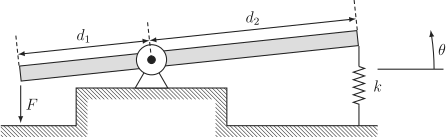
Figure 4:Imbalanced lever with a force applied to one end and a spring attached to the other.
The natural thing to do here is to apply Newton’s second law (rotational version) about the pivot point. This leads to the following free body diagram.
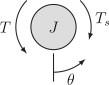
Figure 5:Free body diagram for the imbalanced lever of Figure 4.
To find the spring torque, we first compute the displacement of the right end, which with a small-angle approximation is . Therefore the spring force is , and the spring torque is .
Finally, the applied force causes a torque about the pivot. Collecting our constitutive equations and Newton’s second law, we obtain:
Substituting everything into the last equation and simplifying, we obtain:
We saw that Newton’s second law is also valid if we apply it to the center of mass, however this leads to a more complicated derivation. Here it is anyway, just to show that it works!
Alternative derivation
Let’s apply Newton’s second law about the center of mass instead of the pivot. We will need both a translational and a rotational free body diagram in this case.
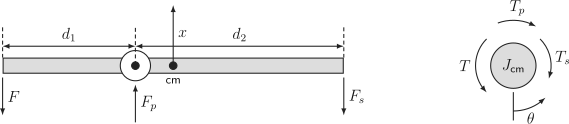
Figure 6:Free body diagrams for the imbalanced lever of Figure 4, this time with both translational (left) and rotational (right) versions.
We can no longer ignore the force at the pivot point , as it will contribute a torque about the center of mass. This is why we need both translational and rotational equations; otherwise we would not be able to solve for . Let’s write out our equations of motion, being careful to use torques and moment of inertia about the center of mass rather than the pivot. Note that we still have here.
The kinematic constraint is something new; it’s a geometric constraint that relates to . We will learn more about kinematic constraints in the next section. Substituting everything into the two Newton’s equations, we obtain:
Multiply the second equation by and add it to the first to eliminate :
The term in brackets multiplying is simply due to the parallel axis theorem, so our resulting equation above is identical to Eq. (8) found previously. Although this approach produced the same solution, it was considerably more work than simply using the pivot as a reference point!
Fundamental components
As with linear motion, we can have rotational versions of stiffness and damping elements. Drawn below is a torsional spring.


Figure 7:Torsional spring being twisted at either end. The eyeball icon indicates the direction of common perspective so that we can talk about rotation direction. For example, as drawn, and are measured in a counterclockwise direction.
We draw an eyeball icon to indicate the direction of common perspective. In Figure 7, the rotational displacements of the two ends and are measured in the counterclockwise direction with respect to the common perspective. In order to twist the spring, we must apply equal and opposite torques to either end. This is analogous to applying equal and opposite forces to the ends of a linear spring as in Figure 1.
The torsional spring is labeled to indicate the torsional spring constant and that it obeys the torsional version of Hooke’s Law: the torque is proportional to the angular displacement.
As with the linear case, we have a minus sign between the angles because represents the twisting of the spring. If you are uncertain about which way the signs should go, you can do a thought experiment:
Imagine holding the left end fixed (). We expect that when we apply a torque to the right end, this will cause a twist in the same direction as the torque, so . Therefore, we should have .
Now imagine holding the right end fixed (). We expect that when we apply a torque to the left end, this will cause a twist in the same direction as the torque, so . Therefore, we should have .
When one end is held fixed, the system obeys superposition; we can just add the two spring torques together and obtain .
Viscous damping is analogous to the translational case, and we obtain constitutive equations of the form when two surfaces are sliding past each other.
Example: rotational spring-mass-damper
As with linear motion, we can have rotational versions of stiffness and damping elements. Illustrated below is the rotational version of a spring-mass-damper system.
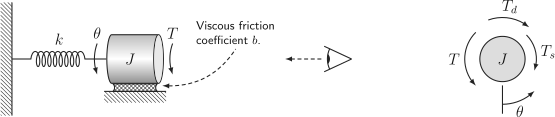
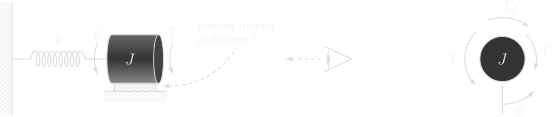
Figure 8:Left: Rotational spring-mass-damper system. Center: Eyeball icon indicating the direction of common perspective for the free body diagram. Right: Free body diagram.
The rotational inertia is connected to a wall by a torsional spring with constant , and is subject to viscous damping with coefficient . The constitutive equations for these elements is analogous to those for the linear case, with displacements and forces replaced by angles and torques, respectively.
For a torsional spring, .
For rotational viscous damping: .
To find equations of motion for rotational systems, we draw a free body diagram similar to the pendulum. To ensure consistency, it is important to draw the diagram from a common perspective, which we denote with an eyeball icon (see Figure 8).
The equations are therefore:
Eliminating and from (13) and rearranging, we obtain our equation of motion.
Notice the striking resemblance between (14) and the equations of motion for the linear spring-mass-damper system of Figure 4, given in Eq. (5).
Test your knowledge
Solution to Exercise 1 #
Begin by drawing the free body diagram for the pendulum about the pivot point.
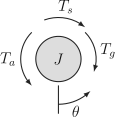
Figure 10:Free body diagram for the inertias in the system of Figure 9.
The moment of inertia of the pendulum about the pivot point is .
The tricky part in this problem is computing the spring torque .
The displacement of the spring is the horizontal displacement of the pendulum at a distance down the shaft. Since we are assuming small angles, this is .
The spring force is the displacement times the spring constant: .
The spring torque is the force times the moment arm, which in this case is again. Therefore, .
The torque due to gravity is the same as it was in the simple pendulum of Figure 1 and Eq. (2). With the small-angle approximation, we obtain .
Finally, the applied force causes a torque since it is applied horizontally at the tip of the pendulum.
As with linear systems, the directions of the arrows in the free body diagram are merely a convention. However, it is important that rotates in opposite directions on both inertias, since the same torsional spring is connected to both inertias, and we must obey Newton’s third law. Now, we can write our system of equations.
Substituting the first four equations into the last one and simplifying, we obtain our equations of motion.
Solution to Exercise 2 #
Begin by drawing the free body diagrams for both inertias.
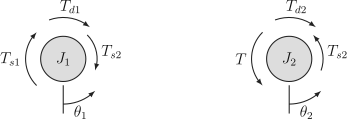
Figure 12:Free body diagrams for the inertias in the system of Figure 11.
As with linear systems, the directions of the arrows in the free body diagram are merely a convention. However, it is important that rotates in opposite directions on both inertias, since the same torsional spring is connected to both inertias, and we must obey Newton’s third law. Now, we can write our system of equations.
we can substitute the first four equations into the last two equations to eliminate , , , and , and obtain: