Kinematic constraints
Kinematic constraints
Mechanical systems often involve multiple inertias (translating or rotating) that are constrained to move together. For example, when two gears interlock and one rotates, this forces the other to rotate along with it. This is known as a kinematic constraint.
On the one hand, these are two separate rotating bodies, each with a moment of inertia, external forces, and subject to Newton’s second law.
On the other hand, the two bodies are constrained to move together, so we can view them as a single body that moves in a complex way.
We will learn through examples to derive equations of motion for such systems.
Example: rack and pinion
A rack and pinion is a mechanical device that converts rotational motion to translational motion. Typically, a torque is applied to a pinion (small gear), which is interlocked with a rack (flat surface with teeth). So when the pinion turns, the rack translates.
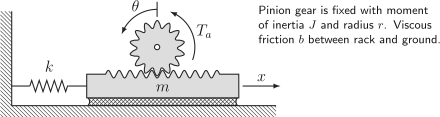
Figure 1:Rack and pinion system.
Our goal is to derive a single equation of motion relating the applied torque to the rack position (we are not interested in the pinion angle).
Since there are two inertias (rack and pinion), we will draw two free body diagrams and derive two sets of equations. We also introduce an (unknown) horizontal force between the rack and pinion that represents the pinion pushing on the rack. We can assume this force is horizontal, since any vertical components will (i) produce no torque with respect to the pinion axis, and (ii) will not drive motion of the rack, since it is constrained to only move horizontally.
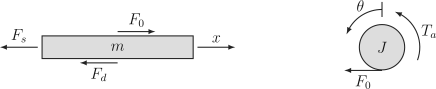
Figure 2:Free body diagrams for the rack (left) and pinion (right) for the system of Figure 1.
It doesn’t matter which way we draw , as long as it is pointing in opposite directions on each free body diagram (Newton’s third law). The equations of motion are
Notice that we wrote in the final equation, since we must use torque in the rotational version of Newton’s second law. Substituting and simplifying, we obtain
We are now stuck; we have two equations, but three variables (, , ). So it is impossible to eliminate both and . What is missing is a kinematic constraint. The rack and pinion do not move independently since they are interconnected. Every time the pinion turns an angle , a point on its circumference travels a distance . Therefore, we have the kinematic constraint . You can think of a kinematic constraint as a constraint on the variables in the system due to geometry.
Since our goal is to eliminate , we will substitute into the second equation:
Now to eliminate , divide the second equation by and add it to the first equation:
This looks exactly like the equation for a standard spring-mass-damper system, as in Eq. (5). The difference is that our mass has been replaced by the equivalent mass . From the point of view of the rack, it’s like it got a little heavier because whenever it moves, it must also spin the pinion.
Example: gear and pinion
We now consider a system with two interlocked gears.
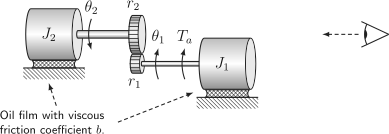
Figure 3:Gear and pinion system.
We would like to derive an equation of motion relating the applied torque to the angle of the second inertia .
As with the rack and pinion example, we will introduce a tangential force where the two gears meet. Here are the free body diagrams.
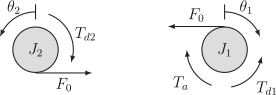
Figure 4:Free body diagrams for the gear and pinion system of Figure 3.
The kinematic constraint this time requires that points on the circumference of each gear travel at the same speed. Therefore, . Our equations are therefore:
Although Newton’s third law ensures that will be equal and opposite on the gear and pinion, these forces produce different torques due to the differing radii. This is why we use and for the torque due to the constraint force for the pinion and gear, respectively. Substituting and simplifying, we obtain:
We now have a complete set of equations: 3 equations in 3 variables (, , ). This is called a differential-algebraic system of equations (DAE) because it is a mix of differential equations and algebraic equations. Since the problem asks to produce a single differential equation relating to , we have a bit of work yet to do.
Substitute from the first equation into the second equation, and multiply the third equation by so that we obtain a common term we can cancel out:
Adding both equations together and grouping like terms, we obtain
Based on the structure of this equation, we conclude that the two inertias move together as though they were a single inertia with damping coefficient .
Test your knowledge
Solution to Exercise 1 #
Introduce the rotation angle of the drum, and draw separate free body diagrams for the drum and mass. We also include a force (the tension in the rope), being sure to draw this force acting in an equal and opposite way on the two inertias.
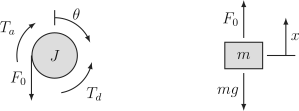
Figure 6:Free body diagrams for the rope hoist mechanism of Figure 5.
The kinematic constraint is , since we assume the rope is winding around the drum of radius without slipping. Our equations are:
Eliminating and using the first two equations, we obtain:
Dividing the first equation by and adding it to the second equation to eliminate , we obtain after simplification:
These equations show that the hoist mass has an effective mass of due to the added inertia of the drum and there is also some effective damping of .