Sketching Bode plots
Although we have only seen first and second-order systems so far, it turns out this is enough to understand the Bode plots of higher-order systems. This is because any transfer function can be decomposed into a product of first and second-order factors, and the Bode plot of the overall system is just the sum of the Bode plots of these factors. In this section, we will see how to decompose a transfer function into Bode form, and then use this decomposition to sketch Bode plots by hand.
Decomposition and Bode form
The idea is to generalize the shifting property we learned to deal with constants. If we have two complex numbers and , then their product is given by
Therefore the magnitude of the product is the product of the magnitudes, and the phase of the product is the sum of the phases. But when magnitude is plotted in decibels, the product of magnitudes becomes a sum of decibels.
So if , then we have
Putting a system in Bode form means decomposing it into factors where the constant term is equal to 1. This ensures that each factor has a DC-gain of 1, which will make Bode plots easier to sketch. For example, if the system has first-order poles and zeros, we can factor out the constants to get:
We can do the same with second-order factors, by factoring out the natural frequency and expressing each quadratic in terms of . If we have integrators or differentiators, we ignore them for now (we will deal with them later). For example:
This form exposes the corner frequency and the damping ratio of each second-order factors, which makes it easier to plot their Bode plots later.
Sketching a Bode plot
Once a transfer function is in Bode form, we can sketch its Bode plot by sketching the Bode plots of each factor and adding them together. However, this approach can be cumbersome as it requires plotting each factor separately and then summing them. We will present a more efficient way of doing this by noting the contributions of each factor, and sketching the overall Bode plot in one shot. The basic workflow is as follows:
This is best illustrated via examples, so we will go through two examples, a simpler one and a more complicated one. The process is the same for both, but the second example will show how to deal with integrators and second-order poles/zeros.
Example 1: simple poles and zeros
Let’s start with the simple example:
Step 1: Bode form
We start by decomposing the transfer function into Bode form and make a table showing each corner frequency in increasing order, and the relevant info: pole or zero, first or second order, and damping ratio (if second order). At a corner frequency of 0, indicate any integrators/differentiators and include the factored gain . For our example in Eq. (5), the Bode form is:
and we have the following table:
| (rad/s) | Info |
|---|---|
| 0 | |
| 1 | 1 zero |
| 10 | 1 pole |
| 100 | 1 pole |
Step 2: Magnitude plot
Plot axes. We use a frequency range that spans one decade below the smallest corner frequency to one decade above the largest corner frequency, so from 0.1 rad/s to 1000 rad/s.
Low-frequency asymptote. Our anchor point (lowest corner frequency) is at rad/s. Before this frequency, we have a flat asymptote at the DC gain, since our system contains no integrators or differentiators. The DC gain converted to DB is dB.
Corner frequencies. We now proceed through the corner frequencies in increasing order. Each time we encounter a pole, the slope of the asymptote decreases by 20 dB/decade, and each time we encounter a zero, the slope increases by 20 dB/decade. For our example, we have the following changes in slope:
(rad/s) Info Slope change (dB/dec) New slope (dB/dec) 0 0 0 (low-freq asymptote) 1 1 zero +20 +20 10 1 pole -20 0 100 1 pole -20 -20 (high-freq roll-off) High-frequency asymptote. After the last corner frequency, the slope of the asymptote should be dB/decade if we didn’t make any mistakes. This slope is our high-frequency roll-off and continues indefinitely. For our example, we had 2 poles and 1 zero, so the slope should be -20 dB/decade, which matches our calculations.
Sketch the plot. Finally, we sketch the magnitude plot by hand, using the straight-line approximations as a guide. The plot should be smooth and roughly follow the straight lines. Here is the sketch for our example:
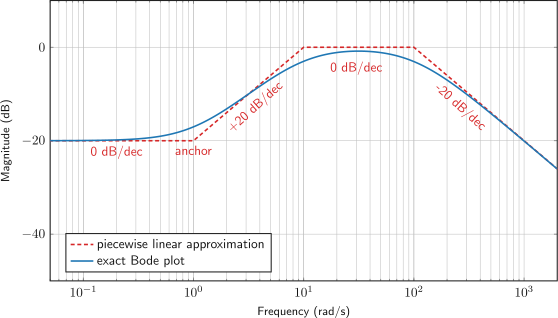
Figure 1:Bode magnitude plot sketch for the transfer function in Eq. (5), showing the piecewise linear approximation and the exact Bode plot.
Step 3: Phase plot
Plot axes. We use the same frequency axis as the magnitude plot, so a range from 0.1 rad/s to 1000 rad/s.
Low-frequency phase. The low-frequency phase is determined by the constant gain and any integrators/differentiators (not applicable here). Since is positive, it contributes 0° to the phase, so the low-frequency phase is 0°.
Corner frequencies. We proceed through the corner frequencies in increasing order. This time, the effects occur 1 decade before and 1 decade after. Each pole causes a decrease of -90° over the two decades (so -45°/decade). Each zero causes +45°/decade increase over the two decades. To keep track of all this, we can make a table:
(rad/s) Info Slope change (°/dec) New slope (°/dec) 0 (start at 0°) 0 0 0.1 start (1 zero at 1) +45 +45 1 start (1 pole at 10) -45 0 10 stop (1 zero at 1) -45 -45 10 start (1 pole at 100) -45 -90 100 stop (1 pole at 10) +45 -45 1000 stop (1 pole at 100) +45 0 High-frequency phase. After the last corner frequency, the phase should be degrees if we didn’t make any mistakes. We should also have a slope of 0°/decade at high frequencies, which matches our calculations.
Sketch the plot. Finally, we sketch the phase plot by hand, using the straight-line approximations as a guide. The plot should be smooth and roughly follow the straight lines. Here is the sketch for our example:
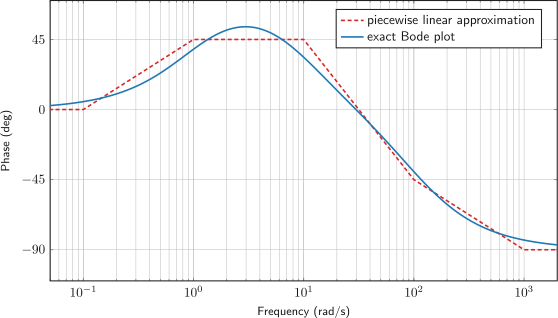
Figure 2:Bode phase plot sketch for the transfer function in Eq. (5), showing the piecewise linear approximation and the exact Bode plot.
This was a relatively simple example because it only contained first-order poles and zeros, and no integrators/differentiators. In the next example, we will see how to deal with these more complicated cases.
Example 2: more complicated case
We will illustrate the process with the example:
Step 1: Bode form
We start by decomposing the transfer function into Bode form and make a table showing each corner frequency in increasing order, and the relevant info: pole or zero, first or second order, and damping ratio (if second order). At a corner frequency of 0, indicate any integrators/differentiators and include the factored gain . For our example in Eq. (7), the Bode form is:
and we have the following table:
| (rad/s) | Info |
|---|---|
| 0 | 1 pole () |
| 0.1 | 1 zero |
| 2 | 2 pole () |
| 100 | 1 zero |
Step 2: Magnitude plot
Plot axes. Draw a set of blank axes for the magnitude and phase plots. For the frequency axis, use a range that spans one decade below the smallest corner frequency to one decade above the largest corner frequency. This ensures that we capture all the important features of the plot. For our example, we would us a range from 0.01 rad/s to 1000 rad/s.
Low-frequency asymptote. Next, we find our anchor point, which is the point on the magnitude plot at the lowest corner frequency .
If there is no integrator/differentiator as in our first example, the anchor point is and the low-frequency asymptote is a horizontal line at this level.
If we have integrators/differentiators, the low-frequency asymptote will have a slope of -20 dB/decade for each integrator, and +20 dB/decade for each differentiator. We however need to account for the contribution of the integrators/differentiators to the magnitude at .
In our example, we have an integrator so the anchor magnitude is:
and the low-frequency asymptote has a slope of -20 dB/decade. Note that we’re just evaluating at , and ignoring the contributions of the other factors, since they all have a DC gain of 1, and is small compared to the corner frequencies of the other poles/zeros. If we had e.g. multiple integrators , or multiple differentiators , we would need to evaluate or , respectively, at .
Corner frequencies. We now proceed through the corner frequencies in increasing order. Each time we encounter a pole, the slope of the asymptote decreases by 20 dB/decade, and each time we encounter a zero, the slope increases by 20 dB/decade. For second-order poles, the slope changes by -40 dB/decade, and for second-order zeros, the slope changes by +40 dB/decade. We draw a straight line at the new slope until we reach our next corner frequency, and repeat. Here is what happens after each corner frequency:
(rad/s) Info Slope change (dB/dec) New slope (dB/dec) 0 1 pole -20 -20 (low-freq asymptote) 0.1 1 zero +20 0 2 2 pole () -40 -40 100 1 zero +20 -20 (high-freq roll-off) High-frequency asymptote. After the last corner frequency, the slope of the asymptote should be dB/decade if we didn’t make any mistakes. This slope is our high-frequency roll-off and continues indefinitely. For our example, we had 3 poles and 2 zeros, so the slope should be -20 dB/decade, which matches our calculations.
Sketch the plot. Finally, we sketch the magnitude plot by hand, using the straight-line approximations as a guide. The plot should be smooth and roughly follow the straight lines. At second-order poles, we should include a resonance peak if appropriate (depending on the damping ratio). At second-order zeros, the peak is reversed and becomes a dip. Here is the sketch for our example:
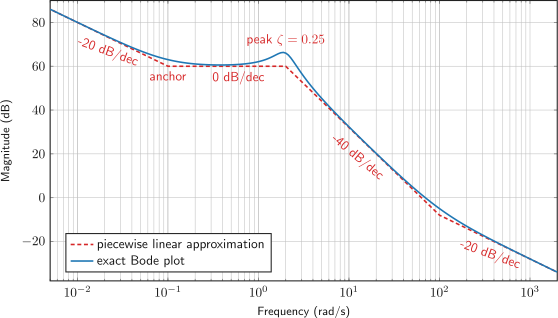
Figure 3:Bode magnitude plot sketch for the transfer function in Eq. (7), showing the piecewise linear approximation and the exact Bode plot.
Step 3: Phase plot
Plot axes. We use the same frequency axis as the magnitude plot, so a range that spans one decade below the smallest corner frequency to one decade above the largest corner frequency.
Low-frequency phase. The low-frequency phase is determined by the integrators/differentiators and the constant gain. Each integrator contributes -90°, each differentiator contributes +90°, and the constant gain contributes 0° degrees if and -180° if . For our example, we have an integrator and a positive gain, so the low-frequency phase is -90°.
Corner frequencies. We proceed through the corner frequencies in increasing order. This time, the effects occur 1 decade before and 1 decade after. Each pole causes a decrease of -90° over the two decades (so -45°/decade). Each zero causes +45°/decade increase over the two decades. For second-order poles/zeros, the decrease/increase is doubled. To keep track of all this, we can make a table:
(rad/s) Info Slope change (°/dec) New slope (°/dec) 0 1 pole (start at -90°) 0 0 0.01 start (1 zero at 0.1) +45 +45 0.2 start (2 pole at 2, ) -90 -45 1 stop (1 zero at 0.1) -45 -90 10 start (1 zero at 100) +45 -45 20 stop (2 pole at 2, ) +90 45 1000 stop (1 zero at 100) -45 0 Since our second-order pole at has a damping ratio of , the phase drop will be more abrupt than the idealized -90°/decade. Taking it to the extreme (), this corresponds to an instantaneous phase drop of -180° at , and would yield the following modified table:
(rad/s) Info Slope change (°/dec) New slope (°/dec) 0 1 pole (start at -90°) 0 0 0.01 start (1 zero at 0.1) +45 +45 1 stop (1 zero at 0.1) -45 0 2 2 poles (, -180° drop) 0 0 10 start (1 zero at 100) +45 +45 1000 stop (1 zero at 100) -45 0 High-frequency phase. After the last corner frequency, the phase should be degrees if we didn’t make any mistakes. We should also have a slope of 0°/decade at high frequencies, which matches our calculations.
Sketch the plot. Finally, we sketch the phase plot by hand, using the straight-line approximations as a guide. The plot should be smooth and roughly follow the straight lines. At second-order poles/zeros, we should make the transition steeper for smaller . As a rough guide, make it twice as steep for , and essentially instantaneous for . Here is the sketch for our example:
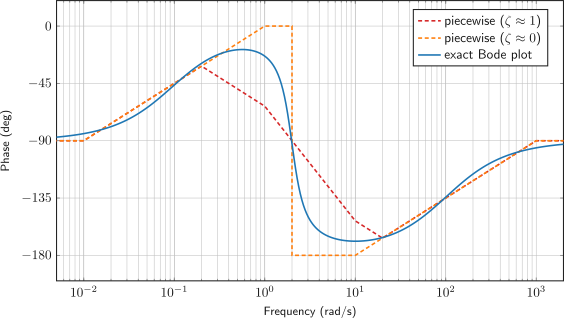
Figure 4:Bode phase plot sketch for the transfer function in Eq. (7), showing the piecewise linear approximation and the exact Bode plot.
In the plot above, we showed two different phase plots:
The first one (red) assumes that the second-order pole at has a damping ratio of , which causes a gradual drop in phase from 0° to -180° over two decades (1 decade before and 1 decade after the corner frequency).
The second one (orange) assumes that the second-order pole at has a damping ratio of , which would instantly cause a -180° drop in phase (no damping).
The exact phase plot (blue) is somewhere in between, since the actual damping ratio is .
Test your knowledge
Solution to Exercise 1 #
Putting our system in Bode form, we have:
Our DC gain is , and we have two corner frequencies, at rad/s and rad/s. The first corner frequency corresponds to a second-order pole with , and the second corner frequency corresponds to a first-order pole. We can make a table for the magnitude plot:
| (rad/s) | Info | Slope change (dB/dec) | New slope (dB/dec) |
|---|---|---|---|
| 0 | 0 | 0 (low-freq asymptote) | |
| 1 | 2 pole () | -40 | -40 |
| 10 | 1 pole | -20 | -60 (high-freq roll-off) |
And a table for the phase plot:
| (rad/s) | Info | Slope change (°/dec) | New slope (°/dec) |
|---|---|---|---|
| 0 | (start at 180°) | 0 | 0 |
| 0.1 | start (2 pole at 1) | -90 | -90 |
| 1 | start (1 pole at 10) | -45 | -135 |
| 10 | stop (2 pole at 1) | +90 | -45 |
| 100 | stop (1 pole at 10) | +45 | 0 |
Here is the resulting Bode plot sketch:
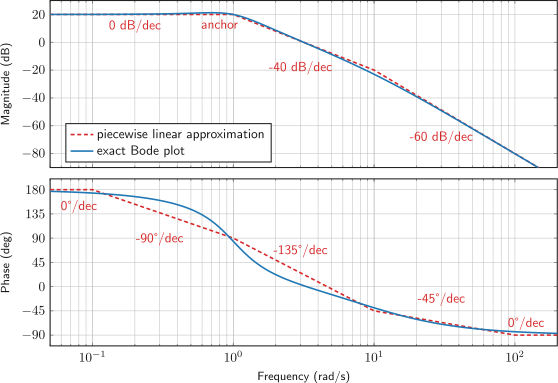
Figure 5:Bode plot sketch for the transfer function in Eq. (10), showing the piecewise linear approximation and the exact Bode plot.
Notice that our phase plot isn’t a great match near because we used decade for the transition even though . If we had used decades, we would have gotten a much better match. This highlights the fact that the straight-line approximations are just that: approximations. They are meant to be a guide for sketching the plot, but they won’t always give you an exact match.