In this section, we will derive the Bode plots for first and second-order systems. Just like understanding the time-domain response of first and second order systems allows you to predict the behavior of more complex systems (via partial fraction decomposition), understanding the frequency response of first and second order systems allows you to predict the frequency response of more complex systems. However, it’s even easier with frequency response because no partial fraction decomposition is needed!
We will start with the simplest systems (constant gains and integrators) and then move on to first and second-order systems.
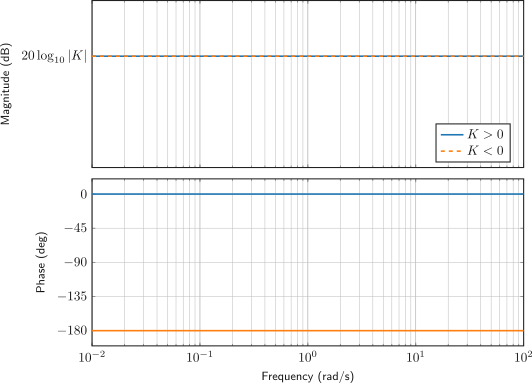
Let’s start with the simplest of transfer functions, a constant gain G(s)=K. The frequency response is given by G(jω)=K, which is a complex number with magnitude M(ω)=∣K∣ and phase ϕ(ω)=∠K. The frequency response is constant for all frequencies, which means that the Bode plot will be a horizontal line in both the magnitude and phase plots. However, the value of the magnitude and phase will depend on whether K is positive or negative. Here are the plots:
Figure 1:Bode plot for a constant gain G(s)=K. The phase plot changes depending on whether K is positive or negative, while the magnitude plot is the same for both cases.
So we can just shift the Bode magnitude plot of G up or down by 20log10∣K∣ dB, depending on whether K is greater than or less than 1.
For the phase plot, we have:
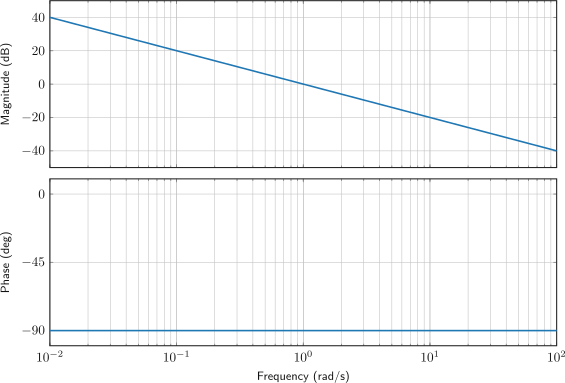
An integrator has the transfer function G(s)=s1, which means that its frequency response is given by G(jω)=jω1. The magnitude of the frequency response is M(ω)=ω1, which means that:
As with the constant gain, the phase is constant at all frequencies. This time it’s a 90° phase lag. Here is the corresponding Bode plot:
Figure 2:Bode plot for an integrator G(s)=s1. The phase plot is constant at -90°, while the magnitude plot has a slope of -20 dB/decade.
Notice that the DC gain of the integrator is infinite. This is because G(s)=s1 so G(0)→∞. We can see why this is the case by looking at the time-domain response. Integration of a sinusoid produces:
The output amplitude is ω1, which gets larger the smaller we make ω. In the limit ω→0, the input becomes u(t)=1 and the output becomes y(t)=t, which grows without bound as t→∞. This is why the DC gain is infinite. That being said, integrators still possess high-frequency roll-off, so high-frequency inputs are attenuated/smoothed.
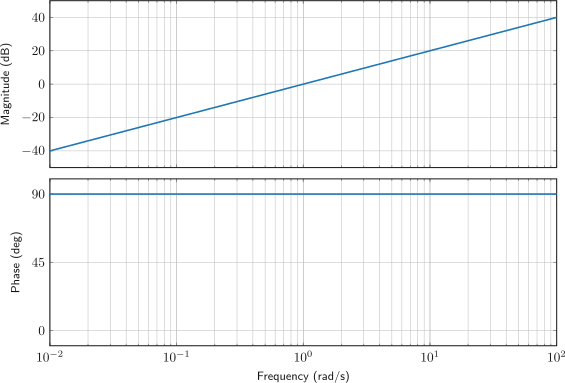
A differentiator has the transfer function G(s)=s, which means that its frequency response is given by G(jω)=jω. This is the inverse of what we had for the integrator. This time, MdB(ω)=20log10(ω) and ϕ(ω)=90°. So our magnitude plot is a constant slope of +20 dB/decade and the phase plot is a constant 90° of phase lead. Here is the Bode plot:
Figure 3:Bode plot for a differentiator G(s)=s. The phase plot is constant at 90°, while the magnitude plot has a slope of +20 dB/decade.
This time, the DC gain is zero (the derivative of a constant is zero), while the high-frequency gain is infinite. We can see this again with the time-domain response:
Let’s consider a first-order system with transfer function G(s)=τs+11. The frequency response is given by G(jω)=jωτ+11. Let’s treat the magnitude and phase separately.
This is a -20 dB/decade slope, since every time we multiply ω by 10, M decreases by 20 dB. This is the same as what happened with the integrator.
When both denominator terms are equal, (ωτ=1), we have M(ω)=21≈−3 dB. This is a corner frequency, and it marks the transition between the low-frequency and high-frequency behavior.
Again, we can look at low, medium, and high frequencies:
At low frequencies (ωτ≪1), we can let ωτ≈0 and the phase is approximately 0°.
At high frequencies (ωτ≫1), we can let ωτ→∞ and the phase becomes approximately -90°.
In the middle, at the corner frequency (ωτ=1), the phase is exactly -45°.
The phase plot also has “point symmetry” about the corner frequency. This means that the phase plot makes an S-shaped curve that looks the same if you rotate it by 180° around the corner frequency. To see why, expand the explanation below.
Why point symmetry?
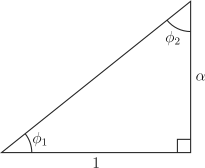
To see why, imagine two frequencies ω1 and ω2 equidistant from the corner frequency on a log scale, so ω1τ=α and ω2τ=α1 for some α>0. Then,
We can sketch the Bode magnitude by plotting the two asymptotes (low frequency constant and high-frequency slope) and then connecting them smoothly around the corner frequency.
For the Bode phase plot, the S-curve starts and ends roughly one decade before and one decade after the corner frequency. We can approximate the shape by connecting these points with straight lines and drawing a smooth curve on top.
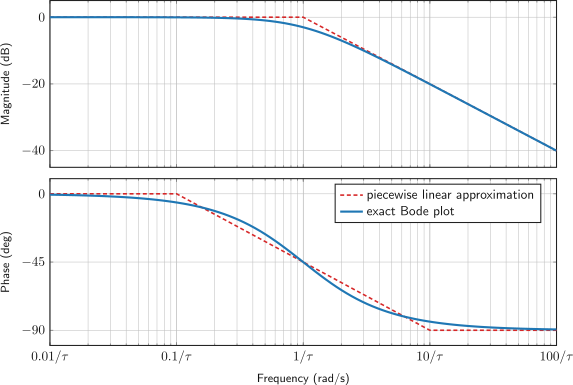
Here is the bode plot for our first-order system, showing the approximation and the true plot overlaid:
Figure 5:Bode plot of a first-order system G(s)=τs+11. The asymptotes are shown in dashed lines, while the true plot is shown in solid lines.
The interactive demonstration below shows the frequency response of a first-order system: a water heating device where the input is the flame intensity and the output is the water temperature. You can adjust the frequency of oscillation ω=τ1 and observe how the response changes. You can also click the boxes to animate the plot and reveal the Bode plot. Notice that as you increase the frequency, the magnitude decays (high-frequency roll-off) and the phase lag increases up to 90°.
The derivation of the Bode plot for second-order systems is similar to the first-order case, but more involved. Let’s start with a standard second-order system with DC gain 1:
At low frequencies (ω≪ωn), we can neglect the ω terms in the denominator and the magnitude is approximately 1 (0 dB).
At high frequencies (ω≫ωn), and the (ωnω)2 term dominates, so M(ω)≈(ωnω)−2. Every time ω increases by a factor of 10, M(ω) decreases by a factor of 100, which corresponds to a slope of -40 dB/decade.
At the corner frequency, we don’t have a constant drop of -3 dB like in the first-order case. Instead, the magnitude at ω=ωn depends on the damping ratio ζ. This leads to the possibility of resonance.
To see whether there is a resonance peak, we can see if M(ω) reaches a local maximum for some ω>0. This happens when the denominator is minimized, which occurs when
This solution is only valid if 1−2ζ2>0 because the left-hand side must be positive, which means that ζ<21≈0.707. In this case, the maximizing frequency (called the resonance frequency) is the solution of Eq. (15), which is ωr=ωn1−2ζ2.
We can plug this back into the expression for M(ω) in Eq. (12) to find the peak height:
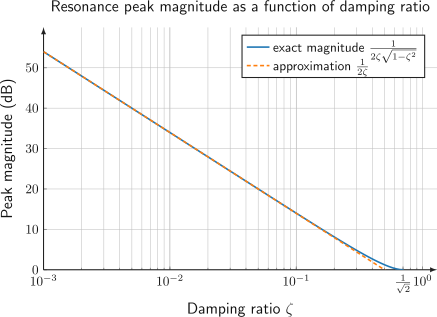
For very small ζ, the peak gain becomes very large, which is why we say that the system is “resonant”. In such cases, a useful approximation is to set ζ2≈0 in the denominator, which gives M(ωr)≈2ζ1. Remember that to read this on a Bode plot, you need to convert this value of M(ωr) to decibels! Here is a plot showing the peak size and its approximation as a function of ζ:
Figure 6:Resonance peak magnitude as a function of damping ratio ζ. We observe that the approximation is quite good for ζ<0.3.
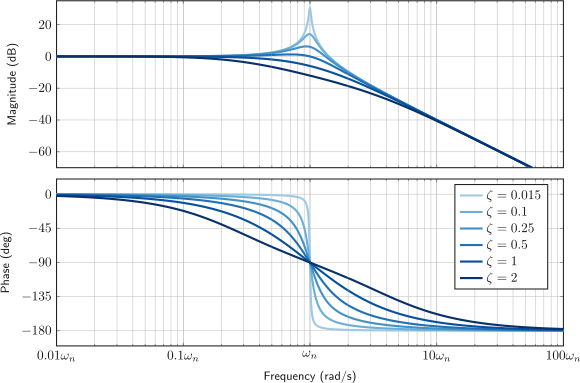
Just like the first-order case, the second-order case also exhibits point symmetry about the corner frequency. The main difference is that the transition between the low and high-frequency behavior gets steeper as ζ gets smaller. We wil see this in the Bode sketch below.
We can sketch the Bode magnitude by plotting the two asymptotes (low frequency constant and high-frequency slope) similarly to how we did for the first-order system, remembering that the roll-off is now -40 dB/decade instead of -20 dB/decade. For the resonance peak, as covered above:
If ζ<21≈0.707, there will be a peak. As ζ→0, the peak becomes pronounced, growing roughly like 2ζ1, and occurring at a frequency slightly before the corner frequency ωn.
If ζ≥21, there is no peak and the magnitude plot looks more like that of a first-order system. The larger ζ is, the more flat the plot.
For the phase plot, the shape is a similar point-symmetric S-curve to the first-order case, but the curve goes from 0° to -180° instead of -90°.
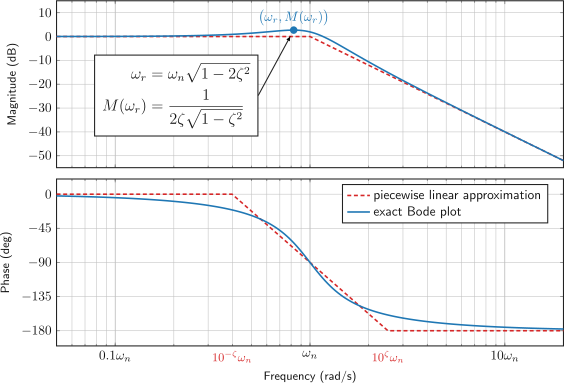
The transition region gets steeper as ζ gets smaller. You can approximate it as three straight lines like in the first-order case, but this time the middle segment should range ±ζ decades around the corner frequency ωn instead of ±1 decade. Here is an example for ζ=0.4:
Figure 7:Bode plot of a second-order system with ζ=0.4. The asymptotes are shown in dashed lines, while the true plot is shown in solid lines.
The dashed guidelines break at ±ζ decades around the corner frequency ωn, which means that the bend occurs ±0.4 fraction of the distance to the next decade. For the magnitude plot, the two asymptotes always meet at ωn regardless of ζ, but the resonance peak (if it exists) occurs at ωr, which is slightly before ωn.
Here is what happens for different values of ζ (dashed lines removed for clarity).
Figure 8:Bode plot of a second-order system G(s)=s2+2ζωns+ωn2ωn2 for different values of ζ.
The interactive demonstration below shows the frequency response of a second-order mass-spring-damper system. You can adjust m, k, and b and the derived quantities ωn and ζ are displayed. As with the first-order demo, you can change the input frequency and observe the output. Notice that as you increase the input frequency, the magnitude first increases as we approach resonance, and then decreases as we move past it. Phase lag also increases with frequency, up to 180°. Try decreasing the damping b to see how the resonance peak becomes more pronounced and the phase transition gets steeper.
The transfer function of the system is G(s)=s2+s+41. This is a second-order system with gain K=0.25, ωn=2, and ζ=0.25. The frequency response is G(jω)=(jω)2+jω+41=4−ω2+jω1.
The magnitude is M=0.32+(−0.1)2=0.1≈0.316, and the phase is ϕ=atan(0.3−0.1)≈−18.4°. Therefore, M≈0.316 and ϕ≈−18.4°
The frequency that produces the largest value of M is the resonance frequency ωr=ωn1−2ζ2=21−2(0.25)2=20.875≈1.871 rad/s. The corresponding peak gain is
the characteristic shape of a second-order system with a resonance peak.
So the plot fits the shape of a second-order system.
The DC gain is -20 dB, which corresponds to a magnitude of 0.1. The corner frequency is roughly at ω=3 rad/s, and the peak height is approximately 6 dB above the DC gain, which corresponds to a peak magnitude 2. Using the approximation M(ωr)≈2ζ1≈2, we conclude that ζ≈0.25. Combining these facts, we can estimate the transfer function as