First-order case studies
Before we dive into the case studies, let’s review first-order systems. We saw that the canonical transfer function of a first-order system is given by
Any stable first-order system can be put in this form. The DC gain tells us the steady-state output in response to a unit step input, and the time constant tells us how quickly the system responds to changes in the input. Specifically, the settling time is .
Pole-zero plots
Recall the definition of poles and zeros. The poles of a system are the values of that make the denominator of the transfer function zero, and the zeros are the values of that make the numerator zero. Since poles and zeros are complex numbers in general, we can plot them on the complex plane. The poles are typically denoted by “x” and the zeros by “o”. For example,
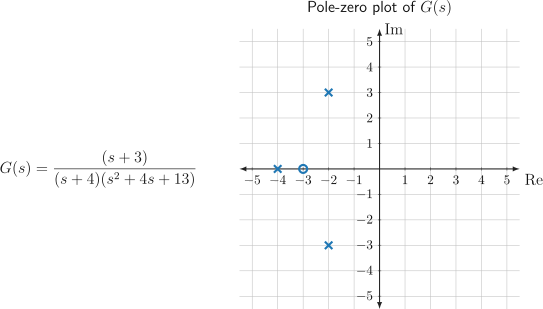
Figure 1:Transfer function and associated pole-zero plot. The poles are located at and , and the zero is located at .
Remember from our definition of stability that a system is stable if all of its poles have negative real part. On the diagram above, this is the region to the left of the imaginary axis, also called the left-half plane (LHP). A system is unstable if any of its poles are in the right-half plane (RHP). The zeros of a system do not affect stability; they can be in the LHP, RHP, or on the imaginary axis.
For a first-order system, there is only one pole and no zeros. The pole is located at , which is always in the LHP since , and therefore stable. The distance of the pole from the imaginary axis (i.e., the real part of the pole) determines how quickly the system responds to changes in the input. The closer the pole is to the imaginary axis, the slower the response; the farther away it is, the faster the response.
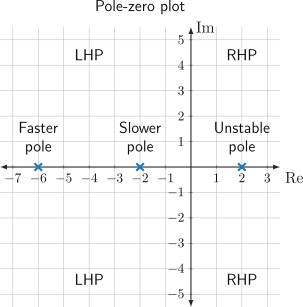
Figure 2:Possible pole locations on a pole-zero plot. The farther left in the left-half plane (LHP), the faster the pole. The closer to the imaginary axis, the slower the pole. Poles in the right-half plane (RHP) are unstable.
As we progress through the course, we will see how the location of poles and zeros on the complex plane affects the performance of more complex systems.
RC circuit
Consider the RC circuit illustrated below.
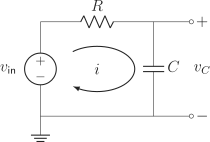
Figure 3:RC circuit with input voltage , output voltage , current , resistance , and capacitance . This will charge the capacitor when steps up.
The ODE relating the input voltage to the capacitor voltage is given by:
This is a first-order ODE with and . Initially, all voltages are zero.
Charging the capacitor
At time , we connect a 1 V battery battery, which acts like a step input . Using the calculation we did in the previous section, we can find the voltage across the capacitor as a function of time, which is Eq. (29):
The capacitor voltage will rise from 0 V to 1 V, with a time constant of . After a time of , the capacitor voltage will be within of its final value of 1 V.
Discharging the capacitor
With the capacitor charged up to V, let’s see what happens if we step the battery down to V. This is equivalent to replacing the battery by a short circuit, and we obtain the figure below.
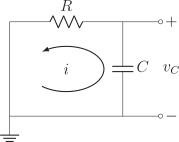
Figure 4:RC circuit from Figure 3 with the battery stepped down (). This will discharge the capacitor through the resistor.
Let’s solve the problem using the ODE. The ODE is the same as before, but now the input voltage is zero and we have an initial condition:
Taking Laplace transforms of both sides, we obtain
Solving for and substituting the initial condition, we get
Taking the inverse Laplace transform, we find
Comparing this equation to the charging case (3), we now have a decaying exponential instead of a rising exponential, but the time constant is still . After ms, the capacitor voltage will be within of its final value of V, about V in this case.
DC motor
Let’s consider a more complex example: a small hobby DC motor. Here are the parameters:
Table 1:DC motor parameters
| Parameter | Name | Value |
|---|---|---|
| Resistance of motor windings | Ω | |
| Inductance of motor windings | mH | |
| Motor constant | Nm/A | |
| Moment of inertia of rotor | kg m | |
| Viscous friction coefficient | Nms/rad |
Step response
We previously derived the ODE for the DC motor, which is given by
Let’s assume zero load torque and zero initial conditions. Taking Laplace transforms, we can find the transfer function from input voltage to angular velocity:
Now let’s substitute in the numerical values for the parameters:
Let’s divide the numerator and denominator by to clean things up a bit:
This is not a first-order system, but a quick calculation of the discriminant of the denominator: reveals that it is positive, meaning that there are actually two real poles. We can calculate them using the quadratic formula:
Therefore we can factor our transfer function, and find a partial fraction expansion using the cover-up method. The result is
In the last step, we put each term of the PFE in canonical form. Now we can apply superposition: Because , the step response of the motor is the sum of the step responses of and .
The first term has a time constant of ms and a DC gain of .
The second term has a time constant of ms and a DC gain of .
The first term has a dominant effect due to its larger DC gain. It also has a much slower time constant, meaning that it will be the main contributor to the step response. Here is what the step response looks like:
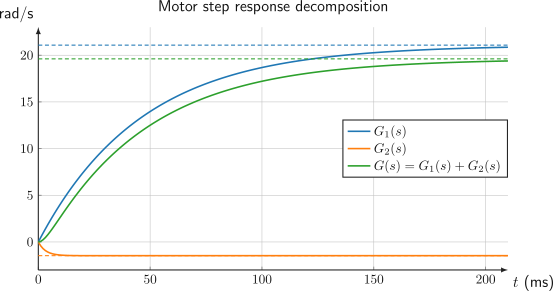
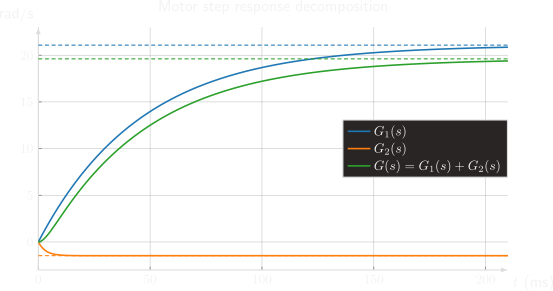
Figure 5:DC motor step response decomposition. The motor step response is the sum of the step responses of and . The first term dominates the response due to its larger DC gain and slower time constant.
We can see in Figure 5 that the main effect of on the total response is to cause a small initial dip in the response, and eventually a smaller steady-state value.
Ideal motor approximation
In the ideal motor approximation, we have and , which means that the transfer function simplifies to
So a single first-order term with a time constant of 50 ms and a DC gain of 20. This is a good approximation to the actual motor, since the time constant of is close to 50 ms and its DC gain is close to 20.
Pole-zero plot
The pole-zero plot of the motor is shown below.
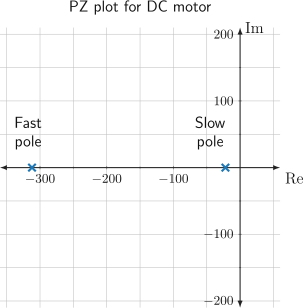
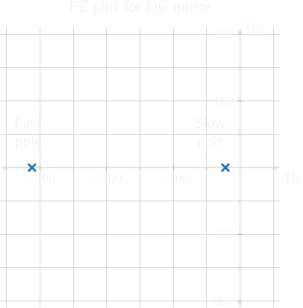
Figure 6:Pole-zero plot of the DC motor. The poles are located at (slow pole) and (fast pole). There are no zeros.
We saw that the bulk of the step response was due to the slow pole at . The fast pole at has a much smaller effect on the step response, since it has a much smaller DC gain and a much faster time constant.
It turns out that this phenomenon of dominant poles is quite common in practice. Later, we will see how to use this idea to simplify the analysis of complex systems by approximating them as simpler systems.
Test your knowledge
Solution to Exercise 1 #
Button pressed down. In this case, the current is split: goes through the LED and into the capacitor. We can write down constitutive equations for each element using KCL for node :
We care about the current , so let’s eliminate and . Substituting the last equation into the first to eliminate , we get
Now substitute the second equation into the first to eliminate and simplify:
As a differential equation, this is:
This is a first-order ODE with time constant and DC gain . Therefore, the settling time for the LED to fade on is
Button released. In this case, the current through the LED is the same as the current discharging the capacitor. The circuit becomes a simple RC circuit identical to the one we analyzed in Figure 4, except that the resistance is now instead of . The ODE for this case is
This has time constant . However, we care about the current, not the capacitor voltage. It turns out that the current also has the same time constant! To see why, we can solve for the current, which is . Substituting this into the ODE, we get the same ODE:
Therefore, the settling time for the LED to fade off is
In reality, LEDs typically have a voltage drop of around 1.7-2.0 Volts over a wide range of current flows.