Skip to article frontmatterSkip to article content
Site not loading correctly?

This may be due to an incorrect BASE_URL configuration. See the MyST Documentation for reference.

First-order systems

First-order systems are the simplest type of dynamic system, and they provide a foundation for understanding more complex systems. In this chapter, we will explore the properties of first-order systems, how to analyze their behavior, and how to find their responses to various inputs.

Examples

The system order refers to the highest power of the derivative in the system’s differential equation. So a first-order system has only one derivative. There are many such examples across different domains of science and engineering.

Each of the examples above has a single “storage” element that accumulates or depletes a quantity over time (e.g., mass, charge, energy, population). In each case, the rate of change of that quantity depends linearly on the current value of the quantity and possibly on an external input. If there were additional storage elements (e.g., a spring in the mass-damper system, an inductor in the RC circuit, an additional species in the chemical reaction), the system would be of higher order.

Transfer function and canonical form

All the examples above have a similar mathematical structure. They can all be modeled as first-order linear ODE relating an output variable y(t)y(t) to an input variable u(t)u(t):

ay˙(t)+by(t)=cu(t)a \dot y(t) + b y(t) = c u(t)

where aa, bb, and cc are constants that depend on the specific system. The system therefore has a transfer function of the form:

G(s)=Y(s)U(s)=cas+b=cbabs+1G(s) = \frac{Y(s)}{U(s)} = \frac{c}{a s + b} = \frac{\frac{c}{b}}{\frac{a}{b} s + 1}

Renaming τ=ab\tau = \frac{a}{b} and K=cbK = \frac{c}{b} gives the canonical form of a first-order system:

G(s)=Kτs+1\boxed{G(s) = \frac{K}{\tau s + 1}}

Returning to the time domain, the corresponding canonical-form ODE is:

τy˙(t)+y(t)=Ku(t)\boxed{\tau \dot y(t) + y(t) = K u(t)}

The two parameters τ\tau and KK have names:

Example: cruise control

Consider the cruise control example from the linearization chapter. The linearized equations of motion are:

mδv˙+2cv0δv=δFm \delta \dot v + 2 c v_0\, \delta v = \delta F

To put this in canonical form, we must have a coefficient of 1 in front of δv\delta v. Dividing through by 2cv02 c v_0 gives:

m2cv0δv˙+δv=12cv0δF\frac{m}{2 c v_0} \delta \dot v + \delta v = \frac{1}{2 c v_0} \delta F

Therefore the time constant and DC gain of the cruise control system are:

τ=m2cv0,K=12cv0\boxed{\tau = \frac{m}{2 c v_0}, \quad K = \frac{1}{2 c v_0}}

Example: ideal DC motor

When the load torque TLT_L is zero, the ideal DC motor model has transfer function:

G(s)=Ω(s)Vin(s)=KmJRs+Km2G(s) = \frac{\Omega(s)}{V_{\textsf{in}}(s)} = \frac{K_m}{JR s + K_m^2}

where KmK_m is the motor constant. We need the constant term in the denominator to be 1, so we divide numerator and denominator by Km2K_m^2:

G(s)=KmKm2JRKm2s+1=1KmJRKm2s+1G(s) = \frac{\frac{K_m}{K_m^2}}{\frac{JR}{K_m^2} s + 1} = \frac{\frac{1}{K_m}}{\frac{JR}{K_m^2} s + 1}

Therefore, the time constant and DC gain of the ideal DC motor are:

τ=JRKm2,K=1Km\boxed{\tau = \frac{JR}{K_m^2}, \quad K = \frac{1}{K_m}}

We can check that the units of τ\tau are correct:

[τ]=[J][R][Km]2=kgm2Ω(Nm/A)2=kgA2ΩN2=kgA2ΩNkgm/s2=A2ΩNm/ss=s\begin{aligned} [\tau] &= \frac{[J][R]}{[K_m]^2} = \frac{\text{kg}\cdot\text{m}^2 \cdot \Omega}{(\text{N}\cdot\text{m}/\text{A})^2} = \frac{\text{kg}\cdot \text{A}^2 \cdot \Omega }{\text{N}^2} \\ &= \frac{\text{kg}\cdot \text{A}^2 \cdot \Omega }{\text{N} \cdot \text{kg}\cdot \text{m}/\text{s}^2} = \frac{\text{A}^2 \cdot \Omega}{\text{N}\cdot \text{m}/\text{s}} \cdot \text{s} = \text{s} \end{aligned}

where the last step follows because A2Ω=Nm/s=W\text{A}^2 \cdot \Omega = \text{N}\cdot\text{m}/\text{s} = \text{W} are all units of power.

Step response

Let’s start with how a first-order system responds to a unit step input. The Laplace transform of a unit step input is U(s)=1sU(s) = \frac{1}{s}, so the output in the Laplace domain is:

Y(s)=G(s)U(s)=Kτs+11s=Ks(τs+1)Y(s) = G(s) U(s) = \frac{K}{\tau s + 1} \cdot \frac{1}{s} = \frac{K}{s(\tau s + 1)}

To find the time-domain response, we can use partial fraction expansion and take the inverse Laplace transform.

Ks(τs+1)=K/τs(s+1/τ)=As+Bs+1/τ\frac{K}{s(\tau s + 1)} = \frac{K/\tau}{s(s+1/\tau)} = \frac{A}{s} + \frac{B}{s + 1/\tau}

Solving for AA and BB gives A=KA = K and B=KB = -K. Therefore:

Y(s)=KsKs+1/τY(s) = \frac{K}{s} - \frac{K}{s + 1/\tau}

Taking the inverse Laplace transform gives the step response:

y(t)=K(1et/τ)\boxed{y(t) = K \bigl(1 - e^{-t/\tau}\bigr)}

Since tt only appears in the combination t/τt/\tau, we can think of tt as being measured in units of τ\tau. The output is also scaled by KK, so we can make a single table that tells us how all first-order systems respond to a unit step input:

Step response of a first-order system to a unit step input

tty(t)y(t)
1τ1\,\tau0.6321K0.6321\,K
2τ2\,\tau0.8647K0.8647\,K
3τ3\,\tau0.9502K0.9502\,K
4τ4\,\tau0.9817K0.9817\,K
5τ5\,\tau0.9933K0.9933\,K
\infty1.0000K1.0000\,K

We can see that the output starts at 0 and asymptotically approaches KK as tt \to \infty. The time constant τ\tau determines how quickly the output approaches its steady-state value KK. After one time constant (t=τt = \tau), the output has reached about 63%63\% of its final value. After five time constants (t=5τt = 5\tau), the output is very close to its final value, at about 99%99\%.

We can also look at the slope of the step response at t=0t=0. The slope is given by the derivative of y(t)y(t) at t=0t=0:

y˙(t)=Kτet/τ    y˙(0)=Kτ\dot y(t) = \frac{K}{\tau} e^{-t/\tau} \quad\implies\quad \dot y(0) = \frac{K}{\tau}

We can use this information to sketch the step response of a first-order system without doing any calculations.

First-order step response. The dashed lines show tangent lines to the curve. The curve always points towards its destination (y=K) at one time constant into the future.

Figure 1:First-order step response. The dashed lines show tangent lines to the curve. The curve always points towards its destination (y=Ky=K) at one time constant into the future.

Settling time

The step response of a first-order system never actually reaches its final value KK, but it gets arbitrarily close as time goes on. In practice, we define a settling time as the time it takes for the output to get within a certain percentage of its final value and stay there.

Settling time is an important performance metric for control systems. It tells us how quickly the system responds to changes in the input and reaches its desired output. A smaller settling time means a faster response, which is often desirable in control applications.

Impulse response

We can calculate the impulse response in a similar way to the step response. The Laplace transform of a unit impulse input is U(s)=1U(s) = 1, so the output in the Laplace domain is:

Y(s)=G(s)U(s)=Kτs+1=K/τs+1/τY(s) = G(s) U(s) = \frac{K}{\tau s + 1} = \frac{K/\tau}{s + 1/\tau}

Taking the inverse Laplace transform gives the impulse response:

y(t)=Kτet/τ\boxed{y(t) = \frac{K}{\tau} e^{-t/\tau}}

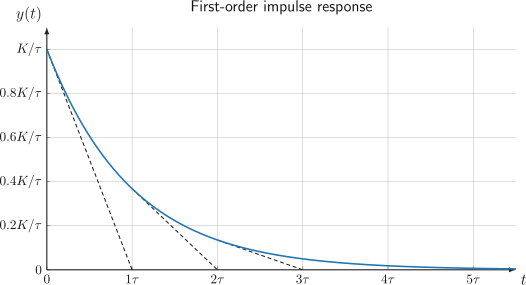
This is a decaying exponential with the same time constant τ\tau as the step response, but scaled by K/τK/\tau instead of KK. This means the settling time is the same as before. The impulse response starts at K/τK/\tau at t=0t=0 and decays to 0 as tt \to \infty. Here is a plot of the impulse response:

First-order impulse response. The dashed lines show tangent lines to the curve. The curve always points towards its destination (y=0) at one time constant into the future.

Figure 2:First-order impulse response. The dashed lines show tangent lines to the curve. The curve always points towards its destination (y=0y=0) at one time constant into the future.

Physical interpretation

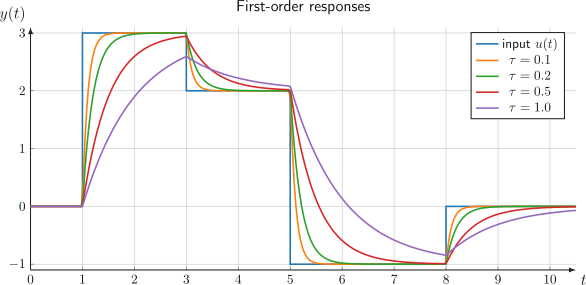
When inputs are more complicated than steps or impulses, the response of a first-order system can be more complicated. However, the key feature of a first-order system is that it always tries to “catch up” to the input, but always lags behind. The output will always point towards where the input will be one time constant into the future.

Here is an illustration of this behavior for a more complicated input, and different choices of τ\tau. We picked K=1K=1 for simplicity, but the same behavior would hold for any value of KK (just scale the output by KK).

First-order responses (with K=1 and different \tau values) to the same input. The system is always trying to “catch up” to the input, but always lags behind. Smaller \tau values correspond to faster responses.

Figure 3:First-order responses (with K=1K=1 and different τ\tau values) to the same input. The system is always trying to “catch up” to the input, but always lags behind. Smaller τ\tau values correspond to faster responses.

Another interpretation of a first-order response is that it smooths out the input. The time constant τ\tau determines how quickly the system can respond to changes in the input. A smaller τ\tau means a faster response and less smoothing, while a larger τ\tau means a slower response and more smoothing. A more precise term for this is that first-order systems act as low-pass filters, which we will explore in more detail in later chapters.

Ramp response

As a final example, let’s look at the response of a first-order system to a ramp input:

u(t)=tH(t)={tt00t<0u(t) = t \cdot H(t) = \begin{cases} t & t \geq 0 \\ 0 & t < 0 \end{cases}

The Laplace transform of a ramp input is U(s)=1s2U(s) = \frac{1}{s^2}, so the output in the Laplace domain is:

Y(s)=G(s)U(s)=Kτs+11s2=Ks2(τs+1)Y(s) = G(s) U(s) = \frac{K}{\tau s + 1} \cdot \frac{1}{s^2} = \frac{K}{s^2(\tau s + 1)}

The partial fraction decomposition is:

Ks2(τs+1)=K/τs2(s+1/τ)=As+Bs2+Cs+1/τ\frac{K}{s^2(\tau s + 1)} = \frac{K/\tau}{s^2 (s + 1/\tau)} = \frac{A}{s} + \frac{B}{s^2} + \frac{C}{s + 1/\tau}

Solving for AA, BB, and CC gives A=KA = K, B=KτB = K \tau, and C=KC = -K. Therefore:

Y(s)=Ks+Kτs2Ks+1/τY(s) = \frac{K}{s} + \frac{K \tau}{s^2} - \frac{K}{s + 1/\tau}

Taking the inverse Laplace transform gives the ramp response:

y(t)=Kτ(tτ(1et/τ))\boxed{y(t) = K\tau \left( \frac{t}{\tau} - \bigl(1 - e^{-t/\tau}\bigr) \right)}

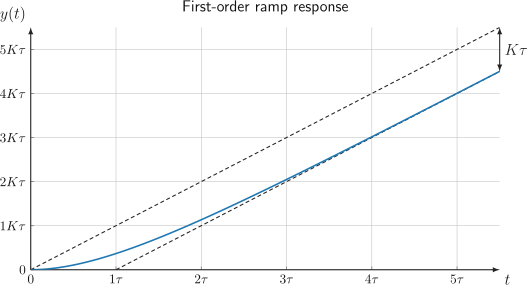
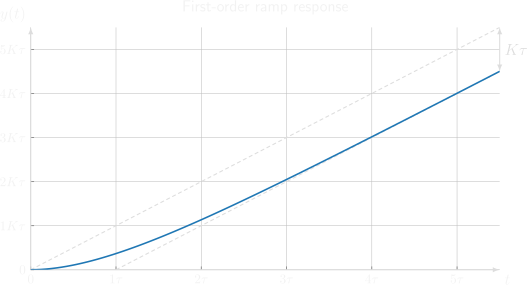
Here is a plot of the ramp response:

First-order ramp response. The system is trying to catch up to the ramp (top dashed line), but always lags behind, eventually settling to a constant offset of K\tau.

Figure 4:First-order ramp response. The system is trying to catch up to the ramp (top dashed line), but always lags behind, eventually settling to a constant offset of KτK\tau.

Unlike the step and impulse responses, the ramp response does not settle to a constant value, since the input is continuously increasing. Instead, it does its best to catch up but ends up settling to a constant offset from the input ramp. The output lags behind the input by a constant amount KτK\tau. This lag is known as the steady-state error of the system in response to a ramp input.


Test your knowledge

Solution to Exercise 1 #

We transform each system into canonical form τy˙+y=Ku\tau \dot y + y = K u by rescaling appropriatelyand we identify τ\tau and KK:

Systemτ\tauKK
Mass–dampermb\frac{m}{b}1b\frac{1}{b}
RC circuitRCRC11
Ideal DC motorJRKm2\frac{JR}{K_m^2}1Km\frac{1}{K_m}
Newton cooling1k\frac{1}{k}TT_\infty
Solution to Exercise 2 #

Since the canonical form is G(s)=Kτs+1G(s) = \frac{K}{\tau s + 1}, we can identify KK and τ\tau for each motor by comparing to the given transfer functions:

G1(s)=200.2s+1,τ1=0.2K1=20G2(s)=300s+10=300.1s+1,τ2=0.1K2=30G3(s)=800.1s+2=400.05s+1,τ3=0.05K3=40\begin{aligned} G_1(s) &= \frac{20}{0.2 s + 1}, & \tau_1 &= 0.2 & K_1 &= 20 \\ G_2(s) &= \frac{300}{s + 10} = \frac{30}{0.1 s + 1}, & \tau_2 &= 0.1 & K_2 &= 30 \\ G_3(s) &= \frac{80}{0.1 s + 2} = \frac{40}{0.05 s + 1}, & \tau_3 &= 0.05 & K_3 &= 40 \end{aligned}

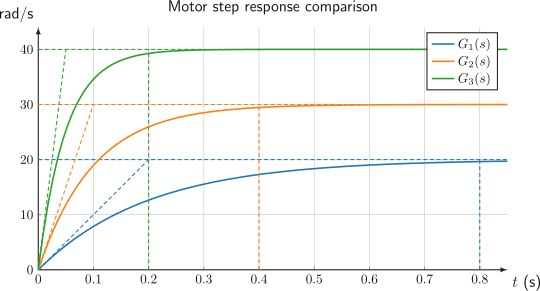
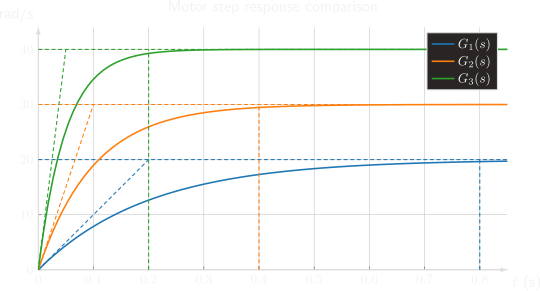
The slowest time constant is τ1=0.2\tau_1 = 0.2, so this motor will take 4τ1=0.84\tau_1 = 0.8 seconds to settle to its final value. The largest DC gain is K3=40K_3 = 40, so this motor will have the largest final value. We can use this information to make the scales on our plot. The result is shown below:

First-order step response comparison. Step responses of the three motors from . Vertical dashed lines indicated the settling time 4\tau for each motor. The slowest motor (blue) takes the longest to settle and hals the smallest final value, while the fastest motor (green) settles the quickest to the largest final value.
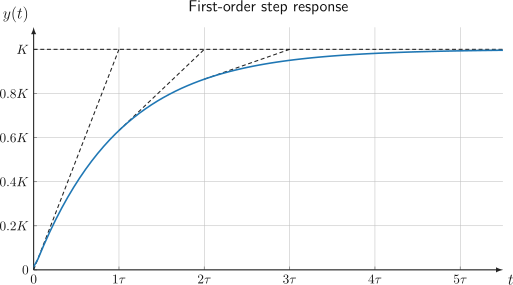
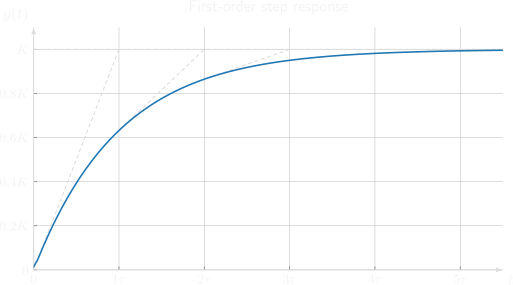
Figure 5:First-order step response comparison. Step responses of the three motors from Exercise 2. Vertical dashed lines indicated the settling time 4τ4\tau for each motor. The slowest motor (blue) takes the longest to settle and hals the smallest final value, while the fastest motor (green) settles the quickest to the largest final value.