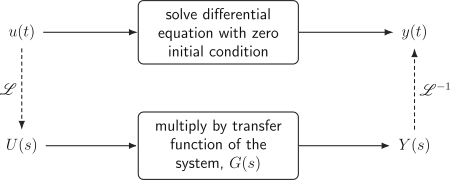
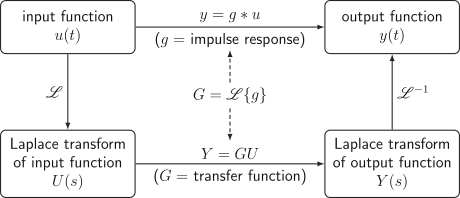
So far, we have represented linear time-invariant (LTI) systems in two different ways. First, as ordinary differential equations (ODEs), and second, as transfer functions (TFs). These representations are related via the Laplace transform and summarized in the following diagram, which we derived in the section on Laplace transforms.
Figure 1:Diagram comparing time-domain and s-domain paths for solving a system.
In this section, we will derive a third representation for LTI systems: the impulse response. This representation lives entirely in the time domain, and it allows us to compute the output of an LTI system for any input signal without ever leaving the time domain. The impulse response is based on the pulse decomposition from the section on Linear systems, where we argued that any input signal can be approximated a sum of scaled and shifted pulses. We will now take this idea to its logical extreme by considering inputs that are infinitely narrow pulses, known as impulses, and obtain an exact representation for the output of an LTI system in terms of its impulse response.
This motivates us to define the impulse functionδ(t) as a limiting version of δh(t) as h approaches zero. It does not make sense to think of δ(t) as an ordinary function, since we would have to write a definition that looks like
which doesn’t make much sense. Instead, we will define δ(t) based on how it behaves when we integrate it. Although we call it a “function,” δ(t) is not a traditional function. Mathematically, it is known as a distribution.
We saw earlier that if we use the unit step (Heaviside) function H(t) as an input to an LTI system, the output we obtain is called the step response of the system.
Similarly, if we apply an impulse input δ(t) to an LTI system, the output we obtain is called the impulse response of the system.
Secondly, the impulse function and the unit step function are related by differentiation and integration, which means the impulse response and step response of an LTI system are also related in the same way.
Solution:
Remember that for input u(t) and output y(t), we have Y(s)=G(s)U(s), where G(s) is the transfer function of the system. To find the output, we compute the inverse Laplace transform: y(t)=L−1{G(s)U(s)}. Let’s start by finding the transfer function. Taking Laplace transforms of both sides of the ODE (with zero initial conditions),
We used Table 1 for the inverse Laplace transforms. Here we relied on transforms that are already in our table; the general machinery for inverting arbitrary rational transfer functions (partial fraction expansion and inverse Laplace transforms) is developed in the next two sections. Finally, let’s verify that the impulse response is the derivative of the step response:
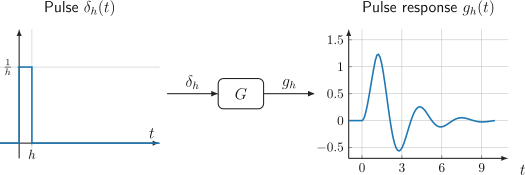
Let δh(t) be the pulse function defined earlier, and let gh(t) be response of our system G corresponding to this input. We can represent this relationship as the following diagram.
Figure 4:Diagram showing the response of a system G to a pulse input δh(t), resulting in output gh(t).
Suppose our input signal is u(t). We will approximate it as a sum of shifted and scaled pulses by assuming u(t) is piecewise-constant over intervals of length h. This allows us to write:
The reason for the extra factor of h in the sum is that each pulse has height h1, so multiplying by h gives the correct amplitude for the piecewise-constant approximation of u(t). By superposition, we can approximate the output y(t) as:
In the limit h→0, the pulse function δh(t) approaches the impulse function δ(t), and the response gh(t) approaches the impulse response g(t). Therefore, taking the limit as h→0 in equations (17) and (18) gives:
This follows from the definition of the integral as a limit of Riemann sums. The reason the integral only goes up to t rather than ∞ is that g(t)=0 whenever t<0 due to causality.
This sort of integral is known as a convolution integral, and we denote it using the convolution operator ∗. Thus, we can write the output of an LTI system in response to an arbitrary input u(t) as:
The convolution operation satisfies a remarkable property: it is commutative. In other words, we can swap the order of the functions being convolved without changing the result:
Since convolution produces the output of a system given its impulse response, but the Laplace transform of the output is the product of the Laplace transforms of the input and the transfer function, we can relate convolution in the time domain to multiplication in the Laplace domain. For any two functions f(t) and g(t), we have:
The impulse response represents the position of the satellite after receiving an instantaneous “kick” from the thruster. The kick imparts a velocity to the satellite. Since there are no other forces acting on the satellite, it continues to move at this constant velocity, causing its position to increase linearly over time. This is why g(t)=t.
The step response is the inverse Laplace transform of the transfer function multiplied by s1:
The step response represents the position of the satellite when the thruster is turned on and provides a constant force. This constant force results in a constant acceleration, causing the satellite’s velocity to increase linearly over time. As a result, the position increases quadratically over time, which is why h(t)=2t2.