FVT and high-order systems
In recent sections, we studied the transient response of first and second-order systems in detail. However, many systems of interest are higher-order, meaning that their transfer functions have order greater than 2. In this section, we will discuss how to analyze the transient response of higher-order systems and introduce the concept of dominant poles.
Before we can analyze higher-order systems, we need to introduce a powerful tool called the final value theorem, which allows us to determine the steady-state behavior of a system (of any order) directly from its transfer function.
Final value theorem
The final value theorem (FVT) is a powerful tool that allows us to determine the steady-state behavior of a system directly from its transfer function.
Sketch of proof
The rough steps are as follows:
The validity of the various steps (convergence of integrals, existence of limits, etc.) is guaranteed by the assumptions of the theorem.
DC gain
The most common way to apply the FVT is find the steady-state response of a system to a step input (also known as the DC gain). For example, if we have a system with transfer function and we apply a unit step input , then the output in the Laplace domain is:
Therefore, the steady-state response / DC gain is:
So the DC gain is simply the value of the transfer function at . This confirms what we stated earlier when we first defined DC gain. Let’s verify this property on a couple familiar examples.
Example: canonical forms
For a first-order or second-order system in canonical form:
We can apply the FVT to find the DC gain. In both cases, we have .
Example: first-order with P-control
Recall the closed-loop transfer function of a first-order system in unity feedback with proportional controller :
Using the FVT, the steady-state response is:
which is what we found earlier by using the canonical form.
Example: second-order with P-control
Recall the transfer function of a second-order system in unity feedback with proportional gain :
Using the FVT, the steady-state response is:
Again, this matches what we found earlier by using the canonical form.
There is an analogous result to the FVT called the Initial Value Theorem (IVT) that applies to the limit as instead of . This isn’t as useful for us, but we include it for completeness:
Sketch of proof
Higher-order systems
Any transfer function can be expressed as a sum of first-order and second-order terms via PFE. By superposition, the response to any input is therefore the sum of the responses of these simpler terms. Since we have already analyzed first and second-order systems in detail, we can in principle analyze the transient response of any system!
That being said, the transient response of higher-order systems can be quite complicated, and high-order systems often behave like lower-order systems in practice. For example, we saw that a DC motor has a second-order transfer function, but its step response looks very much like that of a first-order system. We will now study this phenomenon in more detail.
Example: third-order system
Consider the following third-order system and its PFE:
We placed each term in canonical form to make it easier to analyze. The step response of this system is the sum of the step responses of each term. Just like with the DC motor, the first pole is both the slowest and has the largest DC gain, so the first term dominates the transient response. The second and third terms are much faster and have much smaller DC gains, so they only contribute small “bumps” to the transient response at early times.
We say that the pole at is a dominant pole of the system, because it dominates the transient response. The poles at and are non-dominant poles because they do not significantly affect the transient response.
We can approximate the response of by just keeping the dominant pole and ignoring the non-dominant poles. However, we have to do this carefully. If we just keep the first term, we get , which has a DC gain of 1000. However, the original system has a DC gain of , so this approximation is not very good. Instead, we can keep the first term but reduce its gain to match the DC gain of the original system:
This approximation has the same dominant pole as the original system and the same DC gain, so it captures the transient response much better. In fact, the step response of is almost indistinguishable from that of .
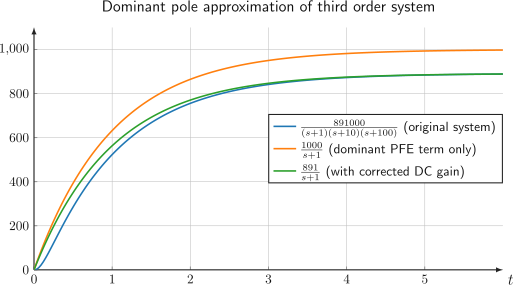
Figure 1:The plot above shows the step response of the original system , the approximation that keeps only the dominant pole but corrects the DC gain, and the approximation that keeps only the dominant pole without correcting the DC gain. We can see that the approximation with corrected DC gain is much better than the one without.
General procedure
Given a transfer function , we can find a reduced-order model that approximates the transient response of by keeping only the dominant poles. Here are the steps.
Example: DC motor revisited
Recall the DC motor case study from earlier. We found that the DC motor had a transfer function
The poles are at and . The pole at is about 14 times closer to the imaginary axis than the pole at , so it is a dominant pole. Therefore, we can approximate the transient response of the DC motor by keeping only the dominant pole. Our reduced-order model is of the form
To find the gain , we can use the FVT to match the DC gain of the original system:
We can now plot the original system and its reduced-order model to see how well the approximation works.
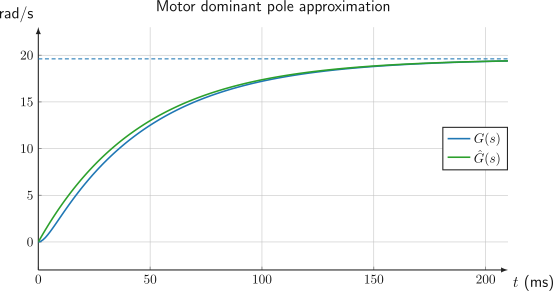
Figure 2:Step response of the original DC motor system and its reduced-order model that keeps only the dominant pole. The reduced-order model captures the transient response of the original system very well, even though it is a much simpler first-order system.
Example: dominant complex poles
Let’s consider the following system:
The poles are at and . We can conclude the following:
If , then the pole at is dominant, and the transient response looks like that of a first-order system. Specifically, the response should look like that of the system
If , then the poles at are dominant, and the transient response looks like that of an underdamped second-order system. Specifically, the response should look like that of the system
If , then there are no dominant poles, and the transient response is complicated and cannot be approximated by a lower-order model.
Let’s verify that this holds true by plotting the step responses of , , and for different values of .
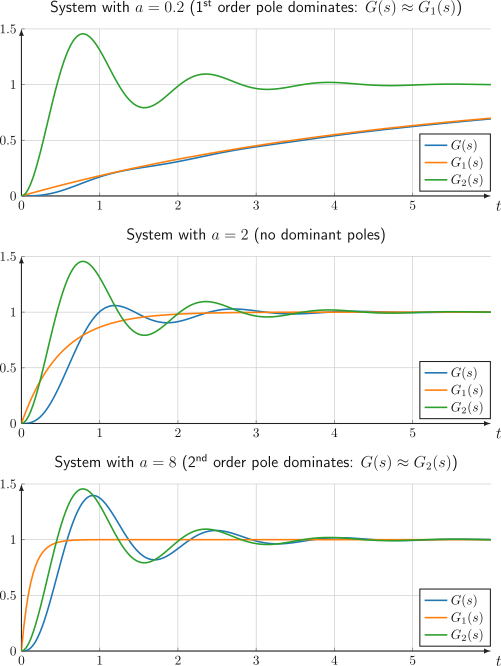
Figure 3:The plot above shows the step response of from Eq. (19) together with the dominant pole approximation of the first-order pole and the second-order pole for different values of . When is small, the response of looks like that of , and when is large, the response of looks like that of . When is in between, the response of does not look like either or , which confirms our analysis.
Test your knowledge
Solution to Exercise 1 #
The poles are at , , and . The pole at is 10 times closer to the imaginary axis than the pole at , so it is a dominant pole. The original system has DC gain . Therefore, the reduced-order model is
The poles are at , , and . The poles at are about 20 times closer to the imaginary axis than the poles at , so they are dominant poles. The original system has DC gain . Therefore, the reduced-order model is
The poles are at , , and . The poles are all about equally close to the imaginary axis, so there are no dominant poles. Therefore, we cannot find a reduced-order model that approximates the transient response of the system.