In this section, we will review the Laplace transform , a technique often covered in introductory differential equations courses. There are two reasons for why they are a relevant topic for controls:
LTI systems are precisely the systems whose differential equations can be solved using the method of Laplace transforms. Therefore, Laplace transforms will be our main tool for solving differential equations.
When dealing with control systems, it is often easier to work with the Laplace transforms of a signals rather their time-domain representations. This leads to simpler representations of LTI systems and easier manipulation of complex systems (interconnections of multiple LTI systems).
The Laplace transform is a transformation that converts a function of time f ( t ) f(t) f ( t ) into a function of “s s s ”, F ( s ) F(s) F ( s ) . As a matter of convention, we will use lower-case letters to denote functions of time and upper-case letters to denote the corresponding Laplace transform whenever possible. The definition is given by the integral:
F ( s ) = ∫ 0 ∞ e − s t f ( t ) d t F(s) = \int_0^\infty e^{-st}f(t)\,\dd t F ( s ) = ∫ 0 ∞ e − s t f ( t ) d t The Laplace transform is also denoted by the “script L” symbol L \Lap L . Different ways of saying that L \Lap L transforms f ( t ) f(t) f ( t ) to F ( s ) F(s) F ( s ) sometimes use functional notation:
f ⟶ L F , F = L { f } , F = L [ f ] . f \overset{\Lap}{\longrightarrow} F,
\qquad
F = \Lap\{f\},
\qquad
F = \Lap[f]. f ⟶ L F , F = L { f } , F = L [ f ] . Sometimes s s s or t t t is explicitly included to remind us of the variables:
F ( s ) = L { f } ( s ) , F ( s ) = L { f ( t ) } , F ( s ) = L { f ( t ) } ( s ) , F(s) = \Lap\{f\}(s),
\qquad
F(s) = \Lap\{f(t)\},
\qquad
F(s) = \Lap\{f(t)\}(s), F ( s ) = L { f } ( s ) , F ( s ) = L { f ( t )} , F ( s ) = L { f ( t )} ( s ) , or the corresponding variants using [ ⋅ ] [\cdot] [ ⋅ ] rather than { ⋅ } \{\cdot\} { ⋅ } .
The second notation is particularly strange, because the left-hand side depends on s s s while the right-hand side appears to depend on t t t . Nevertheless, it is common in engineering textbooks. All of the notations above mean the same thing; they are all equivalent to Eq. (1) .
The thing to remember is that when you perform an integral ∫ 0 ∞ ( … ) d t \int_0^\infty (\dots)\,\dd t ∫ 0 ∞ ( … ) d t , the result no longer depends on t t t . This is why the definition (1) makes sense. The t t t in the right-hand side is a dummy variable . The right-hand side is only a function of s s s .
Since Eq. (1) involves an infinite integral, it is possible that the integral will not converge. In fact, there will always be values of s s s for which the Laplace transform is undefined. This leads us to an important concept and convention.
Every Laplace transform has a region of convergence (ROC), which is a set of s s s for which the integral in Eq. (1) converges. We will not track the ROC explicitly. Instead, we’ll assume s s s is chosen in a way that makes the integral converge . This can typically be achieved by assuming s ≫ 0 s \gg 0 s ≫ 0 is sufficiently large.
A helpful way to think about convergence is this: the factor e − s t e^{-st} e − s t is an exponential damping term. If s s s is large enough, e − s t e^{-st} e − s t decays rapidly as t → ∞ t\to\infty t → ∞ , so it can “beat” the growth of many common signals f ( t ) f(t) f ( t ) and make the integral finite.
Bottom line: when we write F ( s ) F(s) F ( s ) what we really mean is “This is what the formula (1) produces when the integral converges”.
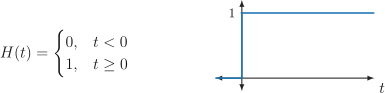
Example: Heaviside step function ¶ The unit step function, also known as the Heaviside step function, named after British mathematician Oliver Heaviside , is defined below.
The Heaviside step function is commonly denoted u ( t ) u(t) u ( t ) or H ( t ) H(t) H ( t ) . Both notations are problematic since u ( t ) u(t) u ( t ) is reserved for a generic system input and H ( t ) H(t) H ( t ) is an upper-case symbol, which is reserved for Laplace transforms. For this function in particular, we will make the exception and call it H ( t ) H(t) H ( t ) and its Laplace transform H ( s ) H(s) H ( s ) .
Applying the definition, we have:
H ( s ) = ∫ 0 ∞ e − s t H ( t ) d t = ∫ 0 ∞ e − s t d t = [ − 1 s e − s t ] t = 0 ∞ = 1 s H(s) = \int_0^\infty e^{-st} H(t) \,\dd t
= \int_0^\infty e^{-st}\,\dd t
=\left[ -\frac{1}{s}e^{-st} \right]_{t=0}^\infty = \frac{1}{s} H ( s ) = ∫ 0 ∞ e − s t H ( t ) d t = ∫ 0 ∞ e − s t d t = [ − s 1 e − s t ] t = 0 ∞ = s 1 In the last step, we picked an s s s that would make the limits finite. In this case, it means picking s > 0 s>0 s > 0 so that lim t → ∞ e − s t = 0 \lim_{t\to\infty} e^{-st} = 0 lim t → ∞ e − s t = 0 .
Example: Simple exponential ¶ Let’s consider f ( t ) = e − a t f(t) = e^{-at} f ( t ) = e − a t . Applying the definition (1) :
F ( s ) = ∫ 0 ∞ e − s t e − a t d t = ∫ 0 ∞ e − ( a + s ) t d t = [ − 1 s + a e − ( s + a ) t ] t = 0 ∞ = 1 s + a F(s) = \int_0^\infty e^{-st} e^{-at} \,\dd t
= \int_0^\infty e^{-(a+s)t}\,\dd t
=\left[ \frac{-1}{s+a}e^{-(s+a)t} \right]_{t=0}^\infty = \frac{1}{s+a} F ( s ) = ∫ 0 ∞ e − s t e − a t d t = ∫ 0 ∞ e − ( a + s ) t d t = [ s + a − 1 e − ( s + a ) t ] t = 0 ∞ = s + a 1 Linearity of Laplace ¶ The Laplace transform is a linear operator . The word linear means the same as in the context of systems: it satisfies additivity and homogeneity. The word operator means it is like a function, except instead of mapping numbers to numbers it maps signals to signals.
We can verify linearity by using the properties of the integral:
L { a f ( t ) + b g ( t ) } = ∫ 0 ∞ e − s t ( a f ( t ) + b g ( t ) ) d t = a ∫ 0 ∞ e − s t f ( t ) d t + b ∫ 0 ∞ e − s t g ( t ) d t = a F ( s ) + b G ( s ) \begin{aligned}
\Lap\{a f(t) + b g(t)\}
&= \int_0^\infty e^{-st}\bigl( a f(t) + b g(t) \bigr) \,\dd t \\
&= a \int_0^\infty e^{-st} f(t) \,\dd t + b \int_0^\infty e^{-st} g(t)\, \dd t \\
&= a F(s) + b G(s)
\end{aligned} L { a f ( t ) + b g ( t )} = ∫ 0 ∞ e − s t ( a f ( t ) + b g ( t ) ) d t = a ∫ 0 ∞ e − s t f ( t ) d t + b ∫ 0 ∞ e − s t g ( t ) d t = a F ( s ) + b G ( s ) We can use linearity to evaluate Laplace transforms of more complicated functions by breaking it up into simpler parts for which we already know the Laplace transform.
Example: More complicated exponential ¶ Let’s consider f ( t ) = 1 a ( 1 − e − a t ) f(t) = \frac{1}{a}(1-e^{-at}) f ( t ) = a 1 ( 1 − e − a t ) . We can split this into two parts using linearity:
f ( t ) = ( 1 a ) ⋅ ( 1 ) + ( − 1 a ) ⋅ ( e − a t ) f(t) = \left(\frac{1}{a}\right) \cdot (1) + \left( -\frac{1}{a}\right) \cdot (e^{-at}) f ( t ) = ( a 1 ) ⋅ ( 1 ) + ( − a 1 ) ⋅ ( e − a t ) Applying linearity, we have:
F ( s ) = ( 1 a ) L { 1 } + ( − 1 a ) L { e − a t } = ( 1 a ) 1 s + ( − 1 a ) 1 s + a = 1 s ( s + a ) \begin{aligned}
F(s)
&= \left(\frac{1}{a}\right)\Lap\{1\} + \left( -\frac{1}{a}\right)\Lap\{ e^{-at} \} \\
&= \left(\frac{1}{a}\right) \frac{1}{s} + \left(-\frac{1}{a}\right) \frac{1}{s+a} \\
&= \frac{1}{s(s+a)}
\end{aligned} F ( s ) = ( a 1 ) L { 1 } + ( − a 1 ) L { e − a t } = ( a 1 ) s 1 + ( − a 1 ) s + a 1 = s ( s + a ) 1 In the previous example, we used the fact that L { 1 } = 1 s \Lap\{1\}=\frac{1}{s} L { 1 } = s 1 . But we previously derived that L { H ( t ) } = 1 s \Lap\{H(t)\}=\frac{1}{s} L { H ( t )} = s 1 . This makes sense because the Laplace transform only depends on the value of the function on t ∈ [ 0 , ∞ ) t\in[0,\infty) t ∈ [ 0 , ∞ ) . So if we change the function on negative t t t , it has no effect on the Laplace transform.
A common errors is to assume that the Laplace transform of a constant is itself, i.e., L { c } = c \Lap\{c\} = c L { c } = c . But this is not true . The correct formula is L { c } = c s \Lap\{c\} = \frac{c}{s} L { c } = s c .
Derivatives ¶ A key feature of Laplace transforms is how they act on derivatives of signals. We can calculate this using integration by parts .
L { f ˙ ( t ) } = ∫ 0 ∞ f ˙ ( t ) e − s t d t = [ f ( t ) e − s t ] 0 ∞ − ∫ 0 ∞ f ( t ) ( − s ) e − s t d t (integration by parts) = [ f ( t ) e − s t ] 0 ∞ + s ∫ 0 ∞ f ( t ) e − s t d t = − f ( 0 ) + s L { f ( t ) } = s F ( s ) − f ( 0 ) . \begin{aligned}
\Lap\{\dot f(t)\}
&= \int_{0}^{\infty} \dot f(t)\,e^{-st}\,dt \\
&= \bigl[f(t)e^{-st}\bigr]_{0}^{\infty} - \int_{0}^{\infty} f(t)\,(-s)e^{-st}\,dt \qquad \textsf{(integration by parts)}\\
&= \bigl[f(t)e^{-st}\bigr]_{0}^{\infty} + s\int_{0}^{\infty} f(t)e^{-st}\,dt \\
&= -f(0) + s\,\Lap\{f(t)\} \\
&= sF(s) - f(0).
\end{aligned} L { f ˙ ( t )} = ∫ 0 ∞ f ˙ ( t ) e − s t d t = [ f ( t ) e − s t ] 0 ∞ − ∫ 0 ∞ f ( t ) ( − s ) e − s t d t (integration by parts) = [ f ( t ) e − s t ] 0 ∞ + s ∫ 0 ∞ f ( t ) e − s t d t = − f ( 0 ) + s L { f ( t )} = s F ( s ) − f ( 0 ) . We can also apply this formula recursively by noticing that
L { f ¨ ( t ) } = L { d d t ( f ˙ ( t ) ) } = s L { f ˙ ( t ) } − f ˙ ( 0 ) . \Lap\{\ddot f(t)\}=\Lap\left\{\frac{d}{dt}\big(\dot f(t)\big)\right\}
= s\,\Lap\{\dot f(t)\}-\dot f(0). L { f ¨ ( t )} = L { d t d ( f ˙ ( t ) ) } = s L { f ˙ ( t )} − f ˙ ( 0 ) . Substituting L { f ˙ ( t ) } = s F ( s ) − f ( 0 ) \Lap\{\dot f(t)\}=sF(s)-f(0) L { f ˙ ( t )} = s F ( s ) − f ( 0 ) gives
L { f ¨ ( t ) } = s 2 F ( s ) − s f ( 0 ) − f ˙ ( 0 ) . \Lap\{\ddot f(t)\}
= s^2F(s)-s f(0)-\dot f(0). L { f ¨ ( t )} = s 2 F ( s ) − s f ( 0 ) − f ˙ ( 0 ) . Continuing in this way, for n ≥ 1 n\ge 1 n ≥ 1 ,
L { f ( n ) ( t ) } = s n F ( s ) − s n − 1 f ( 0 ) − s n − 2 f ˙ ( 0 ) − ⋯ − f ( n − 1 ) ( 0 ) . \Lap\{f^{(n)}(t)\}
= s^n F(s) - s^{n-1}f(0) - s^{n-2}\dot f(0) - \cdots - f^{(n-1)}(0). L { f ( n ) ( t )} = s n F ( s ) − s n − 1 f ( 0 ) − s n − 2 f ˙ ( 0 ) − ⋯ − f ( n − 1 ) ( 0 ) . Here, f ( n ) ( t ) f^{(n)}(t) f ( n ) ( t ) is short-hand notation for n n n time derivatives. i.e., d n d t n f ( t ) \frac{\dd^n}{\dd t^n}f(t) d t n d n f ( t ) .
We can put all our results so far into a table:
Table 1: Table of Laplace transforms
Time-domain f ( t ) f(t) f ( t ) Laplace transform F ( s ) = L { f ( t ) } F(s)=\Lap\{f(t)\} F ( s ) = L { f ( t )} a f ( t ) + b g ( t ) a f(t) + b g(t) a f ( t ) + b g ( t ) a F ( s ) + b G ( s ) aF(s)+bG(s) a F ( s ) + b G ( s ) H ( t ) H(t) H ( t ) or 11 s \displaystyle \frac{1}{s} s 1 e − a t e^{-at} e − a t 1 s + a \displaystyle \frac{1}{s+a} s + a 1 1 a ( 1 − e − a t ) \dfrac{1}{a}(1-e^{-at}) a 1 ( 1 − e − a t ) 1 s ( s + a ) \displaystyle \frac{1}{s(s+a)} s ( s + a ) 1 f ˙ ( t ) \dot f(t) f ˙ ( t ) s F ( s ) − f ( 0 ) \displaystyle sF(s)-f(0) s F ( s ) − f ( 0 ) f ¨ ( t ) \ddot f(t) f ¨ ( t ) s 2 F ( s ) − s f ( 0 ) − f ˙ ( 0 ) \displaystyle s^2F(s)-s f(0)-\dot f(0) s 2 F ( s ) − s f ( 0 ) − f ˙ ( 0 ) f ( n ) ( t ) f^{(n)}(t) f ( n ) ( t ) s n F ( s ) − ∑ k = 0 n − 1 s n − 1 − k f ( k ) ( 0 ) \displaystyle s^nF(s)-\sum_{k=0}^{n-1} s^{n-1-k} f^{(k)}(0) s n F ( s ) − k = 0 ∑ n − 1 s n − 1 − k f ( k ) ( 0 )
Given a function F ( s ) F(s) F ( s ) , we can use Table 1 to find its inverse Laplace transform . That is, the function f ( t ) f(t) f ( t ) whose Laplace transform is F ( s ) F(s) F ( s ) . The inverse Laplace transform is unique in its values for t ≥ 0 t\geq 0 t ≥ 0 . The only thing we have to be careful about is the values for t < 0 t<0 t < 0 , since the Laplace transform will ignore those. As an example if F ( s ) = 1 s + a F(s) = \frac{1}{s+a} F ( s ) = s + a 1 , we could write:
f ( t ) = e − a t or f ( t ) = H ( t ) e − a t f(t) = e^{-at}\qquad\textsf{or}\qquad f(t) = H(t)\,e^{-at} f ( t ) = e − a t or f ( t ) = H ( t ) e − a t Solving an ODE using Laplace ¶ If a system is LTI , the method of Laplace transforms can be used to solve the corresponding differential equations. The basic steps are:
Take the Laplace transform of the ODE .
Solve for the desired output Y ( s ) Y(s) Y ( s ) .
Take the inverse Laplace transform to obtain y ( t ) y(t) y ( t ) .
Example: Cruise control ¶ We will illustrate this approach to solve a cruise control example.
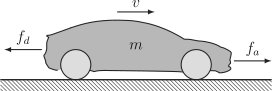
Consider a car with mass m m m moving along a flat road with initial velocity v ( 0 ) = v 0 v(0) = v_0 v ( 0 ) = v 0 .
Starting at t = 0 t=0 t = 0 , we apply a constant force f a ( t ) = f 0 f_a(t) = f_0 f a ( t ) = f 0 . Assuming the drag force is proportional to velocity, so f d ( t ) = b v ( t ) f_d(t) = b v(t) f d ( t ) = b v ( t ) , find the resulting velocity v ( t ) v(t) v ( t ) for t ≥ 0 t\geq 0 t ≥ 0 .
Figure 2: Free body diagram of a car with drag force f d f_d f d .
Substituting f d ( t ) = b v ( t ) f_d(t)=b v(t) f d ( t ) = b v ( t ) , the equation of motion is
m v ˙ + b v = f a , v ( 0 ) = v 0 . m\dot v + b v = f_a,\qquad v(0)=v_0. m v ˙ + b v = f a , v ( 0 ) = v 0 . Take the Laplace transform of both sides, making use of Table 1 :
m ( s V ( s ) − v 0 ) + b V ( s ) = F ( s ) . m\bigl(sV(s)-v_0\bigr) + bV(s) = F(s). m ( s V ( s ) − v 0 ) + bV ( s ) = F ( s ) . Rearrange and group terms:
( m s + b ) V ( s ) − m v 0 = F ( s ) . (ms+b) V(s) - m v_0 = F(s). ( m s + b ) V ( s ) − m v 0 = F ( s ) . Solve for V ( s ) V(s) V ( s ) :
V ( s ) = ( 1 m s + b ) F ( s ) + ( m m s + b ) v 0 . V(s)=\left(\frac{1}{ms+b}\right)F(s) + \left(\frac{m}{ms+b}\right)v_0. V ( s ) = ( m s + b 1 ) F ( s ) + ( m s + b m ) v 0 . Now substitute the constant force f 0 f_0 f 0 starting at t = 0 t=0 t = 0 , i.e.,
f ( t ) = f 0 H ( t ) ⟹ F ( s ) = f 0 s . f(t)=f_0\, H(t)
\qquad\implies\qquad
F(s)=\frac{f_0}{s}. f ( t ) = f 0 H ( t ) ⟹ F ( s ) = s f 0 . Substitute into Eq. (17) and simplify:
V ( s ) = 1 m s + b ⋅ f 0 s + m v 0 m s + b = f 0 / m s ( s + b m ) + v 0 s + b m . V(s)=\frac{1}{ms+b}\cdot\frac{f_0}{s}+\frac{m v_0}{ms+b}
=\frac{f_0/m}{s\left(s+\frac{b}{m}\right)}+\frac{v_0}{s+\frac{b}{m}}. V ( s ) = m s + b 1 ⋅ s f 0 + m s + b m v 0 = s ( s + m b ) f 0 / m + s + m b v 0 . Using Table 1 to find the inverse transform, we obtain
v ( t ) = 1 b ( 1 − e − b m t ) f 0 ⏟ zero-state response + e − b m t v 0 1 b ⏟ zero-input response v(t)=\underbrace{\frac{1}{b}\left(1-e^{-\frac{b}{m}t}\right) f_0}_{\textsf{zero-state response}} \;\;+ \underbrace{e^{-\frac{b}{m}t}\,v_0\vphantom{\frac{1}{b}}}_{\textsf{zero-input response}} v ( t ) = zero-state response b 1 ( 1 − e − m b t ) f 0 + zero-input response e − m b t v 0 b 1 The solution naturally splits into two parts:
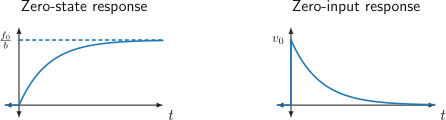
The zero-state response , also called the forced response or particular solution , is how the system would respond if it started at rest v 0 = 0 v_0=0 v 0 = 0 and we just applied the input. This part depends on the input f a ( t ) f_a(t) f a ( t ) .
The zero-input response , also called the natural response or homogeneous solution , is how the system would respond if there was no input f 0 = 0 f_0=0 f 0 = 0 and we just had an initial velocity. This part depends on the initial condition v 0 v_0 v 0 .
When discussing LTI systems, we cautioned that initial
conditions should be zero. We now see a more complete picture: even with nonzero initial conditions, an LTI system satisfies superposition . We can compute the zero-input and zero-state responses separately and add them together to see how the system responds when we have both an input and a nonzero initial condition.
For our cruise control example, the zero-state response increases from zero and eventually reaches the steady state v ( ∞ ) = f 0 b v(\infty)=\frac{f_0}{b} v ( ∞ ) = b f 0 . Meanwhile, the zero-input response decays exponentially to zero. Here is what the responses look like:
Figure 3: Left: zero-state response (with constant input f a ( t ) = f 0 f_a(t) = f_0 f a ( t ) = f 0 ). Right: zero-input response (with initial state v ( 0 ) = v 0 v(0)=v_0 v ( 0 ) = v 0 ). Both for the cruise control example of Figure 2 .
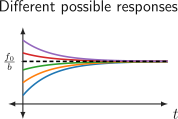
When we sum the responses, the total v ( t ) v(t) v ( t ) will increase or decrease to asymptotically match f 0 b \frac{f_0}{b} b f 0 , depending on whether v 0 v_0 v 0 is smaller or larger than f 0 b \frac{f_0}{b} b f 0 , respectively.
Figure 4: Possible total responses for the cruise control example of Figure 2 , with different relative sizes of v 0 v_0 v 0 and f 0 b \tfrac{f_0}{b} b f 0 .
Test your knowledge ¶ The function has two nonzero pieces. Specifically,
f ( t ) = { 0 , t < 0 1 , 0 ≤ t < 1 2 − t , 1 ≤ t < 2 0 , t ≥ 0 f(t) = \begin{cases}
0, & t < 0 \\
1, & 0 \leq t < 1 \\
2-t, & 1 \leq t < 2 \\
0, & t\geq 0
\end{cases} f ( t ) = ⎩ ⎨ ⎧ 0 , 1 , 2 − t , 0 , t < 0 0 ≤ t < 1 1 ≤ t < 2 t ≥ 0 Evaluating the Laplace transform, we obtain:
F ( s ) = L { f } ( s ) = ∫ 0 ∞ f ( t ) e − s t d t = ∫ 0 1 e − s t d t + ∫ 1 2 ( 2 − t ) e − s t d t . \begin{aligned}
F(s)
&= \Lap\{f\}(s)
= \int_{0}^{\infty} f(t)e^{-st}\,\dd t \\
&= \int_{0}^{1} e^{-st}\,\dd t \;+\; \int_{1}^{2} (2-t)e^{-st}\,\dd t.
\end{aligned} F ( s ) = L { f } ( s ) = ∫ 0 ∞ f ( t ) e − s t d t = ∫ 0 1 e − s t d t + ∫ 1 2 ( 2 − t ) e − s t d t . The first integral is
∫ 0 1 e − s t d t = [ − 1 s e − s t ] 0 1 = 1 − e − s s . \int_{0}^{1} e^{-st}\,\dd t
= \left[-\frac{1}{s}e^{-st}\right]_{0}^{1}
= \frac{1-e^{-s}}{s}. ∫ 0 1 e − s t d t = [ − s 1 e − s t ] 0 1 = s 1 − e − s . For the second integral, use integration by parts with
u = 2 − t , d v = e − s t d t , ⟹ d u = − d t , v = − 1 s e − s t . u = 2-t,\quad \dd v = e^{-st}\,\dd t,
\quad\implies\quad
\dd u = -\dd t,\quad v = -\frac{1}{s}e^{-st}. u = 2 − t , d v = e − s t d t , ⟹ d u = − d t , v = − s 1 e − s t . Then
∫ 1 2 ( 2 − t ) e − s t d t = [ u v ] 1 2 − ∫ 1 2 v d u = [ − 2 − t s e − s t ] 1 2 − ∫ 1 2 ( − 1 s e − s t ) ( − d t ) = [ − 2 − t s e − s t ] 1 2 − 1 s ∫ 1 2 e − s t d t = [ − 2 − t s e − s t ] 1 2 − 1 s [ − 1 s e − s t ] 1 2 = e − s s + e − 2 s − e − s s 2 . \begin{aligned}
\int_{1}^{2} (2-t)e^{-st}\,\dd t
&= \Big[uv\Big]_{1}^{2} - \int_{1}^{2} v\,\dd u \\
&= \left[-\frac{2-t}{s}e^{-st}\right]_{1}^{2} - \int_{1}^{2}\left(-\frac{1}{s}e^{-st}\right)(-\dd t) \\
&= \left[-\frac{2-t}{s}e^{-st}\right]_{1}^{2} - \frac{1}{s}\int_{1}^{2} e^{-st}\,\dd t \\
&= \left[-\frac{2-t}{s}e^{-st}\right]_{1}^{2} - \frac{1}{s}\left[-\frac{1}{s}e^{-st}\right]_{1}^{2} \\
&= \frac{e^{-s}}{s} + \frac{e^{-2s}-e^{-s}}{s^{2}}.
\end{aligned} ∫ 1 2 ( 2 − t ) e − s t d t = [ uv ] 1 2 − ∫ 1 2 v d u = [ − s 2 − t e − s t ] 1 2 − ∫ 1 2 ( − s 1 e − s t ) ( − d t ) = [ − s 2 − t e − s t ] 1 2 − s 1 ∫ 1 2 e − s t d t = [ − s 2 − t e − s t ] 1 2 − s 1 [ − s 1 e − s t ] 1 2 = s e − s + s 2 e − 2 s − e − s . Putting the pieces together,
F ( s ) = 1 − e − s s + ( e − s s + e − 2 s − e − s s 2 ) = 1 s + e − 2 s − e − s s 2 . \begin{aligned}
F(s)
&= \frac{1-e^{-s}}{s} \;+\; \left(\frac{e^{-s}}{s} + \frac{e^{-2s}-e^{-s}}{s^{2}}\right) \\
&= \frac{1}{s} + \frac{e^{-2s}-e^{-s}}{s^{2}}.
\end{aligned} F ( s ) = s 1 − e − s + ( s e − s + s 2 e − 2 s − e − s ) = s 1 + s 2 e − 2 s − e − s . Therefore,
F ( s ) = 1 s + e − 2 s − e − s s 2 \boxed{F(s) = \frac{1}{s} + \frac{e^{-2s}-e^{-s}}{s^{2}}} F ( s ) = s 1 + s 2 e − 2 s − e − s