Linear systems
The systems we have seen so far have had equations of motions that look pretty similar to one another. Whether we were dealing with translational motion, rotational motion, or combinations of the two, our equations of motion always looked like some version of a spring-mass-damper equation at the end of the day. We will see that this pattern persists for electrical circuits, electromechanical systems such as motors and solenoids, and even for hydraulic and thermal systems.
The systems we have seen so far that share this common type of ODE are called linear time-invariant systems (LTI), and they are related to the familiar concept of a linear function. LTI systems are so common that it makes sense to take some time to study their properties in greater generality. This will be the focus of the present section.
Linear functions
The standard definition of a linear function is something of the form , because the graph of such a function is a straight line. From now on, we will only call a function “linear” if , so the function must satisfy . If is not necessarily zero, we call the function “affine”. In summary:
Affine function: A function of the form
Linear function: A function of the form
Therefore, all linear functions are affine, but not all affine functions are linear. Our next task will be to generalize this concept to dynamical systems.
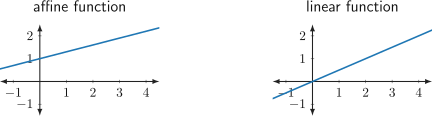
Figure 1:Left: A generic affine function. Right: A generic linear function.
Linear systems
When dealing with systems, the inputs and outputs are now signals (functions of time) rather than just being numbers. So if our input is the signal , our output is the signal , and the system is , we will write .
We can’t draw the graph of a system the same way we can with a function. All we can do (for now) is draw what the output looks like for one particular test input. A common test input is the step function, and when using such an input, the output is called the step response. We might represent this as follows:
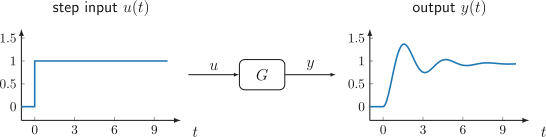
Figure 2:Possible step response of a dynamical system .
In general, the step response of a system only tells use how the system responds to this particular step function input. It doesn’t provide any information about other inputs. However, we will see that if our system is LTI, the step response tells us everything!
A system is LTI provided it satisfies: time-invariance, homogeneity, and additivity. We also add a fourth property called causality, which all physical/real systems must satisfy. Let’s now define these properties and discuss them in more detail.
Time-invariance
Time invariance says that the system does not explicitly depend on time. If I apply the same input now or tomorrow, the system will behave the same way. Mathematically, we can write it as follows.
Here is a graphical illustration of what time invariance looks like for the system of Figure 2.
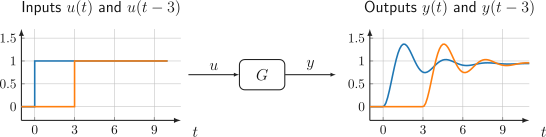
Figure 3:Time invariance: shifting the input in time produces a corresponding shift in the output.
Homogeneity
Homogeneity says that multiplying the input by a scalar leads to a corresponding scaling of the output. This property is also a property of linear functions. Mathematically, we can write it as follows.
Here is a graphical illustration of what homogeneity looks like for the system of Figure 2.
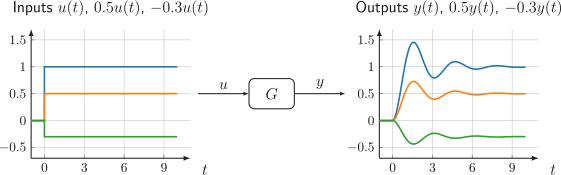
Figure 4:Homogeneity: scaling the input produces a correspondingly scaled output.
In particular, if we pick , it means that for any linear system, .
Additivity
Additivity says that adding two inputs together leads to an output that is the sum of the corresponding outputs. This property is also a property of linear functions. Mathematically, we can write it as follows.
Here is a graphical illustration of what additivity looks like for the system of Figure 2.
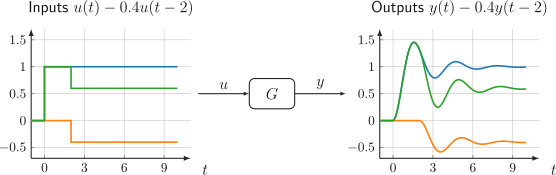
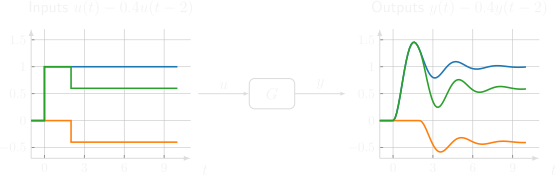
Figure 5:Additivity: adding two inputs adds the corresponding outputs.
Causality
Time-invariance, homogeneity, and additivity are mathematical properties a system may or may not have. Causality is different: it is a basic “reality check.” A real system cannot react to an input before that input is applied. Intuitively:
what you do to the input in the future cannot affect the output now
the output at time is allowed to depend on and on the past for , but not on values for .
Causality is illustrated in Figure 5. The blue and green inputs agree up to time , and so do the blue and green outputs.
Identifying LTI systems
Given a set of differential/algebraic equations describing a system, how can we tell if the underlying system is LTI? Here is a simple rule:
The three properties (causality, linearity, time-invariance) are independent. Here are several examples illustrating how this can happen.
A rocket in space (no air resistance) has an equation of motion
where is the thrust (input) and is the rocket’s mass, which decays over time as fuel burns. This system is causal and linear, but time-varying. With a fixed mass, it becomes LTI.
Consider a system whose output is a time shift of the input ( is a constant).
The system is linear and time-invariant. If , it is non-causal because the output at time depends on future inputs. If , it becomes LTI.
Consider two masses with positions and , and an input . Suppose the equations of motion are:
This system is LTI, since each term consists of a constant times derivatives of one of the signals.
Why LTI systems?
Most of this course will focus on LTI systems. There are two main reasons:
LTI systems are easy to analyze and understand. We can solve all the associated differential equations in closed form (no need for numerical approximation), and a number of control design techniques exist for such systems. LTI systems behave in intuitive, predictable ways.
Typically in control, our goal is to regulate a system (keep the speed of a motor constant, make sure the vibrations of a structure remain small, etc.). In such cases, the system only undergoes small motions (assuming the controller is well-designed), and we can approximate the system as LTI. For example, think about the pendulum; it was nonlinear but when , it becomes LTI. This sort of approximation is called “linearization”, which we will cover in the next lecture.
So LTI systems are easy to work with, and most systems we want to control can be approximated as LTI. How convenient!
Pulse decomposition
We will now discuss one of the advantages of working with LTI systems: they obey superposition. We said earlier that we can’t plot the “graph” of a system the same way that we can plot the graph of a function. The output of a system depends on which input we choose! Instead, we plotted a step response, to show the output for one possible input. When a system is LTI, its step response contains enough information to derive how the system would respond to any input.
First, by adding two shifted step responses, we can figure out how the system would respond to a pulse input.
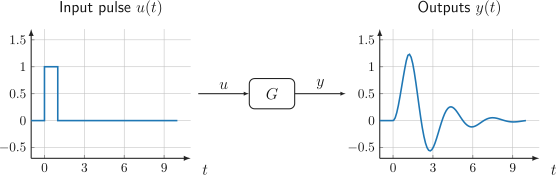
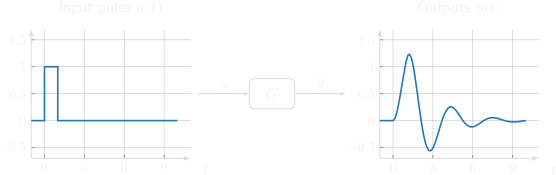
Figure 6:How the system of Figure 2 responds to a pulse input.
We can then take an arbitrary input signal, and decompose it as a sum of scaled and shifted pulses, and then perform the same scaling, shifting, and summing of the output to obtain the net output.
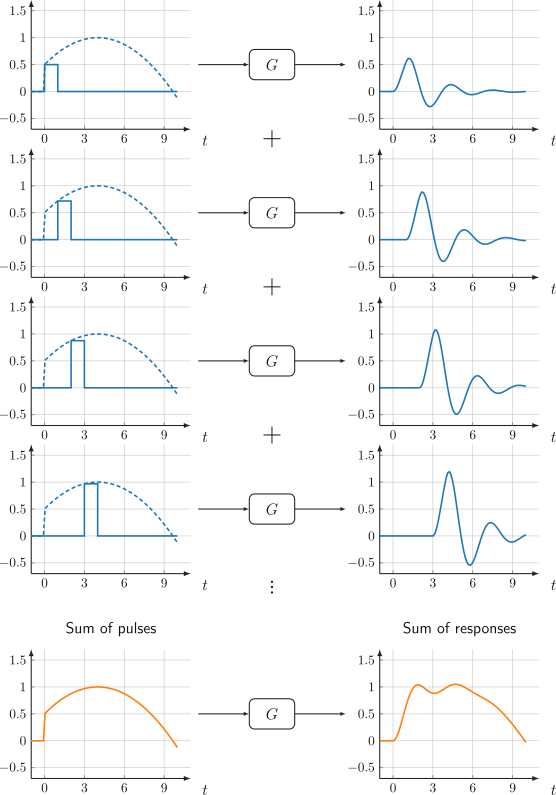
Figure 7:How the system of Figure 2 responds to an arbitrary input, found by decomposing the input as a sum of scaled and shifted pulses.
We can get increasingly better approximations of the true output by using progressively narrower pulses, similar to how we can approximate a definite integral using a Riemann sum. So simply knowing the step response of a system is enough to figure out how the system will respond to any input.
This is one of the many benefits of working with LTI systems. There is more to come!
Test your knowledge
Solution to Exercise 1 #
Yes. We can verify the properties one by one:
Time-invariance: If we use the delayed input , then we can apply a change of variables in the integral and obtain:
In the last step, we used the fact that . But so we have shown that delaying the input by simply delays the output by .
Linearity: We can verify homogeneity and additivity together. Suppose that and . Then we have:
Causality: Based on the limits of the integration, the output only depends on the values of for . Therefore, the system is causal.
A more straightforward way to verify that this system is LTI is to take the time derivative of both sides of (5). By the fundamental theorem of calculus, we obtain . This differential equation satisfies our requirements for LTI systems, so the system is LTI.