Impedance method
In the same way that we can analyze mechanical systems using transfer functions, we can analyze electrical circuits using the concept of impedance. Impedance is a generalized relationship between voltage and current but in the -domain rather than the time domain; it allows us to treat capacitors and inductors in a similar way to resistors.
Impedance in RLC circuits
Let’s revisit the constitutive equations for resistors, inductors, and capacitors from Figure 1, except this time, we will take the Laplace transform of each constitutive equation to express them in the -domain.
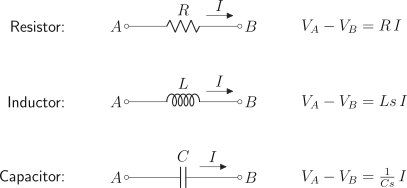
Figure 1:Components of an RLC circuit and their constitutive equations in the -domain.
Each constitutive equation is of the form , where called the impedance of the component. When we want to denote a generic impedance, we often use a rectangular symbol like this:


Figure 2:Generic impedance symbol.
Using impedances allows us to treat all circuit elements as though they were resistors. All we need to do is replace the resistance with the appropriate impedance for each component and proceed with the analysis as before.
Example: series RLC circuit
We will illustrate this with the series RLC circuit we previously analyzed in Figure 7. Taking the Laplace transform of voltages and currents, our circuit becomes:
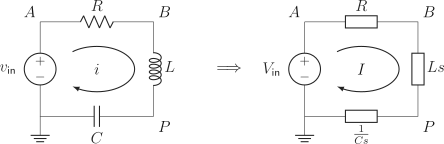
Figure 3:Left: RLC circuit. Right: RLC circuit transformed into impedance form.
From here, the analysis proceeds exactly as before, except we work in the -domain. Writing the equations for each element, we have:
Summing the equations as before, we obtain
Multiplying both sides by , we obtain an -domain relationship between the input voltage and the current:
This is just the Laplace transform of Eq. (3), from when we analyzed the same circuit in the time domain.
Combining impedances
In the same way that we can combine resistors in series and parallel, we can also combine impedances in series and parallel. This allows us to simplify circuits before analyzing them. We will now derive the rules for combining impedances.
Series combination / voltage divider


Figure 4:Combining two impedances in series.
From the figure, we can see that the same current flows through both impedances. Writing constitutive equations for each impedance, we have:
Adding these two equations, we obtain:
So two impedances in series is equivalent to the sum of the two impedances:
We can also combine combine Eq. (4) and (5) to solve for the voltage drop across each impedance to obtain the famous voltage divider equations:
This says that across two impedances in series, the voltage drop across each impedance is proportional to its share of the total impedance.
Parallel combination / current divider
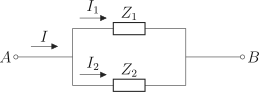

Figure 5:Combining two impedances in parallel.
From the figure, we can see that the voltage across both impedances is the same. Writing constitutive equations for each impedance together with KCL at node , we have:
Solving for the currents in the first two equations and substituting into the second equation, we obtain:
Therefore, two impedances in parallel is equivalent to an equivalent impedance satisfying:
This can also be expressed in terms of the admittance as: .
This is the opposite of what we observed when combining springs in series or in parallel; combining impedances in series is like combining springs in parallel, and combining impedances in parallel is like combining springs in series.
We can also combine combine Eq. (8) and (9) to solve for the current through each impedance to obtain the famous current divider equations:
This says that across two impedances in parallel, the current through each impedance is proportional to the other impedance’s share of the total impedance. Expressed in terms of admittance, the current through each admittance is proportional to its share of the total admittance.
Example: RLC circuit revisited
Returning to our series RLC circuit from Figure 3, we can simplify the circuit by combining the three impedances in series:
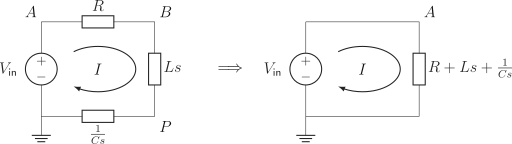
Figure 6:Simplifying series RLC circuit by combining impedances.
And now we can obtain Eq. (2) directly by writing the constitutive equation for the equivalent impedance.
Example: two-loop circuit revisited
Recall the two-loop circuit from Figure 8. We can also analyze this circuit using the impedance method. First, we redraw the circuit in impedance form:
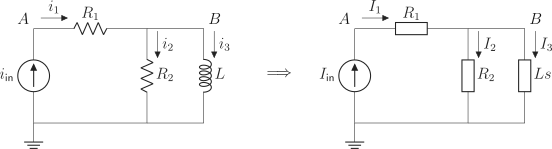
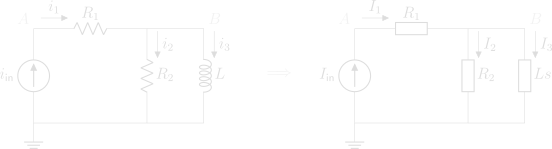
Figure 7:Two-loop circuit redrawn in impedance form.
Since our goal is to solve for in terms of , we can simplify the circuit by combining the two parallel impedances into a single equivalent impedance.
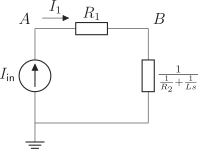
Figure 8:Two-loop circuit redrawn in impedance form.
Although we could in principle combine this further into a single impedance, this would bury the variable we are trying to solve for, . Instead, we stop here and write the constitutive equations for the remaining impedances:
From these equations, we can solve for in terms of (all we need is the first and last equation), and we obtain:
Rearranging, we have:
This is just the Laplace transform of Eq. (7), from when we analyzed the same circuit in the time domain.
Test your knowledge
Solution to Exercise 1 #
This is a current divider. The fraction of the total current through the inductor is the ratio of its admittance to the total admittance:
Expressed as a differential equation, we have:
The voltage across the resistor is the same as the voltage across the inductor, which we can find using the constitutive equation for the inductor:
As a transfer function, we have:
Solution to Exercise 2 #
This is a voltage divider. The voltage across the second resistor and capacitor is the ratio of its impedance to the total impedance times the input voltage:
Expressed as a differential equation, we have:
The current through the second resistor is the same as the loop current, which we can find by combining all impedances in series.